Wednesday, July 12, 2017

The Green Fields of France

Today was about World War 1 for me. I have never been to any of the battlefield sites. For the first time I traveled through Northern France and the Thiepval region where a lot of the action during the Battle of the Somme in 1916 took place. I had about a 1.5 hour ride from Calais to Thiepval which featured a lot of rain, but after this the rain stayed away for the rest of the day. The Thiepval Memorial was my destination and it was easy to see from a long way off. It is a magnificent monument to the dead of WW1 who have no known grave. It is also a monument to a waste of life. While there I looked up the Irish regiments and spotted an "O'Loughlin, J" listed under the Dublin Fusiliers - I'm sure I am not alone in looking up family names on such a memorial. I also visited the Ulster Monument followed by the best part of the day in Beaumont-Hamel. Here I toured around a field dedicated to Canadians from Newfoundland who fought here in 1916 - I was struck by how close the front line with the Germans was. This evening I have ended up in Verdun and I have toured around the city centre of this historic location.

Some photos from today...

A wet start to the day in Dover.
At the Thiepval Memorial...


Look closely - there is an "O'Loughlin, J" listed...

At the Ulster Memorial...


Real trenches...

These are the German trenches, the Bristish trenches are below the tree line - a few hundred metres away...


The view from my hotel room over the Meuse... 


The huge memorial to the Battle in Verdun...

Tuesday, July 11, 2017

Day of Rain

I picked one of the wettest days to cross Britain today. Apart from the first hour or so in Wales, it rained all the way. This means water from the sky, water as spray from other vehicles, and water splashed up from the road. The trip from Holyhead in Wales to Dover in England took 7 hours over 406 miles - inevitably some water gets through my gear. The weak spot is water getting underneath my leggings over my boots. It runs up the boots inside the leggings and makes my jeans wet at the knees. On a short trip this is a minor problem, but after 7 hours it starts to spread down to the feet and up to the ass. By the time I arrived in Dover I felt like I was sitting in water.

A shout out to The Swingate Inn where I'm staying - they dried everything for me in their big tumble drier. By the time I had an Indian meal and a pint inside me - I felt a lot better.

Early start tomorrow - unfortunately rain is forecast again for much of the day. Destination tomorrow is Verdun - I hope the hotel has a tumble drier!

What I had to ride through today...

Image source: Screen shot from UK Met Office.

Monday, July 10, 2017

Almost Ready To Go! #RoadTrip

Today is about getting ready for a ride to Munich starting early tomorrow morning. It is a three day trip and is 1,800 km (1,120 miles) long. Day 1 starts with the 08:05 ferry from Dublin Port to Dover in England. The ride from Holyhead in Wales to Dover is 621 km (386 miles) - estimated to be 6 hours and 15 minutes by Google. I'll have to stop at least once for petrol on the way. On Wednesday morning I am taking a ferry from Dover to Calais - my end-of-day destination is Verdun, a distance of 443 km (275 miles). A long the way I am visiting Thiepval to take in some First World War sights. Unfortunately it looks likes I'm going to get quite a bit of rain on both days - I hope my rain gear will be up to the task. However, riding all day in the rain it is impossible to stay completely dry. Rain also slows down everything and it can be pretty miserable, especially the spray from trucks on motorways. But it beats being at work!

On Thursday morning I'm setting out from Verdun to Munich - a distance of 585 km (363 miles). This should take just under six hours and I hope to meet Roma in Munich - she will have flown from Dublin earlier in the day. The forecast for Thursday is good so far - so I'm looking forward to testing out the new bike on the Autobahn!

I'm a bit more nervous ahead of this trip than for my previous road trips to Europe. It is six years since I rode to Murcia in Spain in July 2011 - my last long ride. Previous to that I rode to Sigean in France (July 2008), and the Algarve in Portugal (July 2005). Long journeys are not easy on the body while riding a bike - the shoulders get stiff and the ass gets sore. I hope the body is up to it! At least I have cruise control on the bike which will make things easier. Trips like these are what a Harley-Davidson Road King was made for - for the next 16 days I will be riding every day around south Germany and Austria, and back home via Luxembourg, Belgium, France, and the UK. I'm looking forward to lots of sight-seeing and being in the Alps, and of course blogging along the way!

Sunday, July 09, 2017

Graduation at Ulster University

On Friday last Roma and I attended our daughter Vicki's graduation with a BSc in Culinary Arts Management from Ulster University. The ceremony was held in the Waterfront  Hall in Belfast - a fantastic location for such a ceremony. Despite several hundred students graduating, the ceremony went quickly. My heart was bursting with pride hearing Vicki's name called out and seeing her collect her parchment. Vicki looked great and we certainly enjoyed seeing her in cap and gown - very academic! The graduation ceremony in my own college is one of my favourite days of the year. Students look great dressed up and the formalities of the ceremony always fascinate me. It's a day for students to feel very proud of their achievements, and for families to participate with pride. 

Congratulations Vicki - well deserved! 


Friday, July 07, 2017

I'm not British #Brexit

Hearing in the news that there has been an increase in the number British people applying for Irish passports, and even German ones (see: "Forget about Irish! Record number of Britons apply for German passports post Brexit", I wondered if the reverse could be true and if I could get a British passport. Ireland has a common travel area with Britain since 1923 long before the EU was founded, so there has never been a reason for an Irish person to have a passport going to Britain. I should state that I have no desire to hold a British passport, an Irish one is good enough for me - I'm just being curious.

Not for me!.
Image source: Wikipedia.
Both my parents were born in what was then the Irish Free State (1922-1937) which was established as a Dominion of the British Commonwealth of Nations (Ireland was not formally declared as a Republic until 1949). All four of my grandparents were born in the early 1900s in Ireland when it was then part of the United Kingdom. I wondered would either my parents and/or grandparents status allow me to get a British passport?

It seems that none of above entitles me to British citizenship. I used the WhatPassport.com website to check this out. Their response was that an application would be "Unlikely: 5%-25% - a claim is unlikely" with "no obvious route to British nationality" for me. Interestingly, they also told me that both my "parents were born (and still are) British, based on their fathers' births in the UK". 

Britain is leaving the European Union (I still can't believe they voted to leave) - so nationality is on people's minds. One of the best things about being in the EU is freedom to travel and live in any one of the 28 countries. Next week I will be travelling through six European countries (UK, France, Germany, Austria, Luxembourg, and Belgium). The only place I will need a passport is crossing the English Channel between Britain and France. There's no advantage for me to have a British passport, so no disappointment in not being eligible!

Thursday, July 06, 2017

Welcome to Ireland Ryan Byrne

Ryan Byrne.
In a short informal ceremony yesterday, some of my first cousin Ryan Byrne's ashes were scattered on the grave of his great-great-grandparents Richard and Julia Cullen in Gorey, Co Wexford, Ireland. Ryan had always wanted to come to Ireland to see the land of his father and meet with his Irish family - he finally made it.

I never met Ryan - yet he is my first cousin. His Dad Brendan, and my Mum Phil, are brother and sister. Ryan lived all his short life in Canada and was just 29 when he died. His dad was born and raised in Temple Cottages near Dominick Street in Dublin City Centre but he left Ireland with his family in the summer of 1958 for a new life in Canada. Ryan's grandmother Kathleen Byrne's maiden name was Cullen - much of the Cullen family lived in the Gorey area until the 1960s. Her father, Richard Cullen, lived in Dublin. It is his father, also Richard, who is buried in the grave in the photos below. The grave also contains his wife Julia (née Browne), and their sons Bryan and Patrick. Richard and Julia are Ryan's (and mine) great-great-grandparents.

It was a sad but also happy feeling to be at the graveside when Mum scattered Ryan's ashes. It was his wish to come to Ireland some day, and it was also his dad Brendan's wish that some of his ashes be scattered on a family grave in Ireland. Neither Mum nor I were at Ryan's funeral, so in a way it was our goodbye to him. We don't know where our Byrne great-grandparents are buried (though I do know that our great-grandmother Margaret (Coburn) Byrne is buried in an unmarked plot in Mt Jerome Cemetery in Dublin). So St. Michael's Cemetery in Gorey it was for our ceremony. Several of Ryan's ancestors are also buried in St Michael's. There are about 40 Cullens listed in the cemetery's register (see http://www.stmichaelsgorey.ie/listofgraves.html).

Rest in Peace Cousin.

My Mum (Phil) scattering Ryan's ashes on the grave of his great-great-grandparents.

The Cullen Graves.


Friday, June 30, 2017

Summer Holidays - Yay!

Today is my last day at work before I go on holidays. After the hustle and bustle of Semester II, exams, grading, and exam boards, the past couple of weeks have been relatively quiet. I've had plenty of time for blogs posts and creating new videos. This past week I attended the NCI Summer School which finishes today - it's been a good way to end the academic year. The year has been an exciting one for me in that I have been involved more in lecturing on data analytics. Hopefully more to follow next year - we are already recruiting students for data analytics programmes, so more busy times ahead.

For most of July I will be on a road trip on my Harley-Davidson Road King with Roma - we are travelling around southern Germany and Austria for 12 days starting in Munich. I'll post plenty of comment/photos from the places we plan to visit - I'm as excited as someone who is really excited about riding a motorcycle around Germany and Austria. Over 4,000 kilometres of road lies ahead, the tough part for Roma will be travelling light for 12 days (she is flying to and from Munich).

So in the meantime, Happy Holidays everybody!

Road Trip!

Thursday, June 29, 2017

Too Busy for Reflection?

xxxxxxxxx
John Dewey
Image source: Goodreads.
xxxxxxxxx We do not learn from experience...

we learn from reflecting on experience.


John Dewey
Yesterday at a continuing professional development session there was much discussion on Reflection. The old Dewey quote above was mentioned, and the importance of reflecting on experience to improve ourselves as teachers and educators was stressed. There is no argument against the value of reflection: thinking back on what went well, what didn't go so well, where one can improve, or what can/should be done differently. These are all good practices, and I'm certain that most people do this informally after many activities. I fixed a shelf in my bedroom yesterday, but when standing back looking at my work, I decided to take down the shelf and put it back up again as I was not happy with my first effort. The second effort was a lot better!

Image source: Creativity at Work.
Formal reflection, like filling out templates, journals, even blog posts, takes time. I guess I am reflecting on yesterday's session now, but during busy term time I rarely have a chance to formally reflect on classes delivered - I'm too busy! Quite often I think of how I could do better in a module, but end up doing exactly the same thing when next delivering the module. It would be great to write things down after a class or at the end of a day - but I almost never do. I'm sure it is possible for me to make the time, wiser people than me might even be able to demonstrate that it would save time in the end. I guess I should try harder, but somehow I'm not too bothered!

Please note: Opinions and comment expressed in this post (and all posts in this blog) are mine alone and do not in any way represent those of anyone else or any institution.

Wednesday, June 28, 2017

Essential Questions for Educators Everywhere - Day Two: What Makes a Good Teacher? #eqfee

The theme for day 2 of the NCI Summer School was "What Makes a Good Teacher". In the workshop session we had to visualise from our own past who we thought were good or bad teachers. For me I first identified my Junior Infants (1964) teacher Mary Keating as a good teacher for encouraging me to learn to avoid getting a slap with a ruler (it worked!). Secondly I identified my 1st year (1972) French teacher John Shanahan also as a good teacher who introduced me to technology in education. I'll not name who I thought was a bad teacher here.

Professor Chip Bruce gave us a great talk about community learning in Nepal. He also discussed multi-modal learning and how who teachers are. He gave a wonderful example of a milk tester in Nepal who is a teacher to the community. He asked the intriguing questions: "If education is conscious life, then what is the teacher's role?". Dr Leo Casey talked to us about teaching being about enabling participation (as distinct from alienation). Participation involves more than one person, therefore there is an important social element to teaching. He gave us the three Rs of teaching: Respect, Risk, and Reflection. He finished up with some advice to us all: "Education always involves risk". 

The third session was delivered by Dr Rose Rudnitski from Mercy College New York. She talked to us a bit about "grit" - you have to have this to succeed in school (my "Grit Score" at angeladuckworth.com is 3.70). Later she talked about wise advocacy/leadership, which I found heavy going in parts. The evening finished up with the energetic Tomás Ó Ruairc of the Irish Teaching Council. He asked us first: "Who teaches teaching of tomorrow?" - the answer is "we do". Teachers are learners too and Tomás had a great message for us about having the "courage" to teach - avoid traps and guilt, and get out and get learning.

Overall - I very much enjoyed the day and look forward to some more during the rest of the week.

Tuesday, June 27, 2017

Essential Questions for Educators Everywhere - Day One #eqfee

Prof Chip Bruce.
This is my last week before summer holidays and it coincides with the NCI Summer School which I am attending. The first day was an open seminar on "Natural Born Learners": Early Years Education and Inquiry Throughout Life. We started off by being asked to think of the earliest play activity we could remember - my choice was to tell the group about playing with my dog Dino as a small boy. Later we used Play Doh to create artifiacts from our earliest learning - I chose to make (a very poor) model of an inkwell and pen that was part of every desk in Carnew National School back in the early 1960s.

Later we were treated to a talk from Professor Nóirín Hayes of Trinity on early childhood learning, the importance of play, care, and opportunity for small children. The last talk of the evening was from Professor Chip Bruce who inspired us with the tale of the Paseo Boricua community in Chicago - learning in the community works boths ways. He told us about wheel-chair bound Mrs Lopez - school kids would stop by her window and "cheer her up", while she asked them "Are you learning your ABCs?". Both had a role in the children's education. Actions like this helped to improve self-awareness and also develop a community that was on its knees.

Lots more to think about and experience over the next few days!

Monday, June 26, 2017

Two More New Videos

Continuing my recent burst of video recording activity I have added two more new videos to my channel:
  • How To... Add and Modify a Moving Average Trend Line in Excel 2016
  • How To... Display Two Lines on a Chart in Excel 2016
Both videos use the same Facebook Q1 2017 stock data downloaded from Google Finance. Excel has added the moving average option to version 2016, making it easy to show a smooth trend in time series data. Displaying two lines on the same chart is not that easy - a secondary axis is required. I wanted to show the closing stock price and trade volume on the same chart for Q1. The trouble is that volume data is in tens of millions, while the closing stock price ranges from $115 to $145 - scale (as always) is a problem for the data visualizaer. So if you want to learn how to do this - here are the videos:


Friday, June 23, 2017

An Introduction to Business Systems Analysis (O'Loughlin, 2009)

At the formal launch of my book with
Paul Mooney (left) and Mark Ryan (right).
Eight years and a bit after my first book was published in 2009, I picked up 13 copies today from The Liffey Press. Over the years the original print run sold out and we have had several short print runs of 50 to 100 copies at a time. The main market for the book is my own students studying Business Analysis in the College. I buy them at a discount from the publishers and pass this on to the students.

I updated the book in 2014 (not a 2nd edition) with corrections of minor errata and a new cover. I make very little money from it now and it sells very little outside of my own class. At eight years old it is getting to the age when a textbook will be regared as being too old. Hoefully I will be able to flog the copies below - the next time my module runs is in December, so I'll be holding them for a while yet. These are the last of the current print run - we'll have to see if there is demand further copies after this.

Thursday, June 22, 2017

Two more YouTube videos

In my short recent burst of creating new "How To..." YouTube videos, my most recent two are closely related. Excel has become a lot better at Data Visualization and now has options to draw sunburst diagrams and tree maps in the Office 365 version. These type of charts are great for displaying hierarchical data. They are really easy to create, and also easily modified. Enjoy!


Data source: Breaking down hierarchical data with Treemap and Sunburst charts.

Wednesday, June 21, 2017

Creating Pareto Charts just got easier!

On the 26th of September 2008, I published only my second ever video on YouTube: "How To... Create a Pareto Chart in Excel 2003" - I had published my first, "How To...Convert PowerPoint to iPod Movie", nearly a year earlier. At that time in one of my classes I needed to show students how to create a Pareto Chart which I did step-by-step in a Word document using screen shots. I recall viewing another "How To" video online but thinking that the content creator had done a poor job of explaining the steps, so I challenged myself to do better - here it is:


Over the years this video has been viewed 109,849 times, but in more recent years (as Excel 2003 gets used less and less) views have decined to 3 or 4 a day. It is now one of five videos I have on the channel - to date the Pareto Chart videos have totalled 506,122 views - not bad!

One of my more recent videos is about creating a Pareto chart in Excel 2016. Microsoft obviously recognised that this is a popular charting tool and have added it to the latest version of Excel. Gone is the need to rank the data, calculate cumulative values, calculate percentages, and manipulating the chart to get the end result. Excel does all this for you. See below how it is done today and compare this to what we had to do above in the good ol' days:

Monday, June 19, 2017

My Photograph in Leaving Certificate History and Appreciation of Art (Ordinary Level) Exam

I was surprised, flattered, and amused to discover that a photograph taken by me of the Children of Lir sculpture in Ballycastle (Co Antrim) which was published in this blog (see Revisiting the #CausewayCoastalRoute and the #MourneCoastalRoute) on 26th July 2015, was used in the Leaving Certificate History and Appreciation of Art ordinary level paper last week. Question 19 asks students to "Describe and discuss the public sculpture..." - a zoom-in for the swans was also provided. Here's the illustration and question:

19.       Answer (a) and (b).

(a)   Describe and discuss the public sculpture illustrated on the accompanying sheet using the following headings:
  • location and size
  • form and shape
  • colour and surface.
(b) Suggest a design for a sculpture to be situated at the entrance to a town‐park or forest‐park. Give reasons for your design decisions.

Illustrate your answer.


I only found out about this when the publishers, The Educational Company of Ireland (www.edco.ie), contacted me seeking permission to reproduce the photo in their State Examinations Booklet of all exam papers to be published next month. My permission to use the photograph in the exam was not sought in advance - I guess that this would have compromised the exam process!

Here is original photo:

Children of Lir and Fair Head, Ballycastle.

Thursday, June 15, 2017

Word Mixing to Defeat Plagiarism

Recently I heard about a website called Spinbot.com that will "rewrite human readable text into additional, readable text" - it is an "automatic article spinner" tool. The site is designed for "bloggers, twitter users and online marketers", and is described as a "dream come true" to help rework content to help with SEO. In its self-promotion, Spinbot.com states that with a "single click you can turn your old blog post or website article into a completely new one, thereby doubling the payoff you get in return for the time and energy you have already invested into creating quality website content". Nothing wrong with doing this I hear you say - re-writing one of your own old posts or any old material is OK, it is your own content.

However, there is (from an academic point-of-view) a more sinister use of this clever tool to avoid plagiarism. Before I go further - I have not detected this as a problem with any of my own students. Could it work that if you copy a passage, say from a book or website, put it through a tool like Spinbot to change words - that it would beat a plagiarism detection tools like Turnitin?

To test this out I took one of my own short posts: "New @YouTube Video: How To... Perform a Wilcoxon Signed Rank Test (By Hand)" written just yesterday to see what it would look like after it was spinned by Spinbot. Before doing this I ran the post through Turnitin using default settings and you can see that it had a 16% similarity with two Internet sources. None of this was copied from the sources listed and you can see that they are simple terms being reused. 

Click image to enlarge.
Now when I put the above post through Spinbot, and then pass it through Turnitin (again with default settings) - here's what comes out:

Click image to enlarge.

Well well well - a 0% similarity index even though I didn't write a single word! Spinbot has completely changed the text and has beaten Turnitin. I'm not surprised that this might be tempting to students. However, there are some tell-tale signs that a spinner has been used to mix words. The "Wilcoxon Signed Rank Test" (actual name of test) is transformed into the "Wilcoxon Marked Rank Test" (no such test). Also the original text "For some time I have noted a gap in my series of Statistics By Hand series" is transformed into "For quite a while I have noticed a crevice in my arrangement of Insights By Hand arrangement". Finally, "Ultimately it will tell the researcher if there is a significant difference between two data sets or not. Enjoy!" is transformed into "Eventually it will tell the scientist if there is a huge contrast between two informational indexes or not. Appreciate!"

While there is some clever stuff going on here, the second readings after Spinbot has been applied make for more difficult reading that is not natural. Anyone aware of tools such as Spinbot.com will immediately be suspicious, even those not so may question the second passage above. I'll certainly be more aware of this and will be watching out for it in future.

Comments are disabled for this post to block Spammers trying to sell me essay-writing services.

Please note: Opinions and comment expressed in this post (and all posts in this blog) are mine alone and do not in any way represent those of anyone else or any institution.

Wednesday, June 14, 2017

New @YouTube Video: How To... Perform a Wilcoxon Signed Rank Test (By Hand)

It is almost six months to the day since I last published a video on YouTube. For some time I have noted a gap in my series of Statistics By Hand series. Today I have published the 157th video on my YouTube Channel. The Wilcoxon Signed Rank Test is a non-parametric test to compare two sets of paired data. It is usually carried out on small data sets or non-normal data (a paired t Test is used for normal data). It is an easy to do rank based test with the only calculations necessary being subtraction and addition. Ultimately it will tell the researcher if there is a significant difference between two data sets or not. Enjoy!

Friday, June 09, 2017

UK Election - How did the pollsters do?

The final YouGov poll before yesterday's general election in the UK predicted the result as follows: Conservatives (42%), Labour (35%), Liberal Democrats (10%), UKIP (5%), and Others (8%). In their final statement before the election they stated:

For now, YouGov’s final call for the 
2017 election is for a seven point 
Conservative lead, leading to an
increased Conservative majority
in the Commons.

YouGov were experimenting with more than one method of polling - so how did they do? The actual result was as follows: Conservatives (42.4%), Labour (40.0%), Liberal Democrats (7.4%), UKIP (1.8%), and Others (8.4%) - here's the visual of this:


The poll was almost spot on for the Conservative and Others vote, but it underestimated the Labour vote by 5% (more than the +/- margin of error), and over estimated the Lib Dem and UKIP votes. So they got the overall result they predicted (an "increased Conservative majority") wrong, but not by much in my opinion. The science of sampling clearly has some work to be done, but I believe that the approach of YouGov to include factors (such as age, likelihood of voting) other than voting intention is a good approach - they can only get better.

Wednesday, June 07, 2017

Rolling Medians for Time Series Analysis via @BBCNews

The UK General Election is tomorrow, and while I'm not too bothered who wins or loses, I am interested in the opinion polls and the efforts of the polling companies to get their predictions right. Polling data makes for interesting Time Series Analysis (TSA) - several different methods can be used to analyse the data and make short term forecasts. In my Statistics classes I most often use Moving Averages, Weighted Moving Averages, and Exponential Smoothing as methods for TSA. This year I introduced the more complicated Holt-Winters method. These concentrate on the mean (average) and smoothing factors.

The BBC keeps a tracking poll-of-polls and provides an interesting visual to show "voting intention" trends over a period of time. Interestingly, they use the median (the middle value of a set of numbers) instead of the mean (the average value of a set of numbers). The trend lines below are calculated as a "rolling median of the seven latest polls". As the poll-of-polls is updated every day, the median "recalculates to take account of the latest 7 poll values". Here is the BBC visualization:

Image source: BBC News.
Taking the poll-of-polls data, I have re-drawn the visual below using a simple seven point moving average (instead of median). The data points (dots) are the same of course, but you'll see slight differences in the trend lines, though they follow the same general trend:

Data source: BBC News.
In something like a general election, a one percent difference on polling day could have an enormous impact on the number of seats won or lost - especially in the UK's first-past-the-post system. Polling companies are trying many new methods such as considering voter's likelihood of voting, their age (older people are more likely to vote), and their demographics (better off people are more likely to vote). The models are getting more complicated - YouGov's 2017 Election Model makes for very interesting reading - it works by "modelling every constituency and key voter types in Britain based on analysis of key demographics as well as voting behaviour in the 2015 general election and the 2016 EU referendum. Turnout is assessed on voters’ demographics and is based on analysis from 2010 and 2015 British Election Study data". Every day YouGov polls around 7,000 voters - currently their model shows results as follows: Conservatives (311 seats), Labour (255 seats), SNP (51 seats), and Liberal Democrats (10 seats). This is "hung parliament" territory - let's see if they get it right this time!

Saturday, June 03, 2017

Leo Varadkar and the New Generation

So - the new leader of Fine Gael is 38 year old Leo Varadkar, and he is to be our new Taoiseach next week. He has made headlines all over the world as the son of an Indian immigrant to Ireland made good, and of course as the country's first openly gay Taoiseach. I wish him well, but he needs a mandate from the people very soon and I hope he calls a General Election before the end of the year. I admire Leo Varadkar as a (so far) straight talking politician. He is courageous and I was one of the many who was listening to the Marian Finucane radio show when he said all of a sudden "I am a gay man". His statement yesterday that "prejudice has no hold in this republic" is a powerful message to all Irish people. 

I met Leo Varadkar once at the Irish Blood Transfusion Serve awards when he was Minister for Health. He presented me with my award for 100 donations and in the few seconds we had before the photo below was taken he congratulated me and asked where I was from. I was struck by how tall he was and how young too. Apart from Brian Cowen, who is three months younger than me, all Taoisigh that I have ever known were a lot older than me. Now suddenly our new Taoiseach is almost 20 years younger than me! This does signify a generational change greater than anything we have ever had in Ireland before. I have never voted for the Fine Gael party in my life, but I might do so now that Varadkar is at the helm.


Friday, June 02, 2017

25,000 @YouTube Subscribers

A recent nice milestone to hit is reaching 25,000+ subscribers on my YouTube Channel. Every day there is a trickle of scubscriptions that over the years has now added up to 25,000+. The actual number of people who have subscribed to my channel is 29,094, but when you remove the 4,086 "lost" subscribers the figure stands today at 25,008.


The trend above from YouTube Analytics shows a recovery in numbers after the damage done to the channel two years ago (when I changed metatdata). The trend roughly follows the pattern of viewers over the same period. I haven't posted a new video since 16th November 2016. In the next few weeks I will have time to update some videos and create new ones. Hopefully this will boost the number of subscribers and views. You don't get anything for having this or any other number of subscribers - it's just a nice number to have.

Thursday, June 01, 2017

It was 50 Years Ago Today #SgtPepper

Image source: Wikipedia.
Woke up, got out of bed, but I have no hair left to drag a comb across my head - Happy 50th Anniversary to John, Paul, George, and Ringo on the release of Sgt Pepper's Lonely Hearts Club Band. I was only 7 years old on the 1st June, 1967 - so have no memory of its release. In our house at that time there was only one radio, which was mostly tuned to Radio Éireann (Radio 1 today). We did not own the Sgt Pepper album. My first copy was a recording on cassette tape from an LP in the 1980s - I did not buy it until it came out on CD in the 1990s. As I write this post I am listening to the album on Spotify.

I do rememeber hearing "When I'm Sixty Four" on the radio - it might have been in my Dad's car. He was able to connect our house radio to an aerial in the car so that we could listen to radio programmes. Along with "Yellow Submarine", I'm sure it was one of those songs that we would all sing along to in the car. 

The album is just 39 minutes and 52 seconds long. For me it is one of my most listened to albums - only Abbey Road is listened to more by me. I love all the tracks. In secondary school in Roscrea (CCR), we used to sing "With a Little Help From My Friends" at Mass - Holy Cool Beatles we were! We also thought that Lucy in the Sky with Diamonds was cool because we thought (wrongly) it was named after the drug LSD. Most of us didn't know what LSD was, but it must have been cool because of the link to Sgt Pepper. On my Dad's 64th birthday (1995) I remember that I sang "When I'm Sixty Four" down the phone to him (and he joined in!) - it is one of the few songs that I know most of the words to. I love the harmonies on "She's Leaving Home", but "A Day in the Life" tops everything. For me this is Lennon at his best - it must have been amazing to hear when people bought the album and brought it home to play the first time. 

I have been listening to this album for most of my life, and will continue to do so for the rest of it. Like millions of Beatles fans all over the world, I feel it is part of me. Every track is instantly recognisable to me, and Sgt Pepper is as fab today as he was in 1967.

Wednesday, May 31, 2017

"colleges make millions from resit fee" says @oreganMark in Irish Independent

I have just finished grading assessments for Semester II (phew!) and am generally very pleased with results. Unfortunately for some students - repeat exams may need to be taken in order to pass subjects. As a student myself who had to repeat exams in both 1st and 2nd year in Trinity, I have a lot of sympathy for students who have to study through the summer and sit repeat exams. There is the stigma of failure to overcome, not to mention thinking about all the other things a student should be doing during the summer. I know of students who had to give up J1 opportunities in America, or come home early to sit repeat exams. This doesn't influence me in the slightest when grading - a fail is a fail, and I always remember advice an old colleague gave to me when I first became a Lecturer: "you don't fail the students in exams, they fail themselves". Sometimes tough love is necessary.

Image source: The Graveyard Waltz.
Writng in the Irish Independent (Sunday 21st May edition), Mark O'Regan tells us that "Students count cost of failed exams as colleges make millions from resit fees". He uses the example from UCD which "earned €1.8m in a single academic year from charging students looking to repeat exams" - UCD charges €230 to repeat a module. O'Regan contrasts this with students who are facing "unprecedented financial pressures", and with staff who "enjoy lucrative pension and service related pay-offs". All this paints us in the third-level sector as money grabbing leeches who prey on cash-starved students who failed their exams. You'd swear we were awarding fail grades just to get an extra few bob in repeat fees! 

Not so.

To those students whose results do not match their expectations, and have failed one or more modules - there's no more stigma in failure. Repeat exams are a second opportunity that should be grasped with both hands to get through a year. For students like me back in the 70s, this was how I got though my first two years in College. I owe a lot to the second chance I got through repeat exams - the fee is worth it. The alternative is to drop out of College, which could end up being the best thing that ever happened to a student, but picking yourself up when you are down and trying again is a sign of character.

Please note: Opinions and comment expressed in this post (and all posts in this blog) are mine alone and do not in any way represent those of anyone else or any institution.

Monday, May 29, 2017

John F. Kennedy #idol

Today is the 100th anniversary of the birth of former US President John F. Kennedy. Like a lot of Irish people I have always had a strong admiration for him, though I was only four years old when he died. Indeed the date of his death, 22nd November 1963, is my earliest memory. I don't recall where I was exactly (most likely either at home or in school) when I heard the news, but I have a vivid recollection of people talking about it. I also have an image of President Kennedy coming out of a fog and turning back to see the bad men chasing him - I guess in the mind of a small boy this is what I thought an assassination was about. When he visited the South-east of Ireland in the summer of 1963, I have no memories of this.

Image source: Wikimedia Commons.
The Irish Times: 13th April, 2009.
I have been to Dealey Plaza, where he was shot by Lee Harvey Oswald, during a business trip to Dallas in the late 1990s. I also went up to the Sixth Floor Museum and looked out the window from where Oswald fired the fatal shots. Last summer I visited the John F. Kennedy Presidential Library & Museum in Boston, and in January 2016 I visited the Kennedy Space Centre in Florida. I have also read Robert Dallek's masterful biography - "John F Kennedy: An Unfinished Life". I even quoted Kennedy in a letter to The Irish Times in 2009 at the height iof the economic crisis in Ireland. It's fair to say that I am an admirer.

Of course dying young (he was just 46) keeps him young in all our minds. We think of the waste of a life, and what might have been had he lived. His generation are now almost all gone, and most of the people who voted for him are now old or gone too. Today I think of a man who was no saint, who stood up to the Russians, who inspired a generation, and who will remain in my memory until the day I too depart this life.

Sunday, May 28, 2017

Good Bye Windows Phone? #SpokeTooSoon

Oh dear - less than two weeks after abandoning my Windows phone in favour of an iPhone, I am back using it again. Last night I left my iPhone on a charger overnight but this morning discovered that a crack in the glass appeared. This is the first time that I have broken a smartphone like this, but I am convinced this happened without any contribution from me. I plugged it in to charge, and then there was a crack. I did not drop it - the crack is a clean single line near the top of the screen, which also leaves a shadow on the screen behind the glass. Did it spontaneously crack while charging? The touch screen in the small space above the crack is still working, but below it there is no response. The screen will have to be replaced.

However, I'm wondering if it is worth it as the cracked screen is already a replacement screen. It will cost around €100 to fix, with no guarantee that it will last - I think the Windows phone has suddenly become attractive again!

Right now there are four old iPhones in my house - including the cracked one to the right. Two are glass-cracked iPhone 6 models, with two old iPhone 5 models. I shudder to think what we have spent on these over the past 2 or 3 years just to create another Apple graveyard of devices - I'm guessing my house is not that different from many others. While Apple laugh all the way to the bank, I am still astonished that glass is still being used in smartphones - there must be an alternative. Millions must be being spent on replacement screens all over the world.

So it is back to fewer Apps and a Google-less Windows phone. Outlook, Edge, and Bing Maps are my new best friends again!

Saturday, May 20, 2017

Annual Conference: The Business Analysis Association of Ireland #baai17

Image via @IrishCompSoc
Yesterday I attended the Business Analysts Association of Ireland's Annual Conference at The Irish Computer Society in Ballsbridge. The theme of the Conference was "Change is Now" and was attended by over 60 Business Analysts who heard a variety of presentations on topics of interest to BAs. Reuben Godfrey of the Blockchain Association of Ireland kicked the event off with a discussion on what Blockchain Management means for Business Analysts. He was followed by Niamh Corby from the Revenue Commissioners who interestingly use the Business Analysis Body of Knowledge (BABOK) in their projects, but not all of it. The morning session was completed by the wonderful Lanre Oluwatona who started off by saying "I'm not here to scare you" - which he promptly did! He talked to us about the General Data Protection Regulations coming into law next year, He pointed out that there will be 99 articles in the new regulations compared to about 30 now. Brilliant presentation Lanre!

After lunch we had interesting talks about No Code Workflow from Shay O'Conner of FlowForma (fascinating stuff), designing cost effective IT solutions from Piaras McDonnell (who in particular warned us about licensing issues with software), and Cloud solutions from Oracle by John Caulfield. The event was finished off by a thought-provoking presentation by Kevin Breen on "Digital Transformation".

In between all of above I made a presentation on "Data Visualization - What can you see?". I used much material from my recently completed first time Data Visualization module at NCI - it was very tough deciding what to include and what to leave out. Hopefully I got it right, there were plenty of questions and comments afterwards. I did feel like a bit of an idiot when I tried to use a link to my Tableau Public Page. I didn't realize that the presentation was being run over two screens and I looked confused and awkward (I was!) as I tried to show  online material. Anyhow - I have uploaded my presentation to Slideshare and embedded below. Enjoy!


Thursday, May 18, 2017

"...no drag-and-drops for deep learning" and "Why R is Bad for You according to Bill Vorhies via @DataScienceCtrl

A most interesting post by William Vorhies at Data Ceience Central poses the argument: "Why R is Bad for You". We are lead to believe that knowledge of the R programming langauge is an essential skill for data analysts/scientists - you can use it to do almost anything with data such as clean, manipulate, visualize, transform, perform statistical tests, and in general look for links/trends/patterns in data. Vorhies says that "R is not the best way to learn data science and not the best way to practice it either". 
Image source: The R Project for Statistical Computing

The trouble is that you have to learn R before you can use it. I and several of my colleagues use R for data analysis in class - in my case to perform statistical tests such as ANOVA, Time Series, and Principal Component Analysis. In the new Data Visualization module introduced this past academic year we also used R to plot charts such as boxplots, interactive charts, and flight paths. It is a very powerful language, but none of my classes are programming classes. Students learn how to perform basic programming in R before they come to my class. Usually I give students code in the notes and ask them to use and modify code already written. However, much time is spent in lab work fixing syntax problems - a missing comma can be difficult and frustrating to find and fix for someone not good at programming. 

Bill Vorhies writes that the "largest employers, those with the most data scientists are rapidly reconsolidating on packages like SAS and SPSS with drag-and-drop" - especially in larger companies. These tools, and the likes of Tableau software, are very powerful and much easier to learn and use. Excel is probably the most used data analysis tool - and is getting more powerful. So why learn R? 

R is free. Many employers list it as an essential skill in job adverts. Having the ability to programme in any language shows that you have a logical mind and you are good at problem-solving - probably good at deep learning too. If you have already learned how to use R, then keep on using it - but as Vorhies says: "in the commercial world the need to actually code models in R is diminishing". Something for us educators to think about!

Please note: Opinions and comment expressed in this post (and all posts in this blog) are mine alone and do not in any way represent those of anyone else or any institution.


Tuesday, May 16, 2017

Abandoning the Windows Phone

Just last year I purchased a SIM-free Microsoft Lumia 950. It was a lot cheaper than a new iPhone or Samsung and the two big things for me were lots of space and a good camera, and of course the very familiar Windows 10 interface. The old iPhone I had sucked for space and the camera was poor. With a 20MP camera and 64GB space on the Lumia - this problem was gone. I quickly got used to using Outlook instead of Gmail and Edge instead of Chrome, and I was confident that the Microsoft App Store would have all I needed. Popular Apps such as Kindle, Netflix, Spotify, Facebook, Twitter, and WhatsApp all had version that worked on Windows. Bing Maps is not as good as Google Maps for me, but I got by. Groove was better than iTunes, but my Bose headphones volume controls didn't work and it would not connect via Bluetooth to my speakers. A huge downside for me was no radio app - I had to use a shortcut to RTÉ Play Live link on the start page. And of course since Microsoft phones are no longer for sale in Ireland there can be little hope of App developers continuing to support Windows.

I have had a spare iPhone for a few months that I used as a second phone for use with Vodafone down the country (especially in Wexford where Virgin Media via Three sucks) - so I am switching back to it. Now the Windows phone is a second phone which I will definitely keep for the camera and of course it still will be able to connect to the web using WiFi.

I tried and persevered with the Microsoft phone - it's now time to go back to Apple.

Monday, May 15, 2017

Happy Birthday Elliott Masie ! @emasie

Elliott Masie.
Image source: Twitter (@emasie)
Last Saturday the great Elliott Masie turned 67 - I have been following him probably longer than anyone else on the planet. I met him once in the (then) CBT Systems offices in Clonskeagh in Dublin for a meeting where I described the CBT Systems product development life cycle to him. I can't remember exactly when this was, but it was around 1993/94. He was a gentleman! 

I have been subscribed to Masie's Learning Trends for as long as I can remember - I always look forward to reading what he is thinking about. In his most recent newsletter (#965), he reflects on what he calls the "half-way point of my career" at age 67. He writes that learning is "amazing", "personal", and "awesome". I particularly connected with his comment that "Learning is all about Curiosity. The world of learning is allowing curiosity to come alive in more and more ways". 

The age of 67 is now the retirement age for workers of my generation - retirement date for me is officially in October 2026, just nine and a half years away. I'd like to think that I will still be as passionate about Learning and Teaching as Elliott Masie is at the same age. There's no sign of Elliott retiring as he is "pumped" to keep on exploring learning - long may he live and stay "curious".

Friday, May 12, 2017

Top 10 Skills in Data Science via @bobehayes

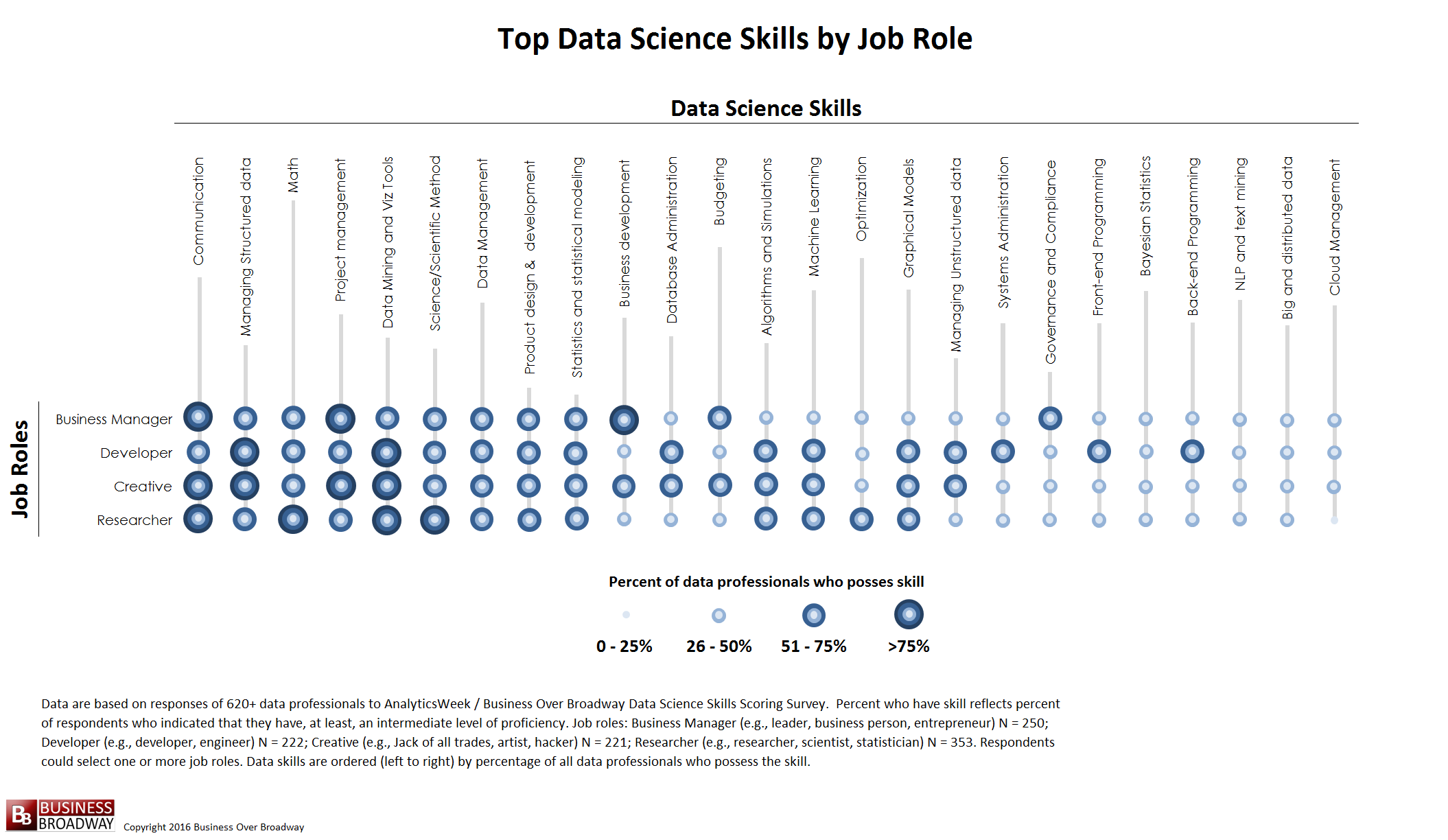
A really interesting post by Bob Hayes for Customer Think "Top 10 Skills in Data Science" tells us that so-called "soft" skills like communication and project management are really important for data scientists. Hayes takes a look at 25 skills assessed in a data science survey, and uses the chart below to filter out the top ten:

Image source: Customer Think (click to enlarge).
It's no surprise to me that Communication is important, but I would not have expected it to be top of the list. In fact we dropped a Communications module from one of our Data Analytics programmes last year and replaced it with Data Visualization (still partly communication I know). Managing structured data (#2) and Maths (#3) rank higher than data mining/management, and statistics (#9). To me these important skills are vital in all roles and perhaps there is a case to be made that these are a given and should be exlcuded from a top ten list of skills? At #11 is "Database Administration", at #12 is "Algorithms and simulations", and at #14 is "Machine Learning" - these would be in the top ten if the standard skills were omitted. Their importance is not lessened, but they should be in the top ten skills for a data scientist.

Thursday, May 11, 2017

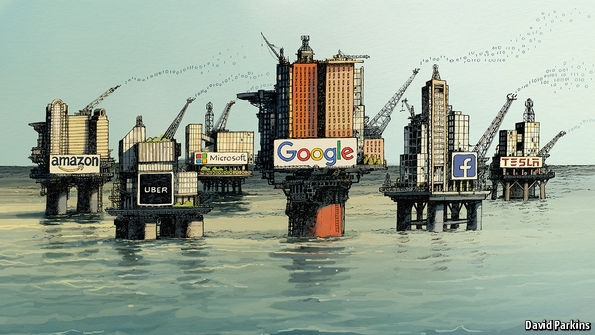
Data - More Valuable than Oil? via The Economist

The hype about data continues - now it is more valuable than oil! The Economist reports that The world’s most valuable resource is no longer oil, but data. Companies like Amazon, Facebook, and Google are "titans" who "deal in data, the oil of the digital era". They have vast amounts of data on us all that is now regarded as a "God’s eye view" of their users' activities. While The Economist discusses how data is valuable to companies it also considers the power of data in different ways: "Google can see what people search for, Facebook what they share, Amazon what they buy" - this can be used to stifle competition. Anti-trust authorities must move to the 21st century and become more "data-savvy in their analysis of market dynamics" to protect privacy. The article signs off with a warning: "But if governments don’t want a data economy dominated by a few giants, they will need to act soon".

Image source: The Economist.
All of this is true, and I'm certain that data is indeed the "oil of the digital era". I'm not sure it is "more valuable than oil" - try getting data to heat your house in the winter, power your car, make plastic, fly across the ocean, and generate electricity to run our computers - but it makes for a good headline. Everybody needs to be more "data-savvy", which is good news for Colleges and Lecturers like myself - we have to keep innovating to provide the right education for students who will need to be as knowledgeable about data as their ability to read and write.

Statistical thinking will one day be as necessary for efficient citizenship as the ability to read and write (HG Wells, 1903).

Saturday, May 06, 2017

First Communion 1966

At this time of year thousands of Catholic children make their First Holy Communion all over the world. While religion has taken a back seat in many Irish families, the Communion stills seems to be a big day as it is the first real big landmark occasion from which our lives are measured. As a sacrament it probably has little value to many children and parents any more - but it still a great celebration of growing up. In my day (1966), it was a mark of reaching the "age of reason". I don't think any of us in Second Class in Carnew National School (Co Wicklow) really knew what that meant. I recall our teacher practicing with cream crackers on our tongues (no putting out your hands for communion in those days) in class while she prepared us for the big day.

Holy Eugene!
I don't remember anything about the day - the photo above was taken after the ceremony on the steps of St Brigid's Catholic Church in Carnew. You can't tell from this photo, but I was wearing short trousers - it was my first ever suit which got outings to Mass every Sunday until it fitted me no more. I was only seven years old. It was part of growing up at that time that you did this - I don't remember anyone in our school not making their First Holy Communion as a choice. Religion dominated our lives without us realizing it.