Thursday, July 09, 2015

Naples #Holidays

Our final day of holidays in Italy was spent in Naples. It turned out that it was cheaper to spend Sunday night in Naples in a hotel and fly home on Monday than flying a day earlier. We stayed at the Hotel San Pietro near Piazza Garibaldi. Coming down from the mountains the city is spread out under the shadow of mount Vesuvius. This volcano has not erupted since 1944, and will surely cause havoc if it does so again.

The first thing that strikes you about the area we stayed in is the filth of it. Graffiti and rubbish are everywhere, even on the churches. However, our hotel was excellent - very comfortable and clean. With just one afternoon and evening to explore the city we walked down to the old city centre (which is a lot cleaner). We had lunch on the Via Duomo, though disappointingly the Graffiti spoiled Duomo itself was closed. We visited the Buried City at the San Lorenzo Maggiore, and walked down an excavated old Roman street. Close by we enjoyed the brilliant Greco-Roman underground aqueduct - the Napoli Sotterranea. We had an excellent English speaking guide who brought us through some very narrow passages - this is well worth a visit. We stopped for a beer at the piazza Bellini, and later we had our last pizza in a very busy restaurant on the Via Tribunali. Even though it was a Sunday night, the narrow streets were very busy with people and fast scooters. Most scooter riders were not wearing helmets and they seem to be immune to any rules of the road. 

Naples is a very historic city, but not as well kept as Rome. Whether I ever go back I'm not sure, but I'm glad to have visited.

At Piazza Garibaldi.

On the Via Duomo.

Underground with some bombs.

Ravello #Holidays

1,500 steps up from our holiday apartment is the town of Ravello on top of a hill. We took our time and climbed the steps on a very hot day. Hard work, but worth it to get to the top. There are several very steep sections, but a couple of water fountains helped. Once there we made a bee line for a cafe and a nice cold beer. There are lots of nice shops with expensive ceramics and souvenirs. We went to Mimi's Pizzeria for a great pizza lunch, on the way passing a plaque dedicated to D.H. Lawrence who wrote Lady Chatterly's Lover here. I also looked through Villa Rufolo and its gardens - the best views of the Amalfi Coast are from here. I decided to take the steps back down to Minori, again hard work - but at least easier than going up. We thought about revisiting Ravello for its famed summer concerts, but it was too much to contemplate going back up the steps, a taxi would be €50, or we would have to take two buses. Instead I got a free classical CD in the Tourist Office which we played when back in the apartment. Ravello - definitely worth visiting.


About 1,400 steps to go!

Overlooking Maiori viewed from Ravello.

Roma and Eugene in Ravello.

Relaxing with a cool beer in Piazza Centrale in Ravello.

Thinking of new business for Monkstown Pharmacy?

Capri #Holidays

A day trip to the Island of Capri is an obvious must for any holiday on the Amalfi Coast. We travelled by ferry from Minori via Amalfi to Capri - a very pleasant trip with smashing views of the coast and islands. On arrival we were struck by the huge crowds everywhere. There were long queues for buses and for the Funincular. We decided on hiring a scooter, great value at €50 for the day. We rode up to the town of Capri, the scooter was difficult to handle at first - but thanks to the prayers Roma at the back was saying we made it to the top. Once again we checked out the shops and bought a few bits. We had a lovely lunch - our table was at the edge overlooking the harbour. We toured out around the island and visited the Azure Caves. Great chaotic fun and spectacular caves to see. We had a final beer at the harbour watching everyone go by - we heard Irish accents for the first time on this holiday. Nice trip back on the ferry. Lovely day out.

On the ferry to Capri!

Lunch on Capri.

Scooters are so much fun!

At the Azure Cave.

Minori #Holidays

After three days in the hustle and bustle of Amalfi we transferred to Suite Principissina near Minori - a beautiful apartment overlooking the sea. The good folks at AmalfiVacation transferred us the short distance from Amalfi and allowed us to get into the apartment earlier than normal. We were shown down the 160 steps to the sea - magnificent! For the next six days this is our base to check out the region. We are about a 1 km (scary) walk to Minori, and the apartment is right beside the main road - this means that it is subject to the constant beeping of bus horns as they navigate the narrow corners of the road. The view to the sea is directly south facing, this combined with the high hills behind us, means that we are in shadow from about 18.00 onwards. No harm in this as it is very hot. I already have a heat rash and am not too interested in getting a tan anymore. Lots of Mosquitos here, despite covering ourselves in insect repellent, the little bastards got through. Lots of scratching!

The veranda of Suite Principissa.

Relaxing at the Infinity Pool.

At the Santa Caterina Hotel.


Beautiful location of Villa Principissina (right centre of photo)

Tuesday, July 07, 2015

Amalfi #Holidays


Untitled
Cheers from Amalfi!
I'm just back from a 10-day break in Italy - Roma and I stayed on the beautiful Amalfi Coast and in Naples. We arrived very early into Naples airport where we were picked up by a driver who took us straight to the town of Amalfi via Ravello over the steep mountain climbs. Our apartment in Amalfi was provided by AmalfiVacation and I certainly recommend this company for holidays in this area. The town of Amalfi is lovely and we enjoyed the tiny streets and shops. The restaurants are plentiful and we certainly enjoyed the pasta and pizza. On our first morning there were fire works set off just after 7 o'clock (6 am on our biological clocks) - odd, noisy, unwelcome (at that hour), and a bit scary. The valley of the town fed the loud bangs up to our apartment and we had an early start on our first day. 

We were three nights in Amalfi and on one of the days we took a day trip to Positano 15 kms further down the coast. We went by bus which must be one of the best roller coaster rides in Europe. Great fun! (we returned by ferry). Positano has lots of winding narrow streets and many shops. We had lunch on a veranda overlooking the beach while we watched a man paint a picture of the coast. He had completed the painting by the time we finished lunch and we went down to have a look. It looked better from a distance and we didn't buy.

Positano

Thursday, June 25, 2015

Summer Holidays!

It's about a hour before I finish up for the summer holidays - I am off to Italy for a week tomorrow morning for some sunshine and rest. This of course is perfect timing as a heat wave is predicted for Britain and Ireland next week!

The Academic Year is over - this was my 13th year teaching in NCI. As always, it's the classroom that was the highlight of my year, working with students is very gratifying and if I helped them even one little bit I'm happy. The amount of admin work soared during the year - I did not have new modules to teach which is just as well. We can't escape it, but I do wish it could be less - I'd prefer to teach more. 

I'll take a little break from blogging, though will post some photos if I get the chance.

Image source: Condolux.

Tuesday, June 23, 2015

Dumb Spammers

This has to be the dumbest spam I have ever received - like I'm going to click on one of these links???? 


Monday, June 22, 2015

New Videos @YouTube

In the past week I have made a couple of new videos. The first, "How To... Create a Random Data Sample in Excel 2013" is inspired by Jack Fraenkel and Norman Wallen's 2006 book "How to Design and Evaluate Research in Education" (p237) and uses Excel's Data Analysis Toolpak.


The second video is simply a remake of an Excel 2010 video about calculating the Mean and Standard Deviation of a sample of data. The 2010 version is a surprisingly (to me) popular video with 315,159 views on my channel, so I'm hoping that an Excel 2013 version will be just as popular.


Saturday, June 20, 2015

How to Make Three Irishmen Happy #Dad #Joe #GoodTimes #Guinness

I spent a nice day in Ballingate today with my Mum and Dad. Afterwards we picked up my bro' Joe and went to the Mill Race Hotel in Bunclody for a some delicious Guinness Stout in the sunshine. I couldn't rest a few photos!


Friday, June 19, 2015

19th June 1965

50 Years ago today my Grandfather PJ O'Loughlin died, he was just 61 years old and had been suffering from leukemia. He was a native of Newmarket in Co Cork and was known as "Pattie" while growing up. He was married to Kathleen Hurley, also of Newmarket, and they moved to Tomacork just outside Carnew in Co Wicklow some time around 1930. He was a farmer and an auctioneer, though would have been known more in Wicklow and for his involvement in the GAA - he was Wicklow GAA County Secretary from 1935 to 1942. In the early 1960s he and his family moved to Cornelscourt in Dublin. 

I was just short of six years old when he died and I have few memories of him. I remember his funeral with the tri-colour on his coffin and shots over his grave. I recall his last visit to our farm in Ballingate and spending time with him in Cornelscourt. He taught me how to tie my laces, but my fondest memory is of the day he brought me to Croke Park and the ice cream he bought me afterwards (see my blog post about this from November 2007 here).

Since my other grandfather, Paddy Byrne, lived in Canada - apart from the distant memories above I did not have a relationship with a grandfather. PJ has 17 grandchildren, though only five of us were born before he died. I'm certain had he lived longer he would have brought many of us to GAA matches up and down the country (no soccer, rugby, or foreign games for him!). I am the same age now as he was when he first became a grandfather (7th October 1959 when I was born), and I certainly hope that I live long enough to enjoy my grandchildren (when they come in a few years time), bring them to Croke Park, and buy them all the ice cream they want.

Missing you today Granddad - lots of love, your first grandson - Eugene.


Below is an obituary (courtesy of my Aunt Mary) - probably from the Wicklow People newspaper:


Thursday, June 18, 2015

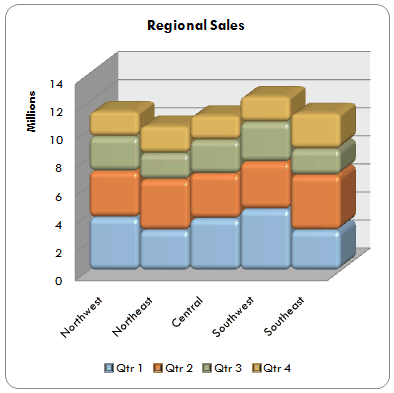
How To... Create and Modify a Stacked Bar Chart in Excel 2013 @YouTube

Some of my most popular videos on YouTube show learners how to do some of the most basic things in Excel. However, many people are new to Excel or only use it occasionally. So if you want to do something like draw a simple bar chart and you have never done so before - it can be a little intimidating to figure out how to do it. These days many learners are more likely to go to YouTube for a "How To" video than look it up in a book/manual or take a course. In fact an astonishing 88,681 learners have viewed my How To... Draw a Simple Bar Chart in Excel 2010 to date.

Image Source: Microsoft Office Support.
In my latest video I am showing how to create a stacked bar chart in Excel 2013. While this is very easy to do, it can be difficult to figure out what the right type of stacked bar chart to choose is. I have also added in a little extra to "jazz" the chart up a bit my showing how to make it look 3D and also to make the blocks on the chart have bevelled edges. The idea and data used for this video is taken from a Microsoft Office Support page. A stacked bar chart is ideal for comparing data in different views. The 3D Bevelled effect looks a lot better and more professional in a presentation or a report.

Here's the latest video... 

Wednesday, June 17, 2015

Conquering Digital Distraction Advice from @DrLarryRosen and @awsamuel

The Harvard Business Review June 2015 issue reports on what could be the "defining problem of today’s workplace" - Digital Distraction. Dr Larry Rosen and Dr Samantha Samuel write that we "waste time, attention, and energy on relatively unimportant information and interactions, staying busy but producing little of value" in a world where "diversions are only a click away". I have to say that when I read the HBR article that I recognised myself in the descriptions of digital distractions given. How do we overcome this?

Image Source: Cohesion Arts.
Dr Rosen recommends taking a break for digital activity to wean ourselves from digital activity. A 15 minute break where you shut down devices, or a 10 minute walk in nature should be enough to train us to avoid "FOMO (fear of missing out), FOBO (fear of being offline), and nomophobia (fear of being out of mobile phone contact)". Dr Samuel suggests that we "fight fire with fire". Here first step is to abandon the myth of “keeping up” - especially in relation to email. She writes: "The kinds of e-mails you probably don't need to see immediately include newsletters, purchase receipts, internal company notices, social media alerts, messages on which you are only copied, and even meeting requests (if they show up in your calendar and can be reviewed there instead). Remember that these messages aren't disappearing—they're in folders waiting to be read at your convenience". Too true - Gmail and Outlook provide the tools to do this. Samuel advises us that "can't and don't need to read everything" - we need to filter material that's unique and significant to give us insights into our field. 

The overall message is that these digital distractions are lowering productivity and wasting a lot of energy. We need to control our digital environment before it controls us. 

I guess I better get back to work!

Monday, June 15, 2015

World Blood Donor Day #GiveBlood

Every year on the 14th of June, countries around the world celebrate World Blood Donor Day. To mark the occasion in Ireland the Irish Blood Transfusion Service held a dinner in the Clontarf Castle Hotel at which people who have made 100 donations were presented with a porcelain pelican by the Minister for Health Leo Varadkar. 

Receiving my award from Minister Varadkar.
Red faced (from heat, not drink)!
I'd say there were about 100 donors present at the event, most with partners - the lovely Roma joined me. Most of the donors, like me, were there for 100 platelet donations. 100 might seem like a lot, but since each donation is counted as a double, and you can donate once a month - it doesn't take long rack up the numbers. In fact it is only just over a year and a half since I reached the 50 donation mark.

Sitting beside us at the table were Ken and Rita Boylan (Dad and Mum to Dublin's MEP Lynne Boylan) - a lovely couple who were great to chat to. Ken was receiving the 100 donations award for 100 whole blood donations. This is a much greater achievement than reaching the 100 mark through platelet donations. Whole blood donations can only be taken once every three months, and each one counts as a single donation. I felt like a bit of a fraud beside Ken. Only one way to feel better - get to 150 or 200!

The theme of this year’s World Blood Donor Day is "Thank you for saving my life". It focuses on thanking blood donors who save lives every day through their blood donations and strongly encourages more people all over the world to donate blood voluntarily and regularly with the slogan “Give freely, give often. Blood donation matters.” 

Over 3,000 blood donations are needed every week in Ireland, and over 1,000 people receive transfusions every week. Only 3% of the Irish population give blood, providing blood for a population of over 4 million people. In fact only 5% of the Irish population eligible to give blood do so (figures from Giveblood.ie). 

If you would like to donate, or find out more information about giving blood - visit the Irish Blood Transfusion Service website for all the details.


Saturday, June 13, 2015

Exploring Ireland's Wild Atlantic Way - launched a Year Ago Today #WildAtlanticWay

This time last year I was excited about the launch of my travel book "Exploring Ireland's Wild Atlantic Way: A Motorcycle Odyssey". I had a successful book signing in the National College of Ireland, a trip to Bikefest in Killarney, interviews on The Ryan Tubridy Show (RTÉ) and The Pat Kenny Show (Newstalk), tweeting photos every day, and great fun seeing my book on bookshelves around the country. While it still can be found in some bookshops, it is now out of print. Easons are out of stock and Amazon just have second hand copies or some for sale by other book sellers left.

So far no decision on a reprint, though it is looking increasingly unlikely. There are now several books about the Wild Atlantic Way available, so the competition has heated up. It is also getting late in the tourist season to order a new print run, so it seems this chapter is coming to an end. I will have two more books out this year - one on the Causeway and Mourne Coastal routes, and another on the East and Southeast coasts. I am publishing these myself through Amazon's Createspace self-publishing solution. It's funny how not having a publisher pressing you for chapters reduces the urgency to finish. Still - I hope to have the Causeway book done in July when I'll have the time while on holidays. 


Friday, June 12, 2015

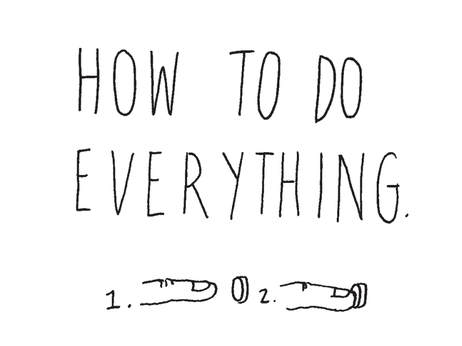
"Searches related to 'how to' on YouTube are growing 70% year over year" via @ThinkwithGoogle

According to Google - there has been an explosion in the amount of searches for "how to", or what they call "I-want-to-do" moments. David Mogensen writing for the Think With Google blog tells us in an article entitled I Want-to-Do Moments: From Home to Beauty, that for "big projects and small fixes, people look for how-to videos on YouTube, increasingly on mobile". Naturally I have an interest in this in that I have about 100 "How To..." videos on my YouTube Channel.

Mogensen writes that the days of asking Dad for help, or turning to a manual, "or worse, customer service" are fast disappearing because today you can "can find out instantly" how to do almost anything on YouTube. 

According to Google, the Top 10 ‘How To Educational’ Searches for 2012 to 2015 are:
  1. how to kiss
  2. how to tie a tie
  3. how to draw
  4. how to get a six pack in 3 minutes
  5. how to make a starburst bracelet rainbow loom
  6. how to make a cake
  7. how to curl your hair with a straightener
  8. how to make a bow
  9. how to make a paper airplane 
  10. how to dance
Image source: howtodoeverything.org.
Now - my channel will not teach you how to do any of these, but it is interesting to think that the smartphone in your pocket is an everyday educational device as well as a communicator. I like the idea for example of in Home Depot that you can check how to do something for home improvement right in the store. You can see if you have the ability to carry out the task, and also if you have the necessary equipment (if not - you can buy it right there in the store). Marketers are latching on to this and have to figure out how to market products and services to help people out.

It is also of course an opportunity for content developers to create the content needed for "How To" videos. Some companies are creating their own, for example: M·A·C has used its range of how-to beauty content to drive sales. Pretty soon I think it will be a factor in purchase decisions - in addition to after sales support we will want "How To" videos as well.


Thursday, June 11, 2015

How To... Calculate ROI and Payback in Excel 2013

Today I have uploaded the second of two "How To..." videos that demonstrate calculations for Return on Investment (ROI), and Payback - two project selection tools that use discounted costs and discounted benefits in calculations. This video follows on from a similar video using the same data to show How To... Calculate NPV in Excel 2013.

This video was a little awkward to do in that it is the first time I have split a topic in two. I wanted in the second video not to redo anything in the first video. However, if you have not watched the first video, the second does not make sense.

Anyway - here it is:

Wednesday, June 10, 2015

The Perfect Norm - Basic Stats for Data Analysts #BigData #HDSDA

In dealing with large amounts of data there are hundreds, if not thousands, of different statistical tests that can be applied which yield many different results. Understanding statistics is not easy, and even though I teach basic descriptive and inferential statistics - I have only the tip of the iceberg in terms of knowledge of statistical methods. Many tests assume that the population data are distributed normally so that we can make inferences based on samples. This is important basic information for a data analysts to understand.

In class I use some classic data of 100 house fly wing length measurements (Sokal and Hunter, 1955) to illustrate what a normal distribution looks like - these data are sometimes used to show an almost perfect normal distribution. Usually we look at a frequency distribution histogram, and if it looks like a bell-shaped (or Gaussian) curve - then we assume normality. Here's the histogram for the fly wing length data plotted in Excel:

Another simple way to check for normality is to see how close the Mean, Median, and Mode are. In the above data they are 45.5, 45.5, and 45.0 respectively - very close. There are also some statistical tests that you can perform on the data to test for normality - the Shapiro-Wilk, and Kolmogorov-Smirnov tests would be the most common ones used. Other measures such as Skewness and Kurtosis are also good indicators of normality. Excel can give several descriptives

Mean 45.50
Standard Error 0.39
Median 45.50
Mode 45.00
Standard Deviation 3.92
Sample Variance 15.36
Kurtosis -0.29
Skewness 0.00
Range 19
Minimum 36
Maximum 55
Sum 4550
Count 100
Confidence Level (95.0%) 0.78

For me, the above is a good start to examine any set of data - you can learn a lot from it!

Reference:
Sokal, R.R. and P.E. Hunter. 1955. A morphometric analysis of DDT-resistant and non-resistant housefly strains Ann. Entomol. Soc. Amer. 48: 499-507.

Tuesday, June 09, 2015

How Much Data is Created on the Internet Each Day? via @joshjames #BigData #HDSDA

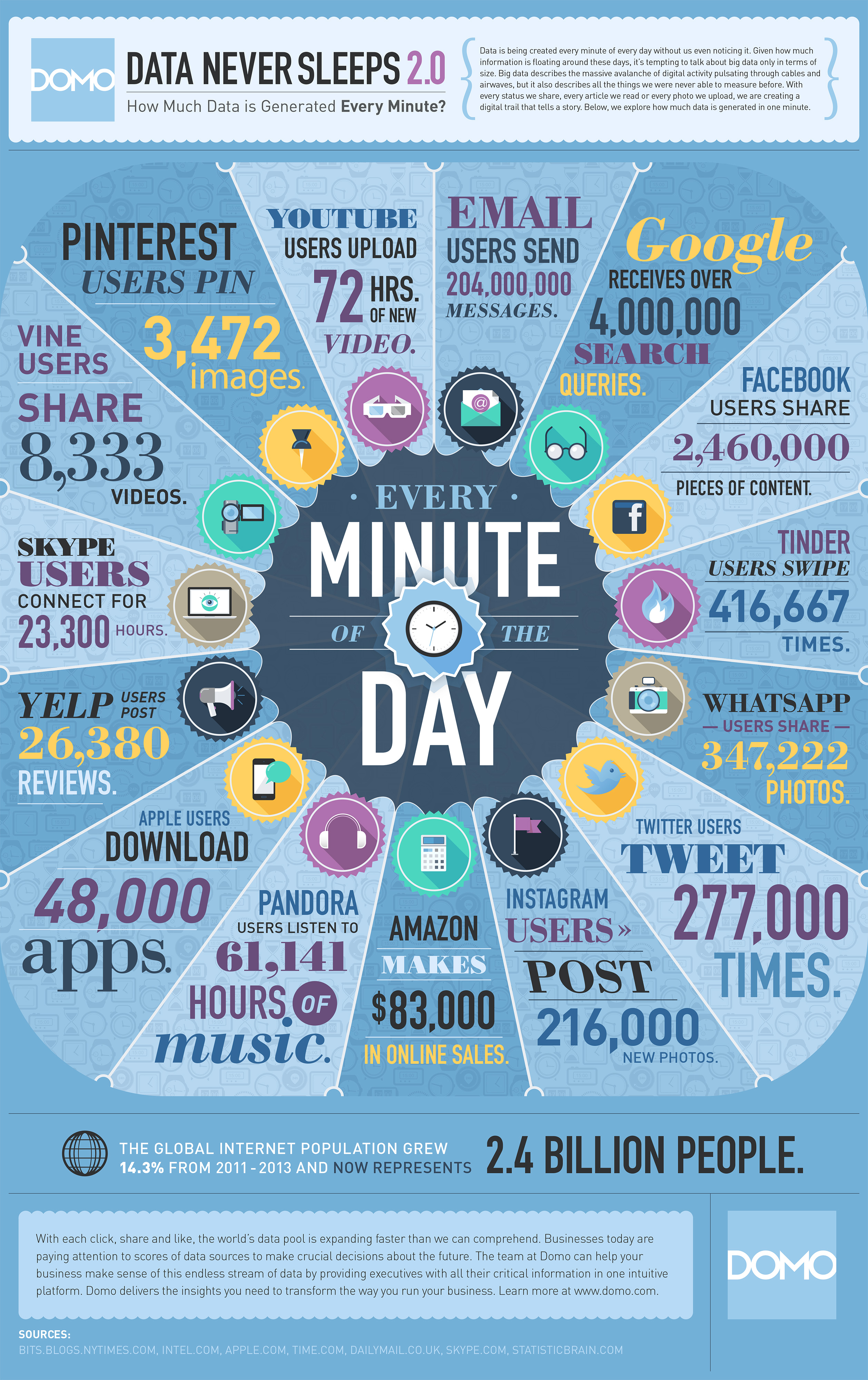
Ever wonder just how much Big Data is created every day? Josh James, writing about Data Never Sleeps 2.0 in Domosphere, tells us via an infographic just exactly what was happening in a minute in 2014.

Just imagine - every minute Facebook users share 2,460,000 pieces of content, Twitter users tweet 277,000 times, Amazon makes $83,000 in on-line sales, and YouTube users upload 72 hours of new video. That's EVERY MINUTE! Where all this stuff is stored I'm not quite sure, but recent announcements of massive servers farms being planned for Dublin and Galway hint at increased demand for storage.

Image Source: Domosphere.
Every piece of data, no matter what it is, is leaving a digital trail behind. We can be profiled and tracked like never before. A real challenge for us all is how to manage our own digital trail whether we want it to be private or not.

Educators have some challenges and opportunities with Big Data. Today's graduates need to be skilled in managing data and over the next few blog posts I will discuss this and the skills we need to be teaching our students, and what the basic levels of competency are that everyone will need.

Saturday, June 06, 2015

York cyclists bad habits on show via @MailOnline

In what is seen every day in every city and every town in the world, an anonymous cyclist has recorded some bad habits by cyclists in the City of York in the UK. This is "Episode One", so expect a lot more. Head cams on bicycles are becoming more common, and they are also popular on motorcycle helmets. I'm sure they will feature in court cases and in name-and-shame videos like this.


Of course it is not only cyclists who behave badly on the road - many other road users like pedestrians, motorists, truck drivers, and (yes) motorcyclists do so as well. One thing that headcams (and dashcams) might do is become the single biggest contribution to road safety ever as we all try to avoid ending up on YouTube!

Friday, June 05, 2015

How To... Calculate Net Present Value (NPV) in Excel 2013 @YouTube

One of the earliest videos that I published was "How To... Calculate Net Present Value (NPV) in Excel 2003" - it was only my third ever video and was uploaded to YouTube on October 10th, 2008. In the six and a half years since it has garnered a modest 79,832 views, 93 Likes (and 6 dislikes), and earned €176.68. I had often thought that I should do an upated version for Excel versions 2007 and 2010 - but since the method was exactly the same, I didn't bother.

Today I have released a long overdue updated version for Excel 2013. While the calculations are the same for all versions, an update is needed as the quality of video and audio has changed a bit since 2008. Back then I used a series of screenshots and saved them as images in order of appearance. I recorded the audio in Audacity and used it to remove noise. I then imported both the audio and images into Windows Movie Maker, and synced the images to the sound. Overall - a tedious and lengthy process. Nowadays I'm using Snagit to make each video in one go.

This latest video is the first part of two videos that show how to calculate Net Present Value (NPV), Return on Investment (ROI), and Payback - these are used to select projects on a financial basis. 

Thursday, June 04, 2015

Free College Places for the Unemployed via @NCIRL

The Government is funding another round of free courses for unemployed people, and at the National College of Ireland we have our share of programmes on offer - see our Springboard+ web page for details. Once again the Higher Diploma in Data Analytics is offered and already there has been a lot of interest in this programme. I hope to be lecturing again on this course and to get students interested in Statistics.

Some interesting numbers from the SpringBoard programme since it started in Ireland in 2011:
  • 21,000 people have participated
  • 42 Colleges have taken part
  • 812 courses have been offered
  • €85,000,000 funding has been provided
From my side of the classroom I have been teaching on six separate classes of the Higher Diploma in Data Analytics to Springboard students. I have seen people's lives changed right before my eyes, as students seek to learn new skills or to improve on existing skills. Our brilliant Career's Office has had great success in placing students in employment as a result of this (and other) courses. You don't have to be unemployed to do this course as it is also offered under ICT Skills funding.

Check out the Springboard+ Launch video (including some cool music by The Corrs) to learn more about this new round of courses:


To apply for ICT Skills/Springboard+ courses, please visit http://www.springboardcourses.ie.

Wednesday, June 03, 2015

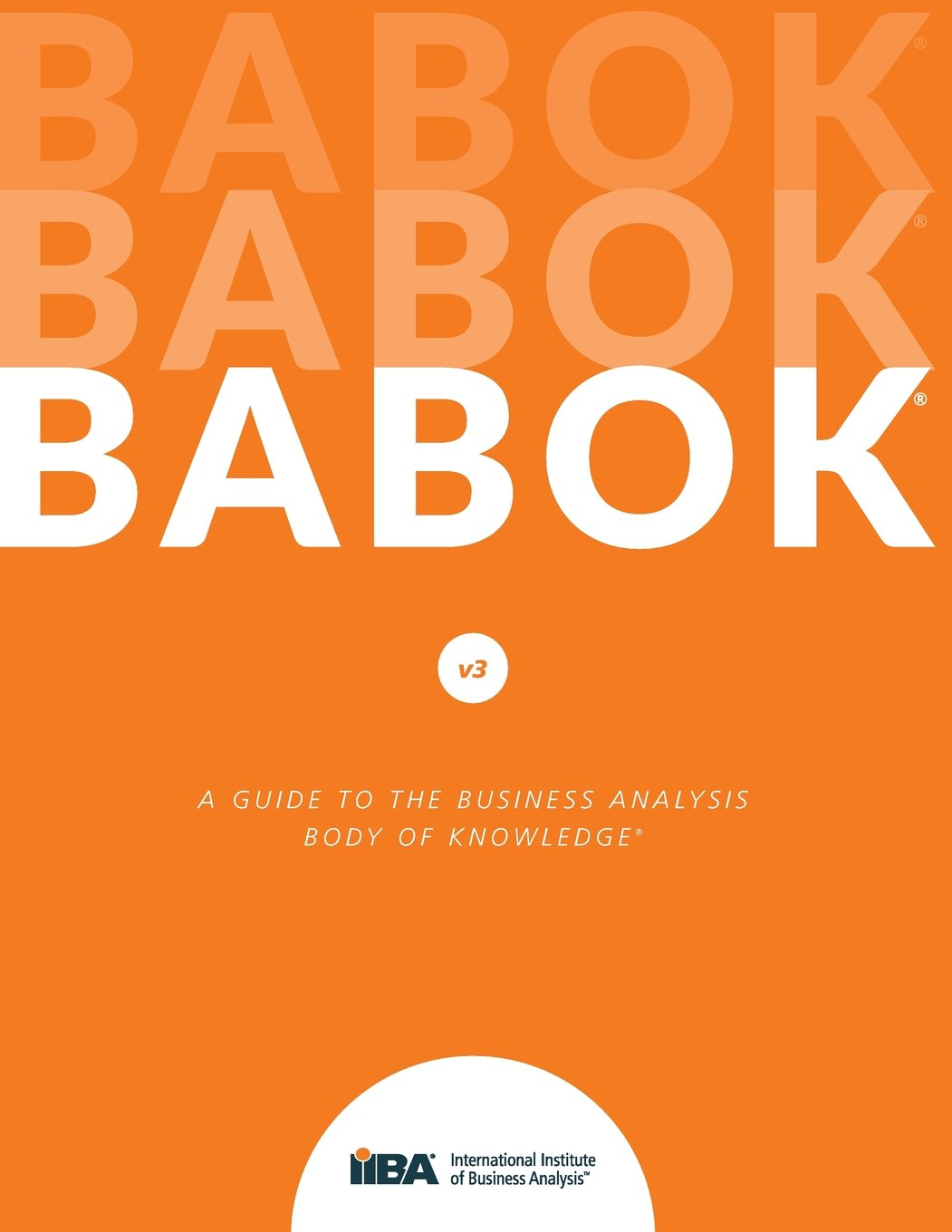
"BABOK® Guide v3 - What’s it all about?" Breakfast Event at @IrishCompSoc

This morning I attended a great talk by Melanie Byrne of SQS at the Irish Computer Society on "BABOK® Guide v3 - What’s it all about?". This was a breakfast event at 8 o'clock suitable for people on their way to work, and is part of a regular series of events run by the Business Analysts Association of Ireland.

Image Source: Amazon.
Melanie outlined some of the key differences between version 2 and version 3 of this international standard for Business Analysis. Version 3 was released last April after over five years of input from experts from all around the world. This has consequences for me and my classes in that modules content will have to be updated to take account of the new standard.

Some of the knowledge areas have been changed, and there is a lot of structural change within the areas plus new techniques and competencies added. But perhaps the biggest two changes that Melanie concentrated on are:

    - New Core Concept Model
    - New Perspectives

The new Core Concept Model components are: Changes, Solutions, Contexts, Value, Stakeholders, and Needs. These concepts are fundamental to the practice of Business Analysis and are recommended by Melanie to be part of every BA task. 

The new Perspectives are used within Business Analysis to provide focus to the tasks - they use the same techniques, but in different ways. The perspectives are:
  • Agile
  • Business Intelligence
  • Information Technology
  • Business Architecture
  • Business Process Management

Overall there are some significant changes and anyone used to the older version will need to update very soon. In particular to me it seems that Agile has become prominent, and as Melanie says - many BAs are now working in Agile environments and must move away from old methods like Waterfall to keep up. 

Tuesday, June 02, 2015

Three objective pros and cons to help you make an informed decision about on-line courses by Ryan Hickey via @usatodaycollege

There is a lot of hype about on-line degrees with many people feeling that they will be the norm in the future, while others see the traditional College system surviving. I have mixed feelings about it. There were no on-line courses available in the late 1970s/early 1980s when I was in College - mostly because there was no "on-line" (I'm not counting correspondence courses or the Open University TV programmes in this). I would love to have had the choice, though my preference would be for a combination of both traditional and on-line courses.

Image source: Banking Sense.
Ryan Hickey, writing in USA Today about "The pros and cons of getting a degree online" objectively outlines three reasons why an on-line degree is a good thing, and three reasons why not.

First - the pros:

  • Opportunity and convenience
  • Potentially lower costs
  • Faster completion
Yes - it can be convenient for some people to take a course at their own computer in their office or home. Hickey also says that it can be cheaper if no room and board is needed to be paid for. His third point is the most interesting about "completion" where "online programs are streamlining extraneous courses out of their degree requirements" with "more targeted degree options that cut out everything but what you actually need to earn a degree in a specific subject". So if someone wanted a lower cost, more convenient, and targeted degree - on-line might be best.

Now - the cons:
  • Some subjects don’t work
  • Increased personal responsibility
  • Networking challenges
Obviously if you want to study occupational therapy, then this will be almost impossible to complete on-line. Hickey reminds us that managing and monitoring degree requirements on-line will be difficult to many learners - especially if they prefer a "highly structured environment". I think the biggest challenge is the lack of networking with other learners and teachers. While this can be overcome with discussion boards, VLEs, Twitter/Facebook interactions - there is still great value from face-to-face interaction, but that in an on-line environment networking "can be significantly more challenging and frustrating than it would be in an on-campus setting". 

I feel the challenges of networking will be reduced by the phones in our pockets and the watches on our wrists. Millennials are more used to communicating on-line so they will not hark back to the good ol' days when communication in education was face-to-face. For me - the biggest challenge that remains is that educators are behind. There are still overhead projectors in classrooms in my College - just think that a student sitting a few metres away could be wearing a SmartWatch! The gap is widening.

Monday, June 01, 2015

YouTube Rankings C+

I read with interest an article in yesterday's Irish Independent by Fiona McBennett - "The Irish YouTubers who have made the big time". Several Irish YouTubers are now making a living from YouTube, including Sinéad Cady who has a massive 650,000 subscribers to her channel. I'm often asked how much I earn and how many views/subscribers I have, and how this compares to others. It is fascinating seeing how others do, and also interesting to discover that my channel comes nowhere near the top.

Today I came across a new website - www.socialblade.com, where you can look up your own stats (I'm a C+) and those of others. Much of what I can see about my own channel is already available to me in YouTube Analytics, but one interesting feature is that Social Blade makes future projections, eg:
  • 9,000,000 views will happen on 28th November 2015
  • 20,000 subscribers be reached on 29th February, 2016
  • 10,000,000 views will happen on 9th June 2016
  • 5 years from today the channel will have 36,000 subscribers and 17,496,000 views
I'll be keeping an eye out to see how accurate these projections are. I've noticed a definite slow down in growth of views, though the number of subscribers continues to grow. I will be adding several new videos in the next few weeks plus continuing to re-brand with new thumbnails. I'm told by my YouTube Account Manager regular posting is essential to keep up views and subscribers.

Sunday, May 24, 2015

Preston North End Promoted to the Championship!

Finally - a play-off success for PNE (tenth time lucky!) today with a 4-0 win over Swindon Town in the League One play-off final at Wembley. It has been a great season, but with a hiccup on the last day meaning the play-offs were the route to the Championship rather than automatic promotion. In truth it was a easy win for PNE despite Swindon dominating possession. The hero today was Jermaine Beckford with a hat-trick, and I'm sure that everyone in the City of Preston will celebrate today's win.

Image source: RIP.IE
While scoring a hat-trick at Wembley must be the stuff of dreams, the reality for Beckford and the rest of the PNE squad is that the Championship is a lot tougher and many of them will probably be discarded as new signings are brought in. Beckford has just been released by Bolton Wanderers! Money will talk, but Preston are not a big club and may well depend on loans again to stay up next year.

Finally, I hope there is Sky Sports in heaven as today would have been a great day for PNE's biggest fan in Ireland Joey McKeever who sadly died suddenly a month ago. He lived right across the green from me at Marian Park and he was passionate about PNE. Rest in Peace.

Here are the highlights...

Saturday, May 23, 2015

26th August, 1988 #EmptyNest

Once when I was young I had no children - it seems so long ago. Life was very different from what it has been over the past near 27 years. The last time Roma and I had no kids was 26th August, 1988 - the day before Claire was born. Little did we know that we would start a family with three wonderful girls that would be so central to our lives. With Claire in New York, and Vicki in Belfast (soon to go to USA for a year), we have been getting used to less people about the house. Today, Kate moved into her own apartment in Dublin City, and I helped her with the move. 

Very mixed emotions on a day like today. My heart is bursting with pride that our three girls are so independent and making their own way, but I miss them so much. Life goes on and I'm certainly not the first Dad to experience the "empty nest" syndrome. I have not lived with my own Mum and Dad since 1978, yet I still call their house "home". I know that I can walk into their house in Ballingate as if I was never away, and I hope our girls will always feel that they can do the same in Blackrock.

Love you girls!

OK Roma - let's party!!!!!!!!!!!!!!

With Claire, Kate, and Vicki - Rosmindle. Co Mayo.

Monday, May 18, 2015

8,000,000 @YouTube Views Milestone #learning

Today my YouTube learning channel reported 8,003,215 views, it has taken almost four months for the last 1,000,000 views to to take place - with a bit of luck it will hit the magic 10,000,000 before the end of the year or early next year.

About this time last year the number of views on the channel was climbing rapidly - approximately doubling year-on-year. On March 3rd 2014 a new daily high view count of 11,944 occurred, but that record has not been broken since. While the seasonal pattern remains the same, growth over the past year has stagnated and for the last few weeks has been running lower than this time last year. Here is chart showing views since November 5th, 2007:


Monday, May 11, 2015

How To... Calculate Pooled Variance in Excel 2013

My YouTube Account Manager recommended that I do several things to improve my channel and get more views. One was to upload videos on a regular basis, and the other was to add custom thumbnails. 

My latest video is taken from one of my Statistics classes where Student's t-Test is used to compare the means of two samples. In unpaired (independent) t-Tests, if equal variance is assumed - the pooled variance of the two samples must be used in calculating the t statistic. My video below shows you how to do this manually in Excel.

For the second major recommendation, add custom thumbnails, I have created what you see below using PowerPoint and Snagit. I mock the graphic up on PowerPoint using my stock portrait image found in my videos, plus a title. I tried many variations on this, but keeping it simple works best for me. Apparently, thumbnails like this attract more viewers and adds a type of brand awareness to my channel.

Here is my latest video...

Friday, May 08, 2015

The Future of Higher Education - What Students Have to Say

Students at the University of New South Wales in Australia are interviewed to get their thoughts on what they think are the "future directions" for higher education. Technology is seen as playing a keen part in this with students seeking an increased role for video, recorded lectures, and more computers to help them in their learning. It's interesting to hear students in the video, who I'm guessing are in their late teens/early twenties and who grew up in the digital age, talk about what they would like to see in higher education. There seems to be some resistance to the traditional lecture, with many students seeing opportunities for more interactivity in class and more use of downloadable material supported with short YouTube videos. We should listen!

Wednesday, May 06, 2015

NCI Guest Blog Post "A Day in the Life of a Lecturer"

Last week I wrote a guest blog post for the National College of Ireland Blog about a day in the life of a Lecturer, which was published yesterday. I chose the last Wednesday of Semester II to log my activities for the day - this was my longest and busiest day of the week. It was fairly typical of my work day - especially ones where I have classes. Sometimes I feel than when I have a class I don't get any work done! But then I remember that I am a Lecturer and should be spending time in class. I played down the amount of administration that I do - this is the boring part of the job that I don't like.

Here's the text of the blog post (Photo credit: Bonnie Cullen):

A Day In The Life of A College Lecturer

Regular readers of the NCI blog may recognise Dr Eugene O’Loughlin, NCI lecturer, author, Harley-Davidson enthusiast, blogger and YouTube content creator. Several years ago Eugene wrote this blog post about NCI’s first foray into blogging and we've finally taken him up on his suggestion!

It’s Wednesday during the final week of the Semester and a busy day lies ahead. As I teach an evening class on Wednesdays I normally do not come into the office until about 11:00am. This gives me some time at home to check personal email and I also write a blog post about the Open Plaques project in the UK that is trying to create a “Museum of the Street”, by recording on-line the commemorative plaques that we see on houses where famous people lived.

Soon it is off on my bike to the National College of Ireland and I arrive just in time for an 11:00 – 13:00 class. In this class the students, who work in groups, make their final project presentations. The presentations are excellent and I am very pleased with the work done. After this I have lunch at my desk and check my office email. There are 54 new emails today, many of which are newsletters and notifications that I subscribe to. I scan through the list for something interesting and note that the Journal of Education for Teaching has an interesting looking paper on “Reflection and Teacher Education”. In some of my classes I get students to complete reflective journals, so I read the abstract and make a note to read the full paper later. I have many emails to respond to from students, many of whom are now feeling the pressure as the semester ends and exams loom ahead.
After dealing with email I have an overdue task to complete which is to update reading lists for modules I will be teaching in the next academic year. I’m surprised at how long this takes. Most of the texts that I have been using over the past 2 – 3 years have new editions out, so the title, year, author, publisher, and ISBN for each text has to be updated. I use Amazon for all the details needed and return the revised reading list to the School Office.
Next I have a short meeting with a colleague to work on an abstract that we are submitting to a conference being held later in the year – the deadline for submission is this coming Friday, so we have no time to lose. Our paper is about Learning Analytics - we are researching ways of collecting data on educational videos and how these data can be interpreted. Following this I take a short mid-afternoon break where I take a walk up and down the quays by the Liffey. While I still have lots to do today, taking a break is important. Many of my students will remember me referring to ABBA (taking “a break between activities”, not the Swedish group!), and to Stephen Covey’s “Sharpen the Saw” story, to state the importance of taking breaks.
It is now 15:30 and I now concentrate on my evening classes for the rest of the day. My first class (17:00 – 18:00) is a tutorial for students who requested extra help in using SPSS and Excel for data analysis. As this is the last tutorial I plan to use so-called “big data”, so I download large files from the Central Statistics Office, Met Éireann, and the World Bank. In our tutorial we look for links, trends, and patterns in the data. I run through all the statistical tests that I will cover and prepare some tasks for the students to complete in the tutorial. Following this I prepare for my 18:00 – 21:00 Statistics class. We have already covered almost all of the curriculum, so this evening’s class will begin with the final lab on making predictions with data using Simple Linear Regression. I already have this prepared, so I quickly go over my plan for the rest of the class where I will provide feedback on a previous Continuous Assessment test, and finish up with reviewing a past exam paper in preparation for the class’s upcoming final exam.
There is a good turnout for the tutorial and almost a full house for the evening class. All goes according to plan, though I get many questions from nervous students about the exam paper. When asked for some tips in the exam I hold up my folder of the course notes and say ”This is what you need” – not many students see the humour in this! I had hoped that as this was the last class of the semester that we could finish a little early, but going over the exam paper took longer than expected and we didn’t finish until 21:00.
It’s always with some sense of sadness that I leave the last class – being with this group of students for 12 weeks has been very enjoyable and gratifying. After class there are a few students with further questions and I don’t get to leave the College until about 21:30. I ride home to a late dinner and a catch-up on the evening's events in the Champions League. A long, but satisfying day.

Enjoy this post? Check out Eugene’s article with advice from a lecturer to his younger self, or read more about our computing courses at National College of Ireland. You can also follow Eugene on Twitter here! 


Monday, May 04, 2015

Belfast Weekend

After years of not visiting the second largest city in Ireland, I now feel like a regular visitor to Belfast. As it was my daughters' birthday weekend we made a break of it for the May weekend. We had a great meal in Howard Street Restaurant, delicious food and great atmosphere. On Sunday I visited the Ulster Museum and particularly enjoyed the exhibition of First World War posters. Today I bought a new jacket selected by my daughters! I also took the time out to visit Scrabo Tower near Newtownards and its wonderful views over Strangford Lough. Last summer I passed through Newtownards on my tour around Northern Ireland's coast, but only saw this tower from a distance - today I got right up to it, but unfortunately the tower itself was closed. I took a lot of photos in an effort to get a good one for my next book - I think this one is the best:


Friday, May 01, 2015

Should Google be Allowed in Examinations?

This is an interesting question posed yesterday on the "Today" show on BBC Radio 4 - the clip below hears both side of the argument where one panel member questions the credibility of an exam where Google was used, while the other states that it should be allowed depending on the type of exam in question. Clearly this is a question for debate amongst all educators and learners?

Image source: Wikimedia Commons.
First - consider this quote attributed to Albert Einstein:

Why should I memorize something I can so easily get from a book?

If he were alive today he might instead say:

Why should I memorize something I can so easily get from Google?

Secondly, consider this fact: In 1975 (the year I sat my Intermediate Certificate), calculators were allowed in Intermediate/Leaving Certificate exams in Ireland for the first time. Lots of people objected to this saying it "dumbed down" maths tests and that they could help a student get a good grade without understanding the concepts behind the maths. Look how common they are now!

Google is part of learning whether we like it or not (I like it - I regularly ask/allow students to look up stuff online in class). This makes it part of teaching. I wish I had it in the 1960s/1970s when I was at school. Of course we have to be careful about a "cut-and-paste" culture and take steps to ensure that this is not learning, but if you use a specific tools to learn, then its presence in an exam should be considered. I am in agreement with Mark Dawe, Chief Executive of the British OCR exam board, who says in the clip that "It is inevitable" that search tools such as Google will be used in exams. I also agree with him in that it should only be used in certain types of exams and that the exam itself will be different is search is allowed. Assessing students' ability to make connections, show understanding, and interpret content is different than assessing recall. If I am preparing an exam where I know access to the Internet and Google will be available, I will naturally set questions accordingly and have different expectations about the answers students should provide. For example, in a Statistics exam I might ask students to find their own data to analyse and interpret, rather than give them a defined data set that all students must use. Which is of greater value?

Listen to the clip and form your own opinion...