Friday, September 28, 2018

Some Advice for On-line Educators Part II - "Don't Lecture"! via @MFPaulsen

Following up from my post earlier this week where I mentioned some advice given in a 2003 book by Professor Morten Flate Paulsen, comes some further pedagogical recommendations from Prof Paulsen. These are based on surveys he conducted in Scandinavian countries in the late 1990s and early 2000s - still relevant today I think:

  • Have Clear Objectives
  • Maintain as Much Flexibility as You Can
  • Encourage Participation
  • Maintain a Non-authoritarian Style
  • Be Objective
  • Don't Expect Too Much
  • Don't Rely on Offline Materials
  • Promote Private Conversations as well as those in the conference
  • Find Unifying Threads
  • Use Simple Assignments
  • Make The Material Relevant
  • Required Contributions
  • Present Conflicting Opinions
  • Invite Visiting Experts
  • Don't Lecture
  • Request Responses

Most educators will agree that the points above will probably apply in all educational settings, but I am drawn first to two (which are highlighted above).


Maintain a Non-authoritarian Style
Prof Paulsen suggests that it is "usually better to avoid the "authority figure" role when teaching online, especially with adults". There is no doubt about it, but already I feel as if I have total control in my new on-line classes - in Adobe Connect (the tool we use to deliver live classes) I am the "Host", while the students are "Participants". It's hard not to be "authoritarian" in such an environment. I have not yet grasped the system where control can be handed over to students - I need to get more comfortable and relaxed with Adobe Connect before I start giving control (authority) to students. Perhaps it shouldn't, but being a teacher in any learning environment does convey a certain natural authority - it's hard to overcome this in my experience.

Don't Lecture
My job title is "Lecturer in Computing". I am a Lecturer and it is hard to swallow a "Don't Lecture" recommendation. However, Prof Paulsen tells us that "Experience strongly suggests that a long, elaborate, logically coherent sequence of comments yields silence. Instead, use open-ended remarks, examples, and weaving to elicit comment and other views". I have certainly already adapted the "weaving" approach. My timetable says that I start with a two hour lecture, and follow this with a one hour tutorial. I never stick to this restriction, and I like weave in and out of short lecture/talk and practice. This is relatively easy to do in a module on Programming, where students are writing code almost all the time in my classes. For the first two weeks, I went through neither of the sets of lecture notes (PowerPoint slides) - I only dipped in and out when needed. I hope to keep this up. One of the best courses I ever attended was a CIPD Train-the-Trainer course. Our Lecturer/Trainer gave us a printed copy of her PowerPoint slides at the end of the 10 day course - we didn't even know they existed!

Thursday, September 27, 2018

Watching Recordings of My Class - Ugh! #vlog08

As my new on-line classes are recorded, I took some time this week to watch and listen to my own class recording. It was not what I expected...!

Tuesday, September 25, 2018

Monday, September 24, 2018

Some Advice for On-line Educators Part I via @MFPaulsen

Image source:
informationr.net.
Now that I am heading into my second week as an on-line educator, I am reminded of some great advice from Professor Morten Flate Paulsen given many years ago that still stands today. In his book "Online Education and Learning Management Systems" (published in 2003) - Paulsen tells us: 

What distinguishes online instruction from entertainment
or recreation is the purposefulness of the designers
and developers in provoking certain intelligent
responses to the learning materials, context,
and environment.

I like the choice of words like "purposefulness" and "provoking", and the distinction of on-line learning from "entertainment". In 2003 when these words were written, there was no YouTube or Netflix - online entertainment was in its infancy. Today - it is mainstream, and it is more important than ever to keep this distinction visible to educators and students. I have often heard lecturers say that they are teachers - not entertainers. At the same time I appreciate that (as in my classes) participating in an on-line class for three hours is a long time. I try to be light hearted at times, but there is serious work to be done. I have yet to figure out how to do "purposefulness" and be "provoking" in my on-line class, but it is certainly something I think all on-line educators should take on board. 

Paulsen also recommended:

When developing and delivering instruction,
whether online or not, the use of technology is secondary
to well-designed learning goals and objectives.

The emphasis on the word "secondary" is mine. It's too easy to get carried away with the technology. In last week's class I had three computer screens, plus lots of applications open. I felt like I was in a sound studio. I'm decreasing to two for tonight's class and will see how I get on. I also found my screens very cluttered - too much going on. Adobe Connect is a brilliant tool, but it cannot replace "well-designed learning goals and objectives". I am a firm believer that goals and objectives will be subtly different for an on-line class compared to a classroom. While the overall module Learning Outcomes should be the same, the delivery and content should be developed with the on-line environment in mind. Simply reproducing lectures notes used in the classroom on-line does not work well in my view. How can module material (eg slides) developed for on environment (the classroom) be unchanged for a different environment (on-line)? Many educators believe they are interchangeable and soldier on regardless. The module (Programming for Big Data) that I am teaching is not being delivered by me in a classroom (it is being by others) - so it will be interesting to compare experiences at the end of the semester.

Thursday, September 20, 2018

Are you ready? #elearning #cisco

In late 1999/early 2000, in just Cisco's second wave of brand advertising they asked the question:

Over 70 million people are receiving an education on the Internet this year.
One day, training for every job on Earth will be available on the Internet.
Are you ready?

At this time I was working in Global Services in SmartForce, and quotes such as this were manna from heaven for a company that sold eLearning content in what was then the very early days of on-line education. I recall a lot of technical issues compounded by the Y2K phenomenon in delivering training content over the Internet. Most companies still purchased their content from SmartForce via CD-ROM - at the time many were just not equipped with fast Internet connections.

Almost 19 years later I feel the same question can still be asked. Millions of people are learning on-line (over 16 million people have watched my videos alone). This year I am finally involved in delivering a course on-line - but this is to just 35 students out of over 100 that I am teaching this semester. Most of our College students still come to the classroom - but the on-line figures are growing. YouTube, which did not exist in the year 2000, has become the "Go To" location for learning anything from Maths, to fixing a tire, to removing contact lenses, or to learning a programming language. While this can be regarded as informal learning (it cannot be tracked or certified), it is taking a much increased proportion of the time that people take for learning.

We have not yet reached "training for every job on Earth" being "available on the Internet" - otherwise classrooms everywhere would not be required. Having delivered a class on-line for the first time ever this week I feel that while Cisco's advertising question "Are you ready" is getting closer to a "Yes" answer - we still have a long way to go for this prediction to come through.

Tuesday, September 18, 2018

Monday, September 17, 2018

Sunday, September 16, 2018

Weekend in Amsterdam #Learning

Amsterdam is just 1 hour and 20 minutes flight time from Dublin - but this weekend is my first ever visit (not counting an airport stopover) to this wonderful city. I can't believe it has taken me over 58 years to finally decide to visit the largest city in The Netherlands. It is always wonderful to experience and learn from other cultures. We have so mush in common, yet there are so many differences. The English language is very common everywhere - we were greeted in English and spoken to in English all the time. In fact, I don't recall anyone greeting or talking to us in Dutch. In several of the places we went, signs were in English only - I wonder what the Dutch think of this?


Canals of course are everywhere - we took an evening cruise, but this was not particularly interesting as you will miss a lot in the dark. One thing I will remember it for is the Worst Pizza Ever, which was served up to us on the barge. Other highlights included a visit to the (very) crowded Anne Frank's house, the Red Light District, the Heineken Experience, the Rijks Museum, Rembrandt's House, and finally the Jewish Museum and Holocaust Memorial. References to the Holocaust are very matter-of-fact - over 104,000 Jews were transported from The Netherlands to death camps. In Anne Frank's house there is not actually that much to see - but being in the same rooms that this wonderful writer hid in for two years before her own death in Bergen-Belsen concentration camp was an eerie feeling. I've experienced it before at the Holocaust Memorial in Berlin the almost complete silence that visitors to the museum wonder around in. Contrast this to the noisy Rijks Museum.

Amsterdam for the most part seems to be a city of young people, with a lot of them cycling around all the time. Bicycles are everywhere, and I was interested to learn that smaller motorcycles can go in the cycle lanes. No helmets are required on smaller scooters - though I saw plenty on bigger ones not wearing helmets either. I didn't sample any of the head shops that are everywhere - I was not keen to learn about being stoned! I'd love to go back - a weekend is not enough time to enjoy this city. Below is our Heineken Karaoke Experience - "Tulips in Amsterdam"!


Friday, September 07, 2018

Training for on-line class delivery finished! #vlog04

Last training session with ET was today - hopefully I'm ready for first class next Monday week - here's my latest video diary:

Monday, September 03, 2018

All-Ireland Football Finals Winning Margins (1892-2018) #Analytics #GAA

Yesterday's All-Ireland Final winning margin between Dublin and Tyrone of 6 points was the biggest since 2007 when Kerry beat Cork by 10 points. In 132 All-Ireland finals*, this was only the 10th time the winning margin was 6 points. Many football fans (me included) expected a bigger margin as the Dubs have been rampant this year. But a closer look at the winning margins since 1892 shows that overall the margins are quite small - the vast majority of finals are won by 4 points or less.

Click/Tap Image to Enlarge.
Data Source: Wikipedia.
The most common winning margin is 3 points (22 times), followed by 1 point (20 times) and 4 points (19 times). My €5 bet @ 7/2 with Paddy Power yesterday that Dublin would win by 1-3 points looked a good bet on the balance of probability. As you can see on the chart above, huge winning margins are rare. The biggest winning margin ever of 19 points was Cork's 6-6 to 1-2 win over Antrim in 1930. In more recent times Kerry's 5-11 to Dublin's 0-9 (17 points) was the biggest winning margin since Mayo's 18 point win over Laois (4-11 to 0-5) in 1936.

One point margins are common (20 times), though incredibly five of these occurred in the past nine finals. Unlucky for Mayo as they have lost three finals (2013, 2016, and 2017) by the minimum amount - all to Dublin.

So - if you like a bet on things like winning margins, be sure to look at the probabilities as well as checking on a team's form before you part with your money. In the long run, betting on winning margins of 1-4 points will pay off.

*Finals between 1887 and 1891 not counted as a goal was then worth 5 points. 

Friday, August 31, 2018

"Women are an untapped resource of IT talent" via @CBROnline.com

Tara O'Sullivan (CMO in Skillsoft*), writing in Computer Business Review this month, tells us that "Women are an untapped resource of IT talent" - for example, only 12.8% of the UK STEM workforce is female. No surprise there, but she offers four interesting ideas for addressing this situation in businesses. In an article entitled "Diversity and the Digital Skills Deficiency" she has a simple message - "get more people involved in tech".
Image source: Wikipedia.

Idea #1 - Invest in STEM training
It seems obvious to invest in STEM training, but more opportunity needs to be provided to women to re-skill in the workforce - to gain what O'Sullivan calls "career mobility". She further advises that every company should be "investing in STEM training throughout the work lifecycle and enabling better career mobility for all regardless of their gender, job title or location". This is not easy to achieve, may cost a lot of money, but is worth it to address IT skills shortages.

Idea #2 - Be proactive
Obvious again, but organisations need to change their attitude to "rally behind female talent". Women in senior positions can provide leadership to achieve this.

Idea #3 - Mind the Pay Gap
O'Sullivan quotes figures to show that men in high-tech companies earn 25% more than women in the UK. She recommends that countries should follow the example of Iceland where a law was passed in June 2017 making it the employer’s responsibility to prove that employees are being paid equally. 

Idea #4 - If I can’t see it, I can’t be it
O'Sullivan points out that we need to have more examples of women in Tech to "demonstrate the attraction of the career to women". At just 12.8% of the UK STEM workforce it will not be easy to find role models for this. On a recent visit to a company I was in an administration office where every single employee in the room was female. As O'Sullivan puts it - "the biggest untapped resource that they [businesseshave: their female employees".

In one of my classes last semester, 24 out of 80 registered students was female - that 30%. A bit better than the UK's STEM workforce (12.8%), but still a significant minority. I hope to see more female students in class this coming academic year. It is also our job as Colleges to make IT courses more attractive to women. Here's one of my former students (in an NCI ad) telling us how one of our IT courses (Data Analytics) changed her life:


* I left Skillsoft in September 2002 shortly after the company I worked for (SmartForce) was taken over by Skillsoft. I have never met Tara O'Sullivan

Wednesday, August 29, 2018

How To... Perform Logarithmic Regression in Excel

In my statistics classes we cover the subjects of Simple and Multiple Linear Regression - they are techniques for making predictions using regression models. If you know the value of one (independent) variable, you can use a model to predict the value of another (dependent) variable. Often this is visualised on a scatter plot where one variable is plotted against the other. But what if the relationship between the two variables is not linear, for example - what if it is curved? Logarithmic Regression is another type of regression that can be used, and I will be introducing it as a topic in this year's upcoming classes.

In my new video below I show how to perform logarithmic regression in Excel using tree growth data. As trees get older, they grow taller, but the increase in height slows down after a few years to give a curved scatter plot. Can this be used to make predictions? Yes it can - see how:

Sunday, August 26, 2018

Marriage Registration of my Great-Great Grandparents James McCann and Catherine Walsh

Anne McCann.

Doing some more research into my family history I had to use the General Register Office (GRO) to find the marriage certificate for my great-great-grandparents James McCann (1842-1927) and Catherine Walsh (1843-1908). No known photographs of them exist, though I do have one of their only daughter Anne (1874-1952).

Below is a copy of their marriage register dated 26th June, 1869 - almost 150 years ago. It was through this document that I found out that James's father was called William, and Catherine's father was James Walsh - mothers names were not recorded. James was a "Labourer", no occupation is given for Catherine. Both their fathers were labourers. James lived in Gorey, while Catherine was from the townland of Moneycross which is just outside Gorey near Camolin where the wedding took place. It is clear that they could not write, as the document indicates that they should make a "mark".


Source: General Register Office.
I wonder what kind of a day it was on 26th June 1869, and what it was like for them. They had survived the Great Famine as children, which was not as bad in Co Wexford as it was in other counties. I wonder did they consider emigration the Canada or the USA, as hundreds of thousands of people their own age were doing at that time. They were  labourers - what made them stay? On their wedding day did they have a big party - were they madly in love or was it a marriage of convenience? They lived in Kilnahue outside Gorey, though James is recorded as living in Wexford Street in Gorey in the 1911 census - this was after Catherine had died (1908) and James had remarried. They are both buried in St Michael's Cemetery in Gorey. I would have loved to have met them.

Headstone of James McCann and Catherine Walsh.

Saturday, August 25, 2018

Remembering John Paul II and Missing Francis I #Pope

His Holiness Pope Francis I arrives in Dublin this morning and I'm not going to see him. I don't have any tickets to his events, and to be honest I made no effort to get any. I had hoped that as part of the Blackrock Choir that we would be asked to participate in the main Mass on Sunday in some way - but it did not come to pass. I wish I was able to go to the Mass, but all the bother about long walks, roads and Luas closed, health & safety dictators ordering us about, and long waits put me off.

Pope John Paul II in Galway.
Image source: RTÉ.

Simca 1100 (ours was blue).
Image source: Living the life in Saint-Aignan-sur-Cher.

It was no bother on 30th September 1979 to travel all the way from Carnew to Galway for the Youth Mass with John Paul II. I was 19, and I travelled with my two brothers Joe (18) and Brian (15) in a small Simca 1100 car. We had our camping gear, and most of the boot space and half the back seat were taken up with a gas cooker and cylinder. We forgot to bring a regulator and could not use the cooker! Nevertheless we camped over night and headed off by foot to see the Pope the next day.

About 300,000 young people of Ireland attended this Mass in Galway Racecourse. We were all corralled into separate sections based on diocese - we were from the Diocese of Ferns. I remember a lot of rain, though Joe had cleverly brought along a sheet of black plastic to cover us - I'm certain there was cow shite on it! We were warmed up by Bishop Eamonn Casey and Fr Michael Cleary singing songs before the Pope arrived - if only we knew what they were up to after Mass every Sunday! We cheered at the top of our voices when the Pope's helicopter flew over the race course, and later when he said the magical words "Young People of Ireland, I Love You". After Mass we headed back to the camp site to start our journey home, but our little Simca broke down on the busy Galway-Dublin road and we spent a very uncomfortable night in the car. No mobile phones at that time to let our parents know where we were - I'm sure they were worried sick.

As a 19 year old this Mass was one of the highlights of my younger years - I had never been (nor since) at such a huge gig. Being uncomfortable didn't bother me in the slightest, but now 39 years later I am less tolerant. Instead on Sunday I will be celebrating my daughter's birthday!

Friday, August 24, 2018

Phew - First On-line Class Over! #vlog03

Video log of my thoughts after first ever on-line class last evening - I'm glad that's over!


Thursday, August 23, 2018

Preparing for First On-line Class #vlog02

My second video log is about preparing for this evening's on-line Information Session and Sample Class (my first ever!) for the Higher Diploma in Data Analytics. I have recorded the vlog with my iPhone, so sound quality is not the best. One last practice session and I think I'm ready to go.


One thing I must remember is that while I have the Virtual Classroom running, others might be able to see it if they log on to my class. I had it running while creating this vlog and a colleague entered the class and saw me waving my iPhone around!!!

Tuesday, August 21, 2018

Video Log About Online Teaching Experience #vlog01

At the suggestion of a colleague I am starting a short series of video logs about my experiences in teaching a module online for the first time. This coming semester I will be teaching the Programming for Big Data module in the online Higher Diploma in Data Analytics. This semester will be my 33rd - all my previous classes have been in regular classrooms or computer laboratories. In my education career I have created content for delivery on floppy disks, CD-ROMs, over the Internet, and in the classroom - but never live online. So this will be a very new experience for me and I hope to share what works (or not) for my students and me throughout the semester.

Here's my first vlog effort:


Monday, August 13, 2018

Repeat Exams

In the autumn of 1979, I had to repeat two modules in 1st year Science in Trinity: Chemistry and Physics. Even though I had found 1st year difficult, I did not expect to fail the summer exams. I scraped through the repeats on the pass-by-compensation rule. Not having learned my lesson, I had to repeat two more much harder modules in 2nd year, and failed both again. I had to repeat the year during which I finally figured out this "College" thing.

We are not defined by our failures (or successes) - they are simply part of the way we learn. There is no shame in failing an exam and having to repeat it. If you need two efforts at passing an exam - so be it and move on. 

To all those students starting repeat exams today - good luck. You are not a failure.

Friday, August 10, 2018

YouTube Channel Analytics #16000000

A nice surprise awaited me when I got back to the office as I checked the analytics for my YouTube channel - it has passed the 16,000,000 views mark some time in the past few weeks. I still get a kick out of every milestone such as another million views. As always - I am totally flattered that so many people view my videos, here's the latest lifetime numbers:

Click/Tap Image to Enlarge.
The figure above of 43,107,239 minutes for Watch Time equates to just under 82 years! Most of the views still come from the United States (34%), but this proportion has been declining as other countries, especially India at 10%, increase the number of views. This time last year the USA was at 36%, and India was at 7.9%. Ireland accounts for just 1.3% (212,936 views) of the 16 million total.

One general trend that I have noticed is that views of my Statistics videos have been growing very well, while some of my older videos on things like Excel, have been declining. I take the approach with the Statistics videos to keep them simple and never deviate from a step-by-step methodology. I also note that the disastrous May/June period in 2015 (when I made changes to the metadata of each video) has now been wiped out. While the summer periods always record a big drop in views (as does Christmas), this summer has been the best since I set up the channel on 7th April, 2006. Hopefully the views will continue to grow, and that I can find the time to add more videos.

Wednesday, August 08, 2018

Back to Work

Image source: Mathematica.
Today is my first day back to the office after summer holidays - I spent most of the day deleting hundreds of emails. In the end there was not much for me to deal with and I got through the lot fairly easily. Summer is obviously a very quiet time in the College - it always amazes me how it can be so hectic at times, and so quiet at other times. Could there be a way of spreading and evening out the work a bit better? Courses are being run during the summer, and getting busier every year.

I spent most of the summer either in Vancouver or Wexford - much of it without connectivity (as I wrote two posts ago). Hence my lower than average output on this blog. However, I was affected slightly by a comment on one of my posts from this time last year: "Who gives a flying f@@@ about your holidays?". I didn't at the time think it would affect me - but this summer I was slower to post. 

Hopefully I'll get back into action in the next few days. I have what I hope will be an interesting challenge in the upcoming semester - a module on Programming with R to be delivered online. I haven't taught programming for a good few years, and I've never delivered a class online - I'll be sure to recount experiences and lessons learned throughout the semester.

Tuesday, July 31, 2018

Lingard's History of England (1903) #nostalgia

While in Westport Co Mayo at the weekend I took a few minutes to browse some "rare books" in the excellent West Coast Rare Books shop on James Street. Lots of interesting stuff, but one book caught my eye almost immediately: Lingard's History of England by Fr John Lingard which was updated by Dom Henry Norbert Birt in 1903 (the original was published in 1854). Flicking through the pages I noticed that the headings on each page were insets (see image below), and I realised that I was holding a copy of a book that I used to read when I was a young teenager. I remembered reading this book and gaining quite a good knowledge of British history - while the book's title indicates a history of England - Scotland and Ireland feature a lot too. I bought it (€15)! I recall the old copy in my parents house had no cover, and I'm guessing that it is since long gone from the house. I loved this book and have already re-read several passages.

The book was primarily intended for use in Catholic schools - I did not know this in the 1970s. Perhaps his sympathetic approach to Scotland and Ireland made it easier for an Irish boy like me to read. Fr Lingard died aged 80 on 17th July, 1851 - I am sure he would be glad to know that at least one student was still reading his book 167 years later!

Fr Lingard is perhaps more well known for his work with Catholic Emancipation in the early 19th century, and for his hymn "Hail, Queen of Heaven"

Hail, Queen of Heav'n, the ocean Star,
⁠Guide of the wand'rer here below!
Thrown on life's surge we claim thy care,
⁠Save us from peril and from woe.
⁠Mother of Christ, Star of the sea,
⁠Pray for the wanderer, pray for me


Monday, July 30, 2018

Connectivity (or lack of it)

Speed test results in Dublin today.
Living in Dublin with Virgin Media's excellent broadband service (see speed test result today at right) can lead to frustration when outside of Dublin. For the past few weeks I have been away from Dublin and have experiences "No Service" on my iPhone/iPad on many occasions. While in Canada I had purchased (€20) a one-month add-on of data for my iPhone which ran out in three days. I also experienced frustration with my iPhone not picking up some WiFi networks, while another phone beside me could. Many times I felt disconnected!

This week's announcement by SSE that they are pulling put of the national broadband bid will mean bad news for many people in Ireland - especially those in rural areas. I travel to Wexford a lot and in the area where I stay, my iPhone's Virgin Media service (piggybacking on Three) is shite. I have a spare phone connected to Vodafone which offers 5-6 Mbps service - not bad, but obviously shite when compared to 246 Mbps in Dublin. This digital divide does no one any favours and simply increases frustration for rural communities. People living in the country need broadband in the same way they need telephone connections, water, electricity, and roads - it is a national right that simply must be subsidised by Government. We take it for granted in Dublin that we can connect to anything - speeds are so fast that we really cannot tell the difference between 100  and 200 Mbps for normal usage. Yet our country fellow citizens try to get by with 4-5 Mbps. 

Not fair!

Monday, July 16, 2018

More new experiences

Today I was in a sea plane for the first time. It was surprisingly smooth on both take-off and landing in the waters of Vancouver. The 45 minute flight took us up over the Sea-to-Sky road towards Whistler and back over the snow capped mountains. We flew over Vancouver city and got a great view of the downtown area. While very pricey, it was worth the trip and was good fun too. 

First today of course was to watch the World Cup Final - it was on at 08:00 in Vancouver. This was the 12th final in a row that I have watched since 1974. Congratulations to France on a great and deserved win - tough luck on Croatia who were really unlucky to concede a penalty. With a population similar to Irelands, we can now hope to make the next World Cup Final in Qatar in 2022. Like most people I knew very little about Croatia. Roma and I have find memories of Poreč in Croatia where we went for our honeymoon - it was then part of Yugoslavia.

Today we also went on a hike to the Baden-Powell trail in Deep Cove which is in North Vancouver. This is quite a tough hike on a hot day like today - but it was worth it to reach the rock at the end overlooking the beautiful scenery of BC. Once again I was enthralled with the magnificence of this part of Canada - today I experienced the fantastic forests from below and above. 


Thursday, July 12, 2018

Wine Day

Vancouver Island has a growing reputation for producing wine - today we took a wine tour of the Cowichan region where we visited three wineries: Venturi Schulze, the Grouse House, and the Enrico Winery. Aided by our excellent tour guide Don Keith of Island Time Tours, we sampled 15 wines in total (5 at each winery). Different styles of wine and presentation by the wine producers made the day very interesting. We were picked up at 9:45, and dropped off at 16:00 - so it was a long time to visit three wineries, though lunch was also provided. To be honest, I had little interest in the white or rose wines - only the reds were worth trying for me. Even though I enjoyed the day I can’t really tell much difference between each wine.

A wine tour is also a great way to see the countryside. I was surprised to see hay being baled into the older style small rectangular bales. Since I used to do this job on the family farm (though more with straw than hay) I was fascinated with this method of farming which has almost died out in Ireland. While Vancouver Island seems to be covered mostly with trees - there is a thriving agricultural section here. Don also showed us some viewing points with spectacular views from the Island to the snow covered Mt Baker in Washington State in the US. This is a beautiful part of Canada and is well worth visiting.


Tuesday, July 10, 2018

Feeling Active (and Young) in Whistler

What a couple of days in Whistler, BC! When God was giving each country a share of His goodies, Canada got a great share. Yesterday we tried White Water Rafting on the Green River. My first thoughts are for the Wedge Rafting Company who must be the most organized bunch of people I have ever come across. Everything was done perfectly for a great experience - there were ten boats (about 60 people), and led by our guide Arianna we paddled across the Green Lake to take the rapids around rocks, twisty bends, and safely reaching our destination. I have done White Water Rafting before (in the Pyrenees), but this was way more fun. Yesterday we also got to walk across the brand new suspension bridge at the top of Whistler Mountain. Nice and wobbly, all you can do is go across and back - the observation area at the end is not ready for tourists yet. We also did the Peak 2 Peak gondola ride - not as exciting as rafting or suspension bridges. All we could do was go across and back, nevertheless it is a wonderful piece of engineering. I was surprised at how many people there were at the top of the mountain on a summer’s day. There were a lot of mountain bikers about, but many many more who like me were on foot.  

Today we tried zip lining - this is really cool. We did the Eagle tour which had five zip lines to try. While nervous at the thought of hanging from a wire between two mountains at first - once the first line was over I was quickly into hands-free mode. This is an adrenaline rush unlike anything I have ever done before - I already want to do more. Next time I’ll be keen to try longer lines with bigger drops.

Whistler is a fun place to be during the summer - I guess it is just as good in the winter for snow-based sports. The staff at everything we have tried are so helpful and professional - they were also very young, but had no difficulty looking after an old-timer like me. We leave tomorrow with a heavy heart, but are also looking forward to arriving in Vancouver Island for a few more days.


Saturday, July 07, 2018

Vancouver - First Impressions

A first full day in Vancouver City and I spent much of the day touring the city on foot. Granville Island was our main port of call - lots of shopping and lunch in The Keg. We took a 40 minute tour on a False Creek ferry (not worth it) up to the Science Museum - I will reserve checking this out until next week. I am really struck by the skyline of the city - lots of tall apartment blocks which thousands of apartments in the city. We could learn a lot from this in Dublin as I’m sure it would go as long way towards resolving our housing crisis. Vancouver does not look like a city destroyed by the tall buildings that we are afraid of in Dublin. It is also a very clean city, but like everywhere else, there are many homeless people on the streets. First impressions are good - this is a city that is very cosmopolitan and diverse. Looking forward to enjoying it some more.


Monday, July 02, 2018

Heat Wave - Bring it on! #data

So - the country is basking in a long heat wave, but not everyone is happy about this. Our airwaves  and media are full of advice about saving water, heat stroke/stress, sun burn - sometimes I think people think we are all idiots and need to be warned all the time. 

The recent high temperature of 32.0°C recorded at Shannon Airport is the highest temperature in all of Ireland since 1976. I remember that summer (and 1975) very well - dust and water shortages everywhere! I love heat waves and try to enjoy them as much as I can. I know there will be another World Cup in 2022, and another one after that in 2026 - but who knows if there will be another heat wave in Ireland?

Below is data from the CSO for Dublin Airport from January 1958 to May 2018 - my life time. The highest temperature of 28.7°recorded before this summer was in August 1990. The chart below shows the highest temperature recorded each month since 1958 - interestingly, the temperature has only exceeded 25°C on 20 occasions. 2018 will make it three years in a row that the temperature will have exceeded 25°C - global warming anybody? This also happened in 1999/2000/2001.

Click/Tap image to enlarge.

So the message is - enjoy the sun and heat. The rain and cold will be back!

Tuesday, June 26, 2018

How To... Perform a One-Sample t Test by hand and in Excel 2016

Yesterday I published a new video showing students how to perform a one-sample t test by hand. This test shows if there is a significant difference between a sample mean and a population mean. My students from next September will need to know how to perform this test by hand. Here's the video:


Today I am publishing how to do the same test using Excel. This has to be done manually step-by-step, as Excel does not have a Data Analysis tool of function to do this test. The same result is obtained - here's the video:


After a sudden burst of creating three new videos, that's it for a while as I am starting holidays from tomorrow. I will be on the lookout for new stats test to cover as I plan on adding some more to my modules next year.

Monday, June 25, 2018

Woodenbridge World War I Memorial Park

1,192 men and women from my native County Wicklow lost their lives in World War I - I did not know this. While leaving the Woodenbridge Hotel after a lovely lunch with my Mum and Dad last Saturday I noticed a sign for a memorial park which is about 50 metres from the hotel. It is located beside the River Aughrim and also on part of the old railway line that ran between Avoca and Shillelagh. The Stonehenge themed format of granite slabs lists the almost 1,200 people from each town and its surroundings in Wicklow, including 12 names from our native Carnew. Many surnames, like Doyle and Byrne, feature on nearly every slab - so many families in Wicklow were affected by the war. My Dad was deeply focused on the familiar names from families that he knew in the Tinahely, Carnew, and Shillelagh areas. Although he was born just 13 years after the war ended, names such as Noblett, Doran, Dowse, and Somers are very familiar to him. 

In the peaceful setting of this memorial garden in Woodenbridge it is hard to feel the horror of the war. Woodenbridge is also the setting of a famous speech when on Sunday 20th September 1914, John Redmond (leader of the Irish Parliamentary Party) urged Irish men to join the British army in the belief that it was for the common good. Little could he have thought that many of those who answered his call would die facing German and Turkish bullets. 1,192 dead Wicklow people (almost one for every day of the war which lasted 1,564 days) is a terrible toll undoubtedly repeated in every county in Ireland.  

My Dad was also interested in the location of the railway line, which he remembers taking in the 1930s and 1940s before it closed. In the photos below you can see the remains of a bridge over the River Aughrim, and some walls on either side of the river are still standing. The railway line opened on 22nd May 1865, but closed for passenger and goods traffic on 24th April 1944. It was finally closed altogether on 20th April 1945. The section from Woodenbridge to Aughrim however remained open until 1953 - part of it today has been redeveloped as a walking route called the "Tinahely Railway Walk".


Friday, June 22, 2018

How To... Calculate Spearman's Rank Correlation Coefficient (By Hand)

It's been a while (four months) since I published a new video on YouTube. My latest one, published today, is a statistics video showing how to calculate a correlation coefficient  - the technique used is based on Charles Spearman's rank-based test. A correlation coefficient tells us the strength (or weakness) of the relationship between two variables. If the data are normal you can use the Pearson's R, but if not - a non-parametric test such as Spearman's should be used. 

I was very rusty making this video and had several re-runs to get it (hopefully) right. This will be a new topic in one of my modules (Advanced Business Data Analysis) next year. Enjoy!


Thursday, June 21, 2018

How far will we go to stop cheating using mobile phones in exams?

Anyone taking part in an exam (or even taking part in a quiz) is warned that mobile phones are not allowed under any circumstances in the exam - there are often severe penalties for anyone caught even having a phone on their person, even if they are not using it. It's a simple rule which most people follow. Obviously, there is huge temptation to use a phone in an exam if you think you can get away with it - nip out to the loo and do a quick Google search for an answer. Exam invigilators can't follow you into a loo cubicle. I'm sure smarter people than me can figure out other ingenious ways to use a mobile phone. How can this be stopped? Should honest people be penalised for the dishonesty of others?

Image source: Ysgol Rhiwabon
The Guardian today reports that Algeria shuts down internet to prevent cheating during high school exams. According to this article, "The whole nation of Algeria went offline on Wednesday for the start of high school exams, the first in a series of internet blackouts to stop the possibility of students cheating". Also "mobile phone jammers and surveillance cameras had been installed in locations where the exam papers were printed". Drastic action indeed - the whole country has no access to the Internet for three hours! I don't know anything about the level of cheating in exams in Algeria, but the article does say that the "2016 exam season was marred by widespread cheating, with exam questions published on social media before, or at the start of, the test". I expect that Algeria is not much different than other countries. It was also reported in The Guardian on 18th May that "Iraq shuts down the internet to stop pupils cheating in exams".

Try blocking access to the Internet for even just a few hours here, or in any European country, or the United States!!!

Cheating will always take place, but it is important to stress that not everyone cheats. Some people will have a strong sense of right and wrong, and will just not do it. Others will not do it for fear of being caught, while of course many people will have prepared well for an exam and not need to cheat. My sense is that current measures work very well and that we have to accept that a small minority will still attempt to cheat. Shutting down the Internet is too drastic a measure to work everywhere.

An alternative is to allow use of the Internet in exams!

My thoughts - no one else's.

Tuesday, June 12, 2018

My Ancestors married often!

Like everyone else, I have eight great-great grand-fathers. One on my mother's side of the family Richard Cullen, whom I have written about before in this blog - he married three times. I discovered this evening, while searching for a link with the late actor Donal McCann, that another of my great-great grand-fathers, James McCann, was married twice. First - he married my great-great grand-mother, Catherine Walsh, in 1869. The genealogy record is not strong on this, but their first son, William, was born in 1870. Their daughter Anne McCann, is my great grand-mother. Catherine (Walsh) McCann died on 2nd May 1908. Eighteen months later, James married Dorah Sheehan - according to the 1911 census, she had a daughter Margaret. Here is a screen grab of their marriage record which can be found at: 


James McCann died on 28th January, 1927. He is buried in St Michael's cemetery in Gorey, Co Wexford, with his son William and his first wife Catherine. No sign of Dorah in the grave with him, and she is not even listed in the list of People Buried at St. Michael's cemetery.


Monday, June 11, 2018

Continuous Assessment vs Over-Assessment

At the end of another academic year (my 16th!), I can look back on a year where I spent an enormous amount of time grading assessments. This past semester I have three modules with three separate assessments (usually two assignments and an exam). The class size is about 60 students on average - that's approximately 540 assessments to grade. For my remaining module, I have weekly labs that must be graded - so there are about 10 of these over the semester. With a class size of 35, this means around 350 separate sets of corrections.  That's almost 900 assessments to grade - all of this takes a long time! For students, they too often feel that they are constantly under pressure of many deadlines throughout the semester, with something due almost every week.

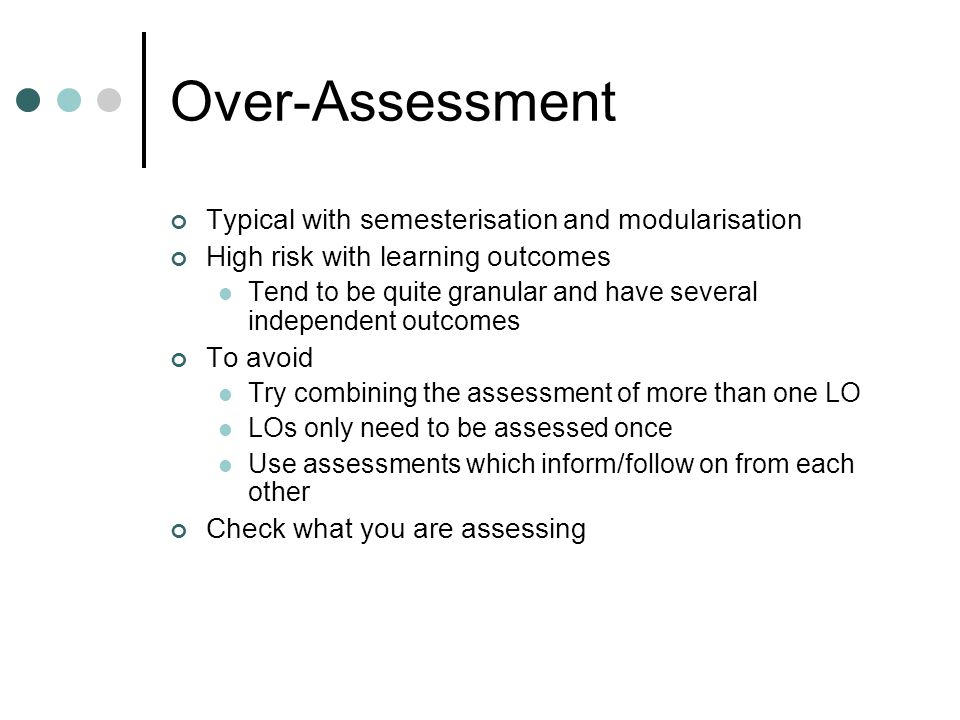
I'm a believer of Continuous Assessment being continuous (the notion of "repeating" a CA drives me mad!). By this I mean that it should be on a regular basis. It's hard work keeping up with weekly lab assessments, but I feel students get more out of it by building on their learning, and building up their grades on a weekly basis. But where should the line be before I cross over into over-assessment? If students are constantly under delivery deadlines (and the threat of penalties if they miss them), where do they find time to experiment, read extra material, examine case studies, take a break, and of course - prepare for exams? A single assignment, and a single exam seems to be the norm in many modules. This is great if you can use them to assess separate Learning Outcome, but it does not always happen that there is a neat division between Learning Outcomes. Designing assessments can be difficult because it is hard to get the balance right. Reducing the number of assessments takes the pressure off students, but we still need to ensure that the Learning Outcomes are assessed adequately. 

Here's a copy of a slide from a presentation by Jean Hughes (Office of the Vice President for Learning Innovation in DCU) relating to over-assessment, with some good tips to avoid over assessing students

Image source: Slide Player.


My thoughts - no one else's.

Sunday, June 10, 2018

Aghowle Medieval Church

Looking north towards the Wicklow mountains from the front door of our house in Ballingate where I grew up, the hill of Aghowle looms large. Despite many years looking across Co Wicklow I had never gone over. My Dad Joe told me about the ruins of a medieval church located there - so yesterday we finally went over in glorious sunshine to check it out.

We found the church easily enough, even though the broken signpost was hidden by weeds at the side of the road. An OPW sign at the site told us that while none of the original monastery remains, it was thought that St Finian from Westmeath had established a monastery there in the 6th century. The ruins you see below date from the mid 12th century - incredible that they are still standing tall (over 10 metres) over 900 years later. 

There are a lot of very old graves dating from the late 1700s according to the headstones. This includes the headstone in beside the ruins where Owen Griffin has lain since 4th April, 1784. There are a handful of burials this century - a more peaceful place to rest cannot be found. There is a beautiful Celtic Cross - I'm surprised it has not been stolen. The most common surnames in the cemetery are Byrne, Doyle, and Keogh/Kehoe. Many headstones pay devotion to Our Lady of Lourdes - there is also some candles and small statues to Our Lady in an alcove that have recently been put there. Later we adjourned to the nearby Crab Lane pub - neither of us had been in it before. A cool beer on a hot day in Aghowle tasted excellent!


Wednesday, June 06, 2018

Death while in class #BobbyKennedy #memories

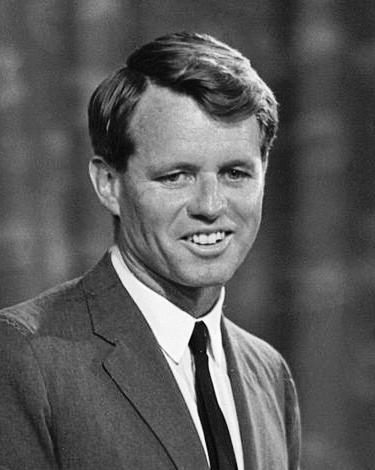
Bobby Kennedy.
Image source: Wikipedia.
On this day, 6th June 1968, I was 8 years old and in 3rd class at Carnew National School. Our classroom was a pre-fab building, and our teacher was a Mr Hennessy (what a pity I cannot remember his first name, he had a cool green MG sports car!). There's no way I would have remembered anything about this day except that it was the day that Bobby Kennedy was shot dead in far away Los Angeles. 

Around mid morning, a girl from another class suddenly came into our classroom to tell us that Bobby had been shot, but was still alive. We were all old enough to know who he was. I don't recall if our teacher got us to pray for him, or even if we talked about him. About an hour later, the same girl came to our classroom again and told us that he was dead. Breaking news the old-fashioned way!  The moment was not lost on us little 8 year olds - it was a tragic but historic interruption of our education on a typical day in school.

Bobby Kennedy was just 42 years old when he was murdered. He may never have become President of the United States - who knows even if he would have won the Democratic nomination or beaten Richard Nixon in the 1968 election. To a lot of us, he will always be simply Jack's younger brother. His toothy black and white image is seared on our brains with an "Only the good die young" message to remind us of who he was. 

Fuck you Sirhan Bishara Sirhan, fuck you.

Tuesday, June 05, 2018

Visiting Belfast #NoBorder

This past weekend I had the pleasure of visiting Belfast once again - since my daughter Vicki went to College there I have been a regular visitor, and I love it. This weekend we went to the Giant's Causeway and a drive around the Causeway Coastal Route. I had last travelled this route on my bike in 2014. 

Brexit casts a shadow from far-away London over Northern Ireland. Some welcome this shadow, while others dread the day next year when the UK leaves the European Union. While Northern Ireland voted 56% Remain and 44% Leave - it will leave the EU along with the mostly grey English vote who have had enough of Europe. Along with many people in Ireland I cannot understand the Brexit vote, and the national self-destruction it brings (from my eye). While driving across the border on the way to Belfast, and later on the way home to Dublin - the borderless border somehow feels natural. In a sense, driving from Co Armagh into Co Louth, feels like driving from Co Wicklow to Co Wexford - only a sign tells you that the two places have different names. 

Along with everyone else, I await the solution that the Oxford/Cambridge trained minds of the UK Government and Civil Service will eventually come up with. I truly believe that some of the smartest people in the world must be able to come up with a solution that works for everybody. The UK government does not yet seem capable of deciding what is best for the UK - but I am hopeful they will. Any kind of border between our two parts in this island must be avoided - but it seems increasingly impossible. I fear for the future and the return of the days when I feel that visiting Belfast will become a memory.

What would Fionn Mac Cumhaill think?