Saturday, June 29, 2019

Chicago to Springfield, Route 66 - Day 2

At last we got on the road - not quite Route 66 as we first had to get out of Chicago. I am delighted with our bike, a Harley-Davidson Electra Glide. This is a great bike for passengers as it’s rear seat is like an arm chair. I like it too, and had great fun on it today. We stopped to visit many Route 66 sites such as Dicks On, Launching Pad, Dwight Petrol station, and the Pontiac museum. Lots of photo opportunities some of which I’ve added below. My GoPro is working great and taking good quality photos and videos. However, our Cardo rider/passenger communication system did not get off to a good start. My headset works OK, but Roma’s is not designed for a half helmet. Insulation tape to the rescue!

So - what is Route 66 like after first day? Really great! So far no regrets in taking on this long journey. Already we can tell that our group are a great bunch to travel with. Our patience was tested today with a half hour long delay coming to Springfield due to some maintenance on the motorway. But we covered the 200+ miles on motorway plus sections of the original Route 66 - there is not much of it left in this first section of our journey. We came close to two thunder storms, but managed to slip by without need to stop and put on wet gear. Our guides, Jan and Jennifer, are knowledgeable and professional - it already feels like we are the first ever group they ever took out, such is their enthusiasm to see that we have a good time.

This evening we arrived in Springfield - birth place of Abraham Lincoln. You can’t miss him - he is everywhere! I would dearly love to spend time here to study his legacy further, but perhaps another time. This is a bike trip, not a history journey!

Here are some photos from today... 

At the Pontiac Museum.

Launching Pad. 

Baby you can drive my car!

Anyone for a fill up?

Dicks On!


Who’s that with Eugene and Roma?


Thursday, June 27, 2019

Eugene & Roma Do Route 66 - Day 1

Wow - Day 1 of our trip has finally arrived. Is is a non-travel day, but it serves to meet and greet our group for the next 15 days, and go through an Induction Session at 16:00 in the afternoon. As we arrived on Tuesday, we had Wednesday and part of today to check out Chicago - where of course Route 66 starts (or ends).

We travelled downtown and had a great day checking out The Loop and all the tall buildings - plus having a beer or two. We took a water boat tour around the Chicago River which was very information and fun. We also attended a free outdoor concert in Millenium Park - lovely Strauss music. However, it started to rain after about 45 minutes and we had to seek shelter in a nearby restaurant. 

At our Induction meeting we met Jan and Jennifer who will be our guides, plus the 12 other members of our group. Everything was well explained to us - so far, it is very organized. We got new biker jackets too! We are the only Irish people in the group - others are from UK, Germany, Australia, New Zealand, and the United States. All seem our age or just a little younger, and all bar one are already Harley-Davidson riders. A very mixed and experienced group. So - a really good start, and I can’t wait to get on the bike tomorrow.

Some photos of the day - sorry, no bikes so far! 


Monday, June 24, 2019

Two Weeks of Learning

I think most of us will have some sort of Bucket List. I am certainly fulfilling many items at once when I ride Route 66 starting on Friday this week. Many people would regard riding Route 66 as the trip of a lifetime - while I hope that it is fantastic, I still hope that there might be other trips of a lifetime still to make! But as an educator I like to think about how and what we can learn from Bucket List experiences.

First of all - I certainly do not consider a Bucket List as a box ticking exercise. Route 66 is a 2,807 miles, my longest ever ride was from Dublin to Almancil in Portugal, which was 3,210 miles including return trip, in the summer of 2005. I rode almost non-stop and it took me four days (including the ferry from Rosslare to Roscoff in France). I did not learn too much about this trip because I stuck to motorways - it can get boring riding a bike from early morning to early evening stopping only at motorway service stations. While Route 66 is a bit shorter, it will take us 13 days to ride - so plenty of stops and sights to see, and a lot of opportunity to learn. Nowadays of course we have phones and cameras to record anything we want. This helps us to recall what we have done much better than before - it's almost like taking notes in class. I have been to the Grand Canyon in the year 2000, but only have a few photos taken with a film camera to remind me of what it was like. We will be stopping at the Grand Canyon on the Route 66 trip, and I hope to learn a lot more this time.

Posing at the Grand Canyon (2000)
I think one of the things I'm looking forward to most is learning about what Americans call the "Mother Road" or "Main Street of America". We will also be in a group of riders from all over the world - so lots of opportunity to learn from fellow motorcycle and travel enthusiasts. 

So - in addition Route 66 being both a "trip of a lifetime" and being on my "bucket list", it will also be two weeks of learning!

Friday, June 21, 2019

Route 66

This day next week Roma and I will be setting out on our long awaited trip across America on Route 66 from Chicago to Los Angeles. It is a two-week guided tour with EagleRider for all 2,807 miles (4,491.2 km to those folks in metric land). It will be 12 days of riding for an average of 233 miles per day with lots of stops. Here's the route map provided by EagleRider:

Image source: EagleRider.
From the EagleRider website:

Route 66 crosses three time zones and 8 States: Illinois, Missouri, Kansas, Oklahoma, Texas, New Mexico, Arizona and California. Route 66 has been the path of migrants, dreamers, desperadoes and an entire generation of vacationers discovering the way west. The 1950's were the Route 66 glory days, when thousands of cars rode bumper to bumper behind each other to experience the Western frontier. Hotels, motels, gas stations, classic restaurants, and the "New" America sprang up everywhere. Much of Route 66's classic roads, restaurants, gas stations, and nostalgic landmarks are preserved just as they were in the 1950’s. The famous and nostalgic Route 66 is the road created in heaven for motorcycle touring. Simply stated, this is the guided tour of America!

Wow - that's a great appetiser for what many regard as a trip of a lifetime! To get in the mood, here's The Rolling Stones live in 1976 "Get Your Kicks On Route 66"!


Friday, June 14, 2019

How To... Create an Overlapping Histogram in Excel @YouTube

Histograms are useful tools to visualise the distribution of data. They are very often associated with bell-shaped curves to illustrate if data are normally distributed (or not). Excel has simple to use tools to draw a histogram based on a single variable - if you have two data sets, you can draw two histograms and compare. While this works in a lot of cases, sometimes it is useful to be able to draw a single diagram which contains two or more distributions, so that you can see where the distributions overlap.

To create overlapping histograms in Excel you need to know how to use Pivot Tables, but they are easy to use and allows us to draw overlapping histograms with ease. I have published a new video today showing how to to this step-by-step. Enjoy!

Wednesday, June 12, 2019

10 Video trends you should know about via @panopto

Recently at the EdTech 2019 Conference I got chatting to one of the Exhibitors (Panopto) about video in the classroom and how it is used as a learning resource to enhance the student learning experience. Panopto has commissioned an interesting survey (based on 500 students in 135 UK colleges, so good sample size) - details of the results can be found on Panopto's website here.

Amongst the interesting findings of this survey is that:
  • 90% of students agreed or strongly agreed that technology improves their ability to learn
  • 92% found recorded lectures useful
  • 78% were already using the likes of YouTube and Vimeo to teach themselves 
It's not really surprising that the figures above are so high. It might be a bit worrying for educators and College authorities that so much of their students' learning is taking place outside the classroom, but I would not agree with this. Most learning takes place outside the class anyway - in my time as a student in the late 1970s and early 1980s, when there was no learning technology, I spent more time in the Library than in class.

Breaking down the 78% figure above for students using video to teach themselves:
  • 52% use video to help with coursework/assignments
  • 28% to research the college application process
  • 23% use video to learn a new language
Interestingly, Panopto's survey found that 33% of students had been given "How To..." tutorial videos by their lecturers - doubling in one year. It's not clear if the videos were made by the lecturers themselves or by third parties. 

We are truly in the age of the flipped classroom and the trend of students seeking out educational resources for themselves will certainly continue. We as educators have a responsibility to provide appropriate guidance to third-party resources, and to get equipped to create our own video resources. More and more classes are being recorded (all NCI's on-line classes are recorded in Adobe Connect). While this will raise many issues for lecturers, it will overtake the classroom in the not too distant future.

Source: All figures quoted about are taken from Video Trends You Should Know About That Enhance The Student Learning Experience. A full copy of Panopto's Infographic summarising the results of their survey can be found here.

Tuesday, June 11, 2019

Copyright - Time to get it right

Copyright
Source:
Wikimedia Commons.
Last week I posted about "Copyright and Third Party Data" - there is a heightened awareness about re-using data that is not your own and that is publicly available. I will strive to acknowledge all sources of data that I use in my classes and try as far as is possible to use only data that I have permission to do so.

The thought has also struck me that this rule should apply to all other third-party resources. For example, it has long been my habit to add images to my module resources such as PowerPoint slides. Usually I show the link where I "sourced" the image, though often I am simply referring to a page which in turn has not acknowledged the original source. Sometimes I use such images for explaining concepts, other times it is simply to fill up blank spaces on a slide or to make the slide look prettier (or at least - less dull). I also used many images that are not my own in this blog, for several years now I have always indicated the source - but this is not enough. It does result in me using images that I do not have permission to do so.

Google always warns us when we do an image search that "Images may be subject to copyright". Google also has a very useful page What is "Copyright"? - well worth reading for anyone not sure about copyright.

Hopefully my practice from now on is to only use images when it is clear that I have permission to do so. Wikimedia Commons is great for this as everything there is open source. There are many other sources of free images, but most seem to be copyrighted. It is a good idea to follow this practice. Not many students read this blog, but it would be hypocritical for me to flout copyright laws while at the same time preaching in class how important it is. 

Friday, June 07, 2019

Copyright and Third Party Data #analytics

Can you use material on the Internet for personal just because it is there? For example, if someone posts a data file on a web page (eg, on GitHub), is it OK for me to use it without asking permission? Can I use it to explain a data analysis concept in class? Can I share it with my students? Can I use it in an assignment, or an exam?

This past year I have used several data sets that I searched the World Wide Web for. I always acknowledge the source in my lecture notes when I can. One data set I used in a class last year was based on Body Dimensions (Heinz et al, 2003)*. Try an exact match search for the file name: "bdims.csv", and you will see several locations where this file can be downloaded. The Journal in which this data set was published does not hold copyright over the material published in the Journal, and warns researchers to get separate permission from the authors. So I emailed the lead author (Professor Grete Heinz) to seek permission to use her data set, and she kindly responded that I could. Should I have to do this for every data set that I use? Will I get a response from everyone?

Sometimes permission is granted on the web page where the data is made available. For example: Fingal County Council here in Dublin have an Open Data policy and advise users of the data of the following:

Citizens are free to access and use this data as they wish, free of charge, in accordance with the Creative Commons Attribution 4.0 International License external link (CC-BY).

Another great example is from our Central Statistics Office:

CSO Publications: Rights and Permissions

  • Statistics disseminated on this site are copyright of The Government of Ireland.
  • The statistics and other information provided on this site are accessible free of charge and licensed under Creative Commons Attribution (version 4.0 cc-by). Creative Commons logo‌
  • Reproduction is authorised subject to acknowledgement of the source

This heightened awareness is great, and many web sites now publish statements such as this so that users and researchers can be reassured that they are not stealing data. The vague area is when this is not specified even though it is intended. Nevertheless, I intend from now on that my students should acknowledge all sources of their data and where available cite permissions to use the data. This is good practice, though it does add an extra step for students to complete.


*Heinz G., Peterson, L. J., Johnson R. W., and Kerk, C. J. (2003). Exploring Relationships in Body Dimensions. Journal of Statistics Education 11(2).

Wednesday, June 05, 2019

Here Comes the Summer! #exams

It must be summer time - the Leaving and Junior Certificate exams start today. Despite the wet weather we have been having recently, the coverage of the start of the exams and the multitudes of advice being given - tells us all that summer is on the way. At the National College of Ireland exams were over a couple of weeks ago and should be most graded by now - again, a feeling of summer is in the air. Secondary school teachers are already off for the summer, with primary schools soon to follow. My summer holidays officially begin on 25th June, but for the next three weeks I am basically done for the 2018/2019 academic year.

June is a weird month for an academic - no classes and no exams to grade. Many of my third-level colleagues are writing papers and attending Conferences, but I am done with all that. Academic freedom is great - while there will be some work to do (we are reviewing some programmes), I hope to be able to do some planning for the next academic year. I will take the time to look back over some of my on-line class recordings - there's definite room for improvement here. I normally teach Project Management in the first semester - my module notes and resources definitely need updating. Throughout the academic year it almost always feels like there's a deadline every day - it's nice to get some quiet time during the year.

This past academic year was my 17th year in the College, and of course marks the completion of 34 semesters. I look forward to my 18th year which, though I'm not done yet, may very well be my last. I will reflect on the past year in a later post.

For all students starting the Junior and Leaving Cert exams today - good luck!

Friday, May 31, 2019

How YouTube support videos are used as part of cramming for exams - Presentation Slides #edtechIE19

I enjoyed presenting at EdTech 2019 in Dundalk IT yesterday - it must be one of the friendliest conferences going! Here is a copy of my slide presentation and abtract:


Abstract

Cramming for exams is a widespread phenomenon where students study almost non-stop just before an exam that’s coming up, but that they haven’t prepared fully for. This traditionally involves going through notes which are either provided by a teacher/instructor, or taken by the students themselves. Cramming is the opposite of the “Spacing Effect” which states that studied material spaced out over time will be remembered better when compared to when material is crammed together. While educators agree that cramming in a poor strategy for learning, it is still a strategy employed by many students. With the arrival of video websites, such as YouTube in 2005, there are many opportunities for modern day students to learn from short videos created by content developers for this purpose.

In this study, data for views, audience retention, and durations of on-line videos provided as support for Statistics modules are examined. The data show stark evidence of intense last-minute study where key videos are viewed in the 48-hour period before a scheduled exam takes place. Almost no views are recorded for the support videos throughout the semester or in the aftermath of an exam. Individual videos are linked to specific exam questions to show the cramming effect. Audience retention and average duration in the 48-hour period before an exam are compared with retention and duration outside this period. Overall, the results clearly indicate that on-line support videos are now part of the cramming phenomenon. No evidence of the spacing effect was found.

Thursday, May 23, 2019

Accents - Be Proud of Yours

I read with interest a recent post on Linkedin by Irene Contreras: "I DO have a foreign accent, so what?". Irene is from Venezuela but lives in USA and writes that she told that she had "a strong accent" so she started to "conceal it". She further writes that the results were "catastrophic" and that trying to hide her accent "wasn’t the solution; that became a new problem".

There's no doubt that we all have an accent! In Ireland we can tell which of our 32 counties a person comes from after hearing just one or two sentences - I'm sure it is the same all over the world. Some people are very self conscious about their accent and try to posh it up a bit. Most of us don't bother. 

I have been living on the south side (posh me?) since 1986. I was born and raised in South Co Wicklow near the Co Wexford border, and when I hear my own voice in recordings, I always think I sound like somebody who is from South Co Wicklow near the Co Wexford border. Apparently not - my family tell me that I am soooooo South Dublin with my accent! A bit of a mix I guess is what I have.

Many of my YouTube Channel viewers leave comments - mostly asking questions and thanking me for posting the video. I do get some negative comments, and very often these are related to my accent:
  • omg your accent is so annoying
  • shame about the accent, thumbs up if you agree
  • I really hate this guy's accent
  • FUCKING ACCENTS!!!
I also get some nice comments on my accent:
  • Are you from Ireland? Nice accent
  • Came for the content, stayed for the accent
  • The accent is everything man
  • Thanks! Your accent made this even more fun to listen to
  • I really enjoy Eugene's Irish accent. It makes learning fun again :D
You can't please everybody!

Thursday, May 16, 2019

Should students be forced to make presentations for assessment?

Image source: Clipart Library.
At this time or year many students are presenting their research results as part of their assessments. For many it is a traumatising experience - I regularly have nervous students in front of me who are terrified of losing marks. We are often told that fear of public speaking is one of the most common of all phobias - yet we (academia) insist on putting students through this experience/torture. And then we grade them!

Anna Fazackerley, writing in The Guardian, asks the question about public speaking: "is the push to make students employable going too far?". Employers often emphasise the importance of communication skills, and it is good to be able to present to colleagues, management, and clients in the work environment. But what about students who suffer from anxiety or other mental conditions - is if fair to force students to present? Mark Twain is quoted as having said: “There are two types of speakers: Those who get nervous and those who are liars”. I think it is fair to say that we all get nervous when presenting. Some people are naturally confident, while others do it for a living (eg - Lecturers such as me). Forcing students to present even for 5 minutes can be daunting - most in my experience get through it and I always try my best to get students to be as relaxed as possible.

Fazackerley, in her Guardian article, writes about efforts at Bristol University to offer "presentation coaching, starting with small exercises and building confidence until students feel they can tackle a whole presentation, and that to begin with, "students practise public speaking as part of a group". Help is available, so students should consider this if they are faced with the prospect of a presentation that they are anxious or worried about. 

Monday, May 13, 2019

"Absolute Confidence" # Statistics #Analytics

Tim Healy writes in The Irish Independent that a US laboratory confirms it will appeal landmark judgement in Ruth Morrissey cervical cancer case. I have no argument with the results of the case or the award made by the court - my comment here is based on statistical probability. However, an intriguing aspect of the judgement is that the Judge ruled that laboratories should have "absolute confidence" in their results.

Is there such a thing as "absolute confidence"? Well - yes, there is. We will all die, night follows day, and so on. But could there be "absolute confidence" in smear or any other tests? The answer is theoretically "Yes", but practically "No". The reason is that in statistics, we make inferences about populations using samples (think of a poll before an election). For example, we accept that Paracetamol is an effective cure for pain in humans - but does it work in all cases for all humans? We can't know that unless we test every single person in the world - an expensive and impractical idea. All we can do is conduct clinical trials on a sample of the population and make inferences about the population using the results. Because it is a sample, we cannot be certain of the result - hence there is always uncertainty in experiments that do not involve the entire population. What we can say is that we are confident of the result - 95% or 99% confidence is often an acceptable level of confidence in statistics.

Without wishing to diminish the awful cases that some people have endured due to misread results, there is uncertainty in almost everything that we do. In 2018, 149  people lost their lives on Ireland's roads - there is a risk that you will die every time you use our roads. Thankfully, this is a small risk - 149 deaths from a population of 4,857,000 (Estimate: April 2018, CSO) - this translates into a 0.003% chance of being killed on our roads. While this is a tiny risk, it does mean that our roads are not safe for everyone. A 0.003% of being killed also means that you have a 99.997% of not being killed.

Is 99% confidence enough? Would you get on a plane if you were 99% certain that it would not crash? According to FlightAware, there is an average of "9,728 planes, carrying 1,270,406 people, in the sky at any given time". If 99% of these were safe, this means that 9,631 would be safe - but 97 would not be safe. That's a lot! What about 99.9% safety? 9,718 would be safe, but 10 would be unsafe. Only at 99.9999% would you get an acceptable safety level - 9,727.99 out of 9,728 flights would be safe. Still a tiny chance, but enough for us to get on a plane. Crucially, even at 99.9999% we cannot have "absolute confidence".

Tuesday, May 07, 2019

A blast-from-the-past

Out of the blue today I received a link to an old video in which I featured but had never seen. In my previous job at CBT Systems/SmartForce in the late 1990s, I was a Product Manager and my first big job was to manage the creation of a suite of Novell Certification courses (then only available on CD-ROM or floppy diskettes). One of the courses was "NDS Design (532)" and I was sent to Provo in Utah to participate in this course delivered by Bob King (who put the video on YouTube last month and sent me the link). It was a three day course and a camera crew came in to the Novell offices to shoot some footage to promote the new course. I had completely forgotten about this. I'm guessing this was done in 1996 - at the time the company was called CBT Systems (which in turn became SmartForce in 1999). I am even seen wearing a CBT Systems t-shirt in the video, and of course I look a lot younger then than I do now.

Here's the video, I am featured at 3:36, 4:45, and 6:05

Thursday, May 02, 2019

How many toilets do you need in a Theatre? #MoreLoos #LittlesLaw

Joanna Lumley.
Image source: Irish Independent.
I read with interest an article by Sinéad Ryan in yesterday's Irish Independent: "Biggest drama in theatre is getting to loos". She had attended an event in a community hall where there were "just two cubicles for a room holding 300 people". As a man I have had rarely needed to queue to use the loo in places such as theatres, arenas, or public places - there is a definite anatomical advantage to being male when it comes to time for a pee. "Joanna Lumley won’t take shortage of ladies’ loos sitting down" writes Rebecca Nicholson in The Guardian newspaper - the lovely Joanna has launched a "More Loos" campaign and says that the "ladies are about to storm the men’s loos. They can’t manage to have a drink and a waz at half time"! In her article, Sinéad Ryan uses our own Abbey Theatre which has been criticised recently for its lack of loos for women. 

So how many loos are needed to satisfy demand?

Prof John Little.
Image source: MIT Sloan.
Fortunately, there is a formula for working these things out. In 1961, Professor John Little of MIT published what became to be known as Little's Law. This law illustrates the mathematical relationship between throughput, work-in-progress (WIP), and cycle time. Let's use Dublin's Abbey Theatre as an example to work out how many toilets for women are needed during a 20 minute interval in the middle of a show.

The capacity of the Abbey Theatre is currently 492 seats - let's assume for simplicity that at a typical performance that 50% of the attendance are female. This means that there would be 246 women at each performance. This is our WIP (demand for toilets). The throughput is the length of the interval time - in this case 20 minutes. Finally, let's assume that on average, each woman spends 3 minutes in the toilet cubicle, and that there are 10 cubicles available (I don't know exact figure as I have never been in the ladies' toilets in the Abbey!).

In summary:

    WIP (Demand for toilets) = 246 women
    Throughput time = 20 minutes
    Work content = 3 minutes

First - we need to calculate the cycle time:

        Cycle time = Throughput = 20 = 0.08 minutes
                    WIP      246

Next - calculate the number of toilets required :

        # toilets required = Work content =  3  = 37.5 toilets
                         Cycle Time    0.08

There are not enough toilets to deal with demand since as 37.5 (say 38) are required. Given that the work content (the time taken to use the loo) cannot realistically be shortened, nor WIP (demand for the loo) be reduced, then what are the options?

  1. More toilets - 38 to cover demand
  2. A longer interval:
     (New) cycle time = Work content =  3  = 0.3
                         # toilets     10


Throughput time = WIP x Cycle time = 246 x 0.03 = 73.8 minutes. The interval would need to be 74 minutes long to ensure that all demand was met.

Wednesday, May 01, 2019

Why don't An Post use eircode?

I took a delivery this morning from An Post for a new book purchased from Amazon - I'm delighted that they use our national postal service to deliver our parcels. No doubt that this is contributing a significant part of An Post's business - see "Profits at An Post surge by 400pc while it closes offices" announced today.

But what really surprised me was that the delivery man called me from his phone as he approached our street - I could see him through our front window. I take particular care to ensure that my address is full and accurate - plus I now always add my postcode/eircode. It turned out that the printing on my parcel label was very close to the edge, and the driver could not tell if my house number was "2", or "12", or "22" and so on. I also know that these drivers are under tremendous pressure to deliver quickly, so no doubt he was saving himself some time to avoid checking every house on our street that has a "2" in the address. When he got to my door I asked him could he not have used the eircode (which was on the label)? He said that while it is used in the sorting office it is "no use" to the drivers, and that the drivers "can't find anything" with the eircode. They do not have a navigation system that can use the eircode and bring them directly to the delivery address. They are still relying on the street address, and still have to use the phone if their is any ambiguity on the address label. 

Jaysus!

Friday, April 19, 2019

End of Semester - Phew!

Today, Good Friday, marks the end of Semester II this academic year - it was the 34th semester of my time at the National College of Ireland. As Easter is so late this year, our second Reading Week is actually next week - no classes or exams next week. It is always a relief to get through a semester - 13 weeks ago the end seemed so far away, but it has passed in a flash.

St John the Baptist, Blackrock.
Image source: Wikimedia.
I like to look back and reflect on a semester as I feel that I learn something new every time. This past semester I had four classes: two for Statistics, one for R Programming (on-line), and one for Data Visualization. The corresponding semester last year was very hectic, with most weeks being 50-60 hours. I made a decision this year to not do this - trying to keep it to less than 40 hours per week. While this greatly improved work-life balance, it did mean I had less time to prepare classes and grade assessments when compared to last year. I did feel less prepared for classes - even ones I had taught before. One of the things I have never been good at is preparing for classes in the shortest possible time.

I am still a rookie in the online delivery of classes - during last semester I had my second module to deliver on-line: R Programming. I was happy with the way the class went, and based of feedback from students they seemed to like to too. Much still to improve on - but I hope to get the opportunity to do more on-line education again next year.

The College is closed today and on Monday - so a nice end-of-semester break is welcome. Good Friday means choir in the mid-afternoon for me - at 3 o'clock I will be joining my colleagues at the Church of St John the Baptist in Blackrock for Good Friday prayers, before heading to Wexford for the weekend. I have a lot to be thankful for!

Tuesday, April 16, 2019

New Video: How To... Create a Simple Data Entry Form in Excel

It has been a while since I made a video based on Excel, so I am glad to be able to publish a new video showing how to create a data entry form in Excel. Many people are used to doing this in Microsoft Access, but very few people use Access compared to Excel. Fortunately, Excel make it easy to do - but it is not immediately obvious where to start. It can be awkward entering data into a sheet with many columns - a form makes this easier. This is the first of two videos on creating a data entry form...

Tuesday, April 09, 2019

New Video: How To... Calculate Spearman's Rank Correlation Coefficient (By Hand)

Last December I got a message on my YouTube channel as follows: "wrong formula! rookie mistake". Naturally I was concerned about this - I often get messages claiming that there are errors on my videos. The video was about how to calculate Spearman's Rank Correlation Coefficient by hand - it is a relatively easy calculation to do and is based on the difference in the rankings of two variables. However, the method I demonstrated had what are called "ties" (two or more values which are the same) - the formula that I used in the video should not be used when there are ties. A rookie mistake indeed! The video was only published in June 2018, but it proved popular as it racked up just over 16,000 views in less than 6 months - very good for a new video. I immediately took the video down from my channel - I did this by making it "Private" so that the 16,000 views would still count in my overall figures. This is cheating of course, but hey - they were still views!

My New Home Studio.
Yesterday I published an updated version - this time with no ties. Some data analysts/statisticians say that if there are only a few ties in a large data set that it does not matter, but the purists say to use a different formula - Kendall's Tau is the recommended one. I hope to do a video of this soon. 

The long delay in replacing the incorrect video was partly due to time pressure, and partly due to me wanting to experiment with my new GoPro camera. I set it up like a document reader and after many trials, I finally got the settings right. I also learned how to control this with my iPad - great for getting the size and settings such as resolution right. I could also start/pause/stop using the iPad. I feel that the quality was really excellent - the sound and video were fine. The GoPro picked up my voice OK, and it was able to focus on the worksheet no problem. I don't have sound proofing in my home office, which could be a problem in future. The GoPro microphone is so good that it is picking up noise from other rooms and from the road outside my house. I have to make recordings during quiet time.

So - finally corrected, here's my new video on how to calculate Spearman's Correlation Coefficient in data that does not have ties...

Monday, April 08, 2019

What does word spinning look like?

Here is my previous post "€8 a page - the price of cheating" put through the spinbot.com word-spinner, two posts for the price of one...!


News in the present Guardian that "US article factory firm targets new understudies through WhatsApp" does not by any means shock me - I'm certain paper factories have numerous cunning approaches to pull in the consideration of understudies who decide not to compose their very own expositions. What surprises me is the value, it is £7 per page (simply over €8). I had never referred to the expense as I clearly have no enthusiasm for completing this. 

So - what might an exposition with a guide of 2,000 words cost? As per the Howard Community College Library site page: 

For a page with 1 inch edges, 12 point Times New Roman text style, and insignificant separating components, a great principle guideline is 500 words for a solitary dispersed page and 250 words for a twofold divided page. 

A 2,000 word exposition would in this manner cost about £28 (€32.56) - exceptionally shoddy. No big surprise understudies are enticed. While most assignments will get a multi week's notice of the accommodation date, it isn't exceptional for understudies to postpone beginning their task until the last minute. At the cost of 5 or 6 pints they can get an exposition factory to take the necessary steps. I don't have the foggiest idea if any of my understudies in the course of recent years have utilized article factory administrations - I surely have never found anybody doing it, nor have I ever even had the smallest doubt. Either these administrations are great, or none of my understudies bamboozled - I want to believe that the last is valid! 

Exposition Mills is one of these administrations who guarantee to be "one of a kind" and who guarantee to give "just 100% literary theft free article papers". I can't help suspecting that one of the strategies they use is word turning (where programming can swap expressions of comparable importance to beat literary theft) - here's certain instances of sentences from their Essay page: 

We appreciate that in the present time of developments; clients want to gain admittance to the rendered administrations from anyplace. 

Regardless of you are in class or at play area, you can get to our administrations from anyplace. 

Regardless of whether you have one percent question that the task composing administration which is taking your well deserved cash from you would not work with an unwavering methodology, you should look for different choices. 

No one composes normally like this. While I have identified word turning previously, any indication of strange sentence development, as in the over three precedents, would quickly raise my doubts.

€8 a page - the price of cheating

News in today's Guardian that "US essay mill firm targets new students through WhatsApp" does not really surprise me - I'm sure essay mills have many clever ways to attract the attention of students who choose not to write their own essays. What does surprise me is the price, it is £7 per page (just over €8). I had never known the cost as I obviously have no interest in getting this done.

So - what would an essay with a guide of 2,000 words cost? According to the Howard Community College Library web page: 

For a page with 1 inch margins, 12 point Times New Roman font, and minimal spacing elements, a good rule of thumb is 500 words for a single spaced page and 250 words for a double spaced page.

A 2,000 word essay would therefore cost about £28 (€32.56) - very cheap. No wonder students are tempted. While most assignments will get several week's notice of the submission date, it is not uncommon for students to delay starting their assignment until the last moment. For the price of 5 or 6 pints they can get an essay mill to do the work instead. I don't know if any of my students over the past 17 years have used essay mill services - I certainly have never caught anyone doing it, nor have I ever even had the slightest suspicion. Either these services are very good, or none of my students cheated - I prefer to think that the latter is true!

Essay Mills is one of these services who claim to be "unique" and who promise to provide "only 100% plagiarism free essay papers". It seems to me that one of the tactics they use is word spinning (where software can swap words of similar meaning to beat plagiarism) - here's some examples of sentences from their Essay page: 

We comprehend that in the current era of innovations; customers desire to get access to the rendered services from anywhere.

No matter you are in class or at playground, you can access our services from anywhere.

Even if you have one percent doubt that the assignment writing service which is taking your hard earned money from you would not work with a faithful approach, you should seek other alternatives.

Nobody writes naturally like this. While I have detected word spinning before, any sign of weird sentence construction, as in the above three examples, would immediately raise my suspicions.

Saturday, April 06, 2019

Selling my Coin Collection

Today at the Whyte's Auction I sold almost my entire coin collection. I have been collecting coins since I was a boy and have enjoyed having them over the years. However, in recent years I have stopped purchasing coins at fairs and coin shops - I had really lost interest. Last September I went to Whyte's Auctioneers in Molesworth Street with a suitcase full of coins. The suitcase was divided into nine lots for the auction - some, such as the 1986 coin set below, sold for less than the guide price, but others, such as the box of collectibles below, made more than the guide price. While I felt a little sad at selling some coins I've had for over 40 years - I also felt it was time to let go. I hope whoever has bought them enjoys these coins.

I didn't expect to make a lot of money on coins over the years. Many of the official Mint sets I purchased were worth less than what I paid for them, and I am certain that I paid far more than the sales total that I received today. None of the individual coins or sets were rare or valuable - though the 1986 set below sold for €240 (it was estimated to sell for up to €400). 


Friday, April 05, 2019

12 Years on YouTube

This weekend 12 years ago I set up my YouTube Channel. This was just 7 months after Google bought YouTube (for $1.65 billion!) - YouTube was founded by  Jawed Karim, Steve Chen, and Chad Hurley on 14th February, 2005. It seems to have been around forever, and it has been part of my life for a long time.

My first video was published on 11th December 2007. It now seems very antiquated and very much out of date (it has just 6,436 views in 12 years). This was very much an experiment to use the (then) latest technology to view class notes created in PowerPoint. The quality compared to today is poor, everything was done as screen shots rather than video capture. Even the use of an iPod seems old - smartphones were not yet anything like as ubiquitous as today - the first iPhone was launched by Steve Jobs just over 5 months earlier on 29th June, 2007. I can remember having fun making this video and also having many "takes" before getting it right. There's no way I would have believed anyone if they told me that I would have 18.5 millions views on my channel 12 years later.

A little bit of nostalgia...

Friday, March 29, 2019

"59 year old farts" don't like Harley-Davidson's new electric bike #LiveWire

Here's news of something I thought I'd never see - Harley-Davidson have recently announced the launch of the LiveWire, a new electric bike. Petrol Heads everywhere must be both surprised and astonished that such an icon of American iron is embracing the electric era. This is what it looks like:

Image source: Clean Technica.

Apart from the Sportster like tank, this does not look like a Harley. No exhaust pipes (which means no noise) looks weird, and the "engine" looks like it wouldn't pull you out of your bed. However, this bike is not built for cruising on long journeys. For a start, it will do just 175 kms (110 miles) on a charge. There is no room for luggage, but I suspect many riders will like the instant acceleration that an electric "engine" gives plus not having to deal with gears. What riders won't like is the price tag, Dublin Harley-Davidson is quoting prices starting at a whopping €34,695 (pre-orders open in April) - that's more expensive that any new motorcycle (other than Trikes) that Harley-Davidson sells in Ireland.

The Beautifully Organised Blog gets it right for me when it quotes a rider called David Lutzow, of Pasadena. While he thinks that it is great for the environment that Harley-Davidson is going electric, he is not sure if it will "catch on". He says. "I think it will attract the younger people — they call them, what, millennials or whatever? I think it will attract that group, other than 59-year-old farts like myself." 

As a fellow 59-year-old "fart", give me the smell and noise of my Monster Ovals exhaust pipes and the rumble of my 1600 cc noisy engine any time!

Thursday, March 28, 2019

30 Years Ago - CBT Systems

On 28th March 1989 I walked though the doors of 39/40 Lower Mount Street in Dublin into my first "proper job" - my how the 30 years since have passed! The company was named "CBT Systems" - when I was interviewed for the job (with BB and TG) I did not know what "CBT" stood for - no Google in those days to look it up! CBT (Computer Based Training) Systems became SmartForce in 1997, which in turn was taken over by Skillsoft in 2002 when I left the company.

I remember that my first day was spent looking at the company's existing e-Learning courses, though it was not called e-Learning then. I remember that the product we (two others started the same days) looked at was called "Protocol 90" - a course on telecommunications that was the first big success for CBT Systems. We spent over a week training in a basement office before we were added to project teams.

One of my first business cards.
When I think back to the technology that we used then it amazes me how we got any work done. The PC I had was an early 1980s IBM 8086 with no hard drive - I was very excited to have a computer to myself to work with! It had two 5.5 inch floppy disk drives, the program we used (TenCORE) was on one disk, our work on the other. The operating system was MS-DOS. No network to back up our work - this was done at the end of the week by copying our work onto separate floppy disks which were taken off site. None of us had mobile phones, laptops, or our own computers at home at that time. 

I remember being very nervous on the first day, but I was put at ease straight away. No way would I have predicted that I would spend over 13 years in CBT Systems/SmartForce which involved moving from floppy disks to the dot com boom. Though it is now nearly 17 years since I left SmartForce I still have fond memories of the people and the work since my first day nervously knocking on the door of 39/40 Mount Street.

Tuesday, March 26, 2019

A New Leader @YouTube

For almost all the time since I published my How To...Create a Basic Gantt Chart in Excel 2010 in January 2011, it has been my most watched YouTube video. It was my first video to reach a million views , and to date it has 1,216,688 views. Earlier this year, my How To... Plot Multiple Data Sets on the Same Chart in Excel 2010 (published in April 2012) became my second video to reach a million views and just a few weeks ago it surpassed the Gantt chart video to take over as my most viewed video. Today it has reached 1,285,406 views. In both cases it has taken about six to seven years to reach the one million views landmark - not exactly "going viral", but figures I am proud of just the same. It is hard to create a YouTube "Hit" in the "How To..." space, a funny dog video might get a million views in just a day!

I have some plans for a new set of videos, but equipment and time are both short at the moment. I would love to do more Statistics By Hand videos but I no longer have access to an adequate document reader (I am experimenting with my new GoPro). I may also dip my toe into R Programming, and a bit more SPSS.

So here's to the new #1...!

Monday, March 25, 2019

Only snobs care about apostrophes

Image source: The Guardian.
The First Dog on the Moon cartoonist makes fun of apostrophe snobs in last week's guardian newspaper: Only snobs care about apostrophes: some correct and popular opinions. It's good fun and as a satirist, the First Dog is not really insulting people who insist on the correct use of apostrophes. I'm also sure he is not having a go at Irish surnames - many, like mine, have an apostrophe in them. I am a self-confessed apostrophe snob!

Beto O'Rourke
Image Source: Facebook.
Your name is one of your most precious things - and I always appreciate the effort that people make to get my surname right. The correct spelling of my family's surname is "O'Loughlin", not "Oloughlin", or "O Loughlin", or "Loughlin". The apostrophe is on all keyboards, just like other symbols and the rest of the alphabet. If people don't make the effort to get a surname right - in a way they are giving a mild insult. Leaving out the apostrophe is the most common error that people make when they get my name wrong. Would "John Smith" be insulted if the name omitted one character and was written as "John S ith"? 

Perhaps if there were more famous people who had an apostrophe, then people would get it right. I hope that Beto O'Rourke gets to be President of the United States - if only to show the world how an Irish name is spelt!

It is not snobbish to want your name spelt correctly - make the effort!

Tuesday, March 19, 2019

"Reading" Week

Today is the start of Reading Week - no classes for four days following yesterday's St Patrick's weekend Bank Holiday. It is a welcome break for me after eight weeks in a row of classes. Most of this week for me will be spent grading Continuous Assessments. I also have the remainder of the semester to plan - though just four more weeks to go. This semester was my first ever with three evening classes, so it will a little strange going back to 9 to 5 for the week.

Reading Week is not just a break from classes. For students it is an opportunity to catch up on study, work on projects, and most importantly to take a break from classes. For faculty it is an opportunity to catch up on grading and class preparation - for some it will be an opportunity to concentrate on research, and most importantly to take a break from classes too. With Easter being so late this year we do not have the opportunity to have two Reading Weeks, so we need to make the most of the break.

The question is - despite above comments, it is worth it? Even the name "Reading Week" suggests that a lot of academic work is being done. No doubt there is much work being done - especially for those students in their final year, or those taking a one year course. But is it the same for all? For me I think that since it was introduced in the College that the break aspect of the week has become most important as semester fatigue sets in. In the week before Reading Week I often note a slight drop in attendance - I guess this is not surprising as it also the lead into a Bank Holiday weekend.

I do hope that students find the time for both study and a rest this week, and set themselves up for the last push before exams start on 1st May. Reading Week - make the most of it!

Sunday, March 17, 2019

Being Irish and Native American on St Patrick's Day

So - I was born, reared, live, and will die in Ireland. In my family tree at Ancestry, as far as I can tell - all of my traced ancestors are Irish. So I guess that makes me 100% Irish? While I certainly feel 100% Irish, apparently this is not the case!

Some years ago I got my DNA assessed by the National Geographic's Genographic Project. Clearly it is tracing my DNA back a long time and the results show a mixed ancestry reflecting a mixed heritage. I am 2% Native American according to my results!


While the figures are very general, it does point out that everyone in the world today is linked in some way. In fact, the common direct maternal ancestor to all women alive today was born in East Africa around 180,000 years ago, and that the common direct paternal ancestor of all men alive today was born in Africa around 140,000 years ago. Not quite Adam and Eve as they lived 40,000 years apart and they were not the only man and woman alive at those times. But only their direct ancestors survive today.

I hope that some of my Native American cousins will celebrate St Patrick's Day today - perhaps even with a pint of the black stuff (which I plan to have later)!

Tuesday, March 12, 2019

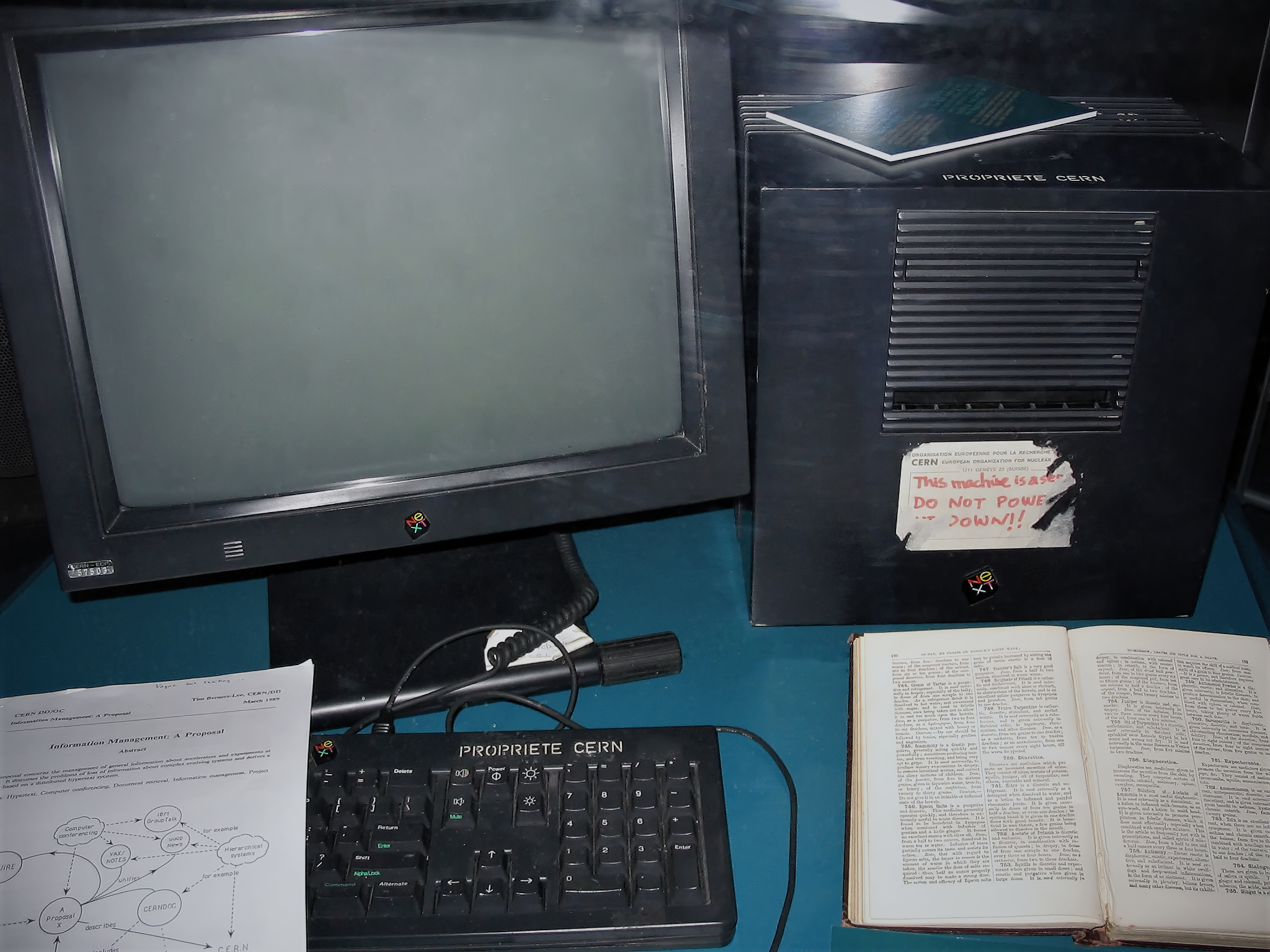
Happy 30th Birthday World Wide Web!

This NeXT Computer was used by Berners-Lee
at CERN and became the world's first web server.
Image credit: By Coolcaesar at the English language
Wikipedia, CC BY-SA 3.0,
https://commons.wikimedia.org/w/index.php?curid=395096
So - 30 years ago today in 1989, Tim Berners-Lee invented the World Wide Web - I was just starting my first proper job (in a company called CBT Systems, which later became SmartForce). Like almost everyone, I was oblivious as to what was going on - and certainly not aware of the impact this moment would have on our lives 30 years later. According to Wikipedia, the definition of what the World Wide Web is:

The World Wide Web, commonly known as the Web, is an information space where documents and other web resources are identified by Uniform Resource Locators, which may be interlinked by hypertext, and are accessible via the Internet.

Of course - very few people used the web in 1989. We didn't even have email (I got my first email address at the end of 1994). There was no wasting time looking up the latest news, or checking Facebook, or watching YouTube. I recall wasting time actually chatting with colleagues in the office!

In 1989, Computer Based Training (CBT) was in its infancy - all our courses were delivered on 5 1/2 inch floppy diskettes. Within 10 years we were delivering courses on the World Wide Web via the Internet. WWW made innovation possible on a scale none of us thought possible - but look at us now! Education has thrived with learners able to study at long distances learning almost any topic they want. One of the four modules I teach (R Programming) is on-line, with students from all over Ireland connecting with me as I sit in my office - a long way from a 5 1/2 inch floppy diskette!

A screen-shot from one of my on-line classes.


Wednesday, March 06, 2019

Jerry Merryman RIP

Jerry Merryman (1932-2019).
Image source: NBC News.
Until today, I did not know who Jerry Merryman was - it turns out he was one of the three men who invented the hand-held calculator. Sadly he died on 27th February last - one can say that he truly had an effect on people's lives.

I am reminded of the Intermediate (now Junior) Certificate exams in 1975 - I was 15 years old and calculators were allowed in State Maths exams for the first time in Ireland. If I recall correctly, there were just two boys in the whole exam hall who had calculators, one was in front of me. It seemed grossly unfair that some boys had calculators, while most of us did not - we had to use the old-fashioned Log Tables instead. The Department of Education quickly abandoned calculators in exams after this and they were not re-introduced for some years. 

Jerry Merryman and his colleagues certainly made life easier for anyone needing to carry out basic and advanced mathematical functions. Some argued when they were introduced that students would lose the ability to add and subtract. This may be so, but it frees up valuable time to study other things. 

Thursday, February 28, 2019

Hands Off Our Houses Mr Daly!

Minister Jim Daly.
Image source:
www.finegael.ie.
Much ado lately about old people being part of the housing crisis as they dare to live in their own large houses while homeless families live in hotels and emergency accommodation. While these families certainly have my sympathy, I object to the idea that I am part of the problem. Yes - I do live in a four-bedroom house and am currently only using one of those rooms. We raised our family in this house and paid for it over many years with money earned after tax had already been deducted.

Minister for Older People, Jim Daly, is examining ways for older people to "right-size to appropriately sized units" according to a report by Lorraine Courtney in last Thursday's Irish Independent: In this bad game of Monopoly, the young find they can't even pass Go. She quotes from an unpublished Housing Options for our Ageing Population policy statement which proposes new ways of dealing with the current crisis in housing.

Just what is a "right-sized unit"? Should I move from a 4 bedroom house to a 3 bedroom one, or 2, or 1, or a bedsit? Why not pack off all the over 55s into a gulag somewhere on their way to a nursing home in later life? I am sorry to inform the minister that the house I live in is the right size for me, and he can fuck off if he thinks that he can get inside my conscience and force me to give up my home. Am I being selfish?

Ireland's population is growing at about 60,000 per year. We have a thing about high rise buildings and not allowing them - the social disaster of the Ballymun Tower blocks in Dublin will stay in the mind for a long time. But other cities, such as Vancouver, can manage high rise and accommodate thousands of people in a small area - I was really struck by the number of tower apartment blocks in Vancouver city centre when visiting last year. I'm sure there are plenty of problems with these blocks, but if carefully planned I'm sure they would work here too.

The Minister is looking at easy targets such as the over 55s - but has he forgotten that we are the people who vote the most? Hands off our houses!

City of Vancouver.
Image source: The Georgia Straight.

Tuesday, February 26, 2019

"Get on with it!" #SnailTortoise

Image source: Celebrating the Ordinary.
Recently, I received a comment from a viewer on one of my YouTube video tutorials to "Come to the point". While comments on my channel are largely very positive, I do get occasional comments that I am going either too slow or too fast. Some also find my Irish accent hard to follow.

So - what is the right pace to deliver content at? It's obvious to all educators that students learn at different paces. Some get the point straight away, while others may leave at the end of class not understanding a thing. I often pause and check how students are getting on in my class - especially practical classes. When I walk around the class I always find that some students get the work done very quickly, while others may not have even started or have got stuck. This makes it difficult to pace a class - we can't go at a speed suitable to the fastest learner - equally it is is very difficult to go at the speed of the slowest learner.  In addition to this there are a lot of distractions in class - almost all my students have computers on during class, and it is obvious to me that some are checking email/messages (and even watching football!). 

It can be a bit frustrating to explain things again and again, but that's part of my job and I do it. I can also see and feel some frustration on the part of students who need to wait while others catch up. In my videos there is the option to fast-forward or rewind (an obvious thing for the author of the comment above to consider). I also have my on-line classes automatically recorded, but I've no sense yet if students find them useful. It is probably one of the biggest advantages that video has over the classroom - I'm certain that there are times in class when my students would like to hit Rewind/Pause/Fast Forward. Maybe even some would like to switch me off!