Tuesday, March 12, 2019

Happy 30th Birthday World Wide Web!

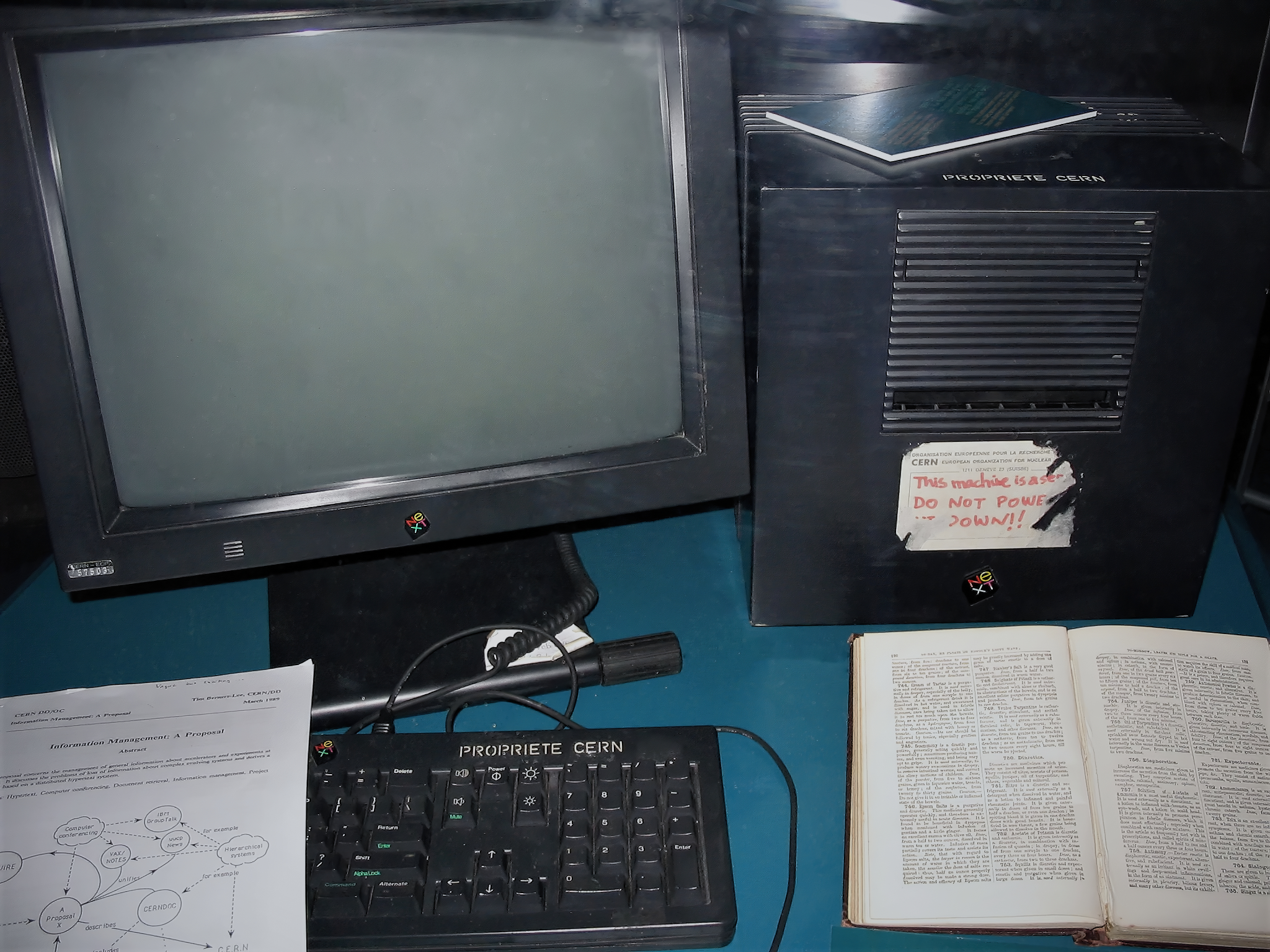
This NeXT Computer was used by Berners-Lee
at CERN and became the world's first web server.
Image credit: By Coolcaesar at the English language
Wikipedia, CC BY-SA 3.0,
https://commons.wikimedia.org/w/index.php?curid=395096
So - 30 years ago today in 1989, Tim Berners-Lee invented the World Wide Web - I was just starting my first proper job (in a company called CBT Systems, which later became SmartForce). Like almost everyone, I was oblivious as to what was going on - and certainly not aware of the impact this moment would have on our lives 30 years later. According to Wikipedia, the definition of what the World Wide Web is:

The World Wide Web, commonly known as the Web, is an information space where documents and other web resources are identified by Uniform Resource Locators, which may be interlinked by hypertext, and are accessible via the Internet.

Of course - very few people used the web in 1989. We didn't even have email (I got my first email address at the end of 1994). There was no wasting time looking up the latest news, or checking Facebook, or watching YouTube. I recall wasting time actually chatting with colleagues in the office!

In 1989, Computer Based Training (CBT) was in its infancy - all our courses were delivered on 5 1/2 inch floppy diskettes. Within 10 years we were delivering courses on the World Wide Web via the Internet. WWW made innovation possible on a scale none of us thought possible - but look at us now! Education has thrived with learners able to study at long distances learning almost any topic they want. One of the four modules I teach (R Programming) is on-line, with students from all over Ireland connecting with me as I sit in my office - a long way from a 5 1/2 inch floppy diskette!

A screen-shot from one of my on-line classes.


Wednesday, March 06, 2019

Jerry Merryman RIP

Jerry Merryman (1932-2019).
Image source: NBC News.
Until today, I did not know who Jerry Merryman was - it turns out he was one of the three men who invented the hand-held calculator. Sadly he died on 27th February last - one can say that he truly had an effect on people's lives.

I am reminded of the Intermediate (now Junior) Certificate exams in 1975 - I was 15 years old and calculators were allowed in State Maths exams for the first time in Ireland. If I recall correctly, there were just two boys in the whole exam hall who had calculators, one was in front of me. It seemed grossly unfair that some boys had calculators, while most of us did not - we had to use the old-fashioned Log Tables instead. The Department of Education quickly abandoned calculators in exams after this and they were not re-introduced for some years. 

Jerry Merryman and his colleagues certainly made life easier for anyone needing to carry out basic and advanced mathematical functions. Some argued when they were introduced that students would lose the ability to add and subtract. This may be so, but it frees up valuable time to study other things. 

Thursday, February 28, 2019

Hands Off Our Houses Mr Daly!

Minister Jim Daly.
Image source:
www.finegael.ie.
Much ado lately about old people being part of the housing crisis as they dare to live in their own large houses while homeless families live in hotels and emergency accommodation. While these families certainly have my sympathy, I object to the idea that I am part of the problem. Yes - I do live in a four-bedroom house and am currently only using one of those rooms. We raised our family in this house and paid for it over many years with money earned after tax had already been deducted.

Minister for Older People, Jim Daly, is examining ways for older people to "right-size to appropriately sized units" according to a report by Lorraine Courtney in last Thursday's Irish Independent: In this bad game of Monopoly, the young find they can't even pass Go. She quotes from an unpublished Housing Options for our Ageing Population policy statement which proposes new ways of dealing with the current crisis in housing.

Just what is a "right-sized unit"? Should I move from a 4 bedroom house to a 3 bedroom one, or 2, or 1, or a bedsit? Why not pack off all the over 55s into a gulag somewhere on their way to a nursing home in later life? I am sorry to inform the minister that the house I live in is the right size for me, and he can fuck off if he thinks that he can get inside my conscience and force me to give up my home. Am I being selfish?

Ireland's population is growing at about 60,000 per year. We have a thing about high rise buildings and not allowing them - the social disaster of the Ballymun Tower blocks in Dublin will stay in the mind for a long time. But other cities, such as Vancouver, can manage high rise and accommodate thousands of people in a small area - I was really struck by the number of tower apartment blocks in Vancouver city centre when visiting last year. I'm sure there are plenty of problems with these blocks, but if carefully planned I'm sure they would work here too.

The Minister is looking at easy targets such as the over 55s - but has he forgotten that we are the people who vote the most? Hands off our houses!

City of Vancouver.
Image source: The Georgia Straight.

Tuesday, February 26, 2019

"Get on with it!" #SnailTortoise

Image source: Celebrating the Ordinary.
Recently, I received a comment from a viewer on one of my YouTube video tutorials to "Come to the point". While comments on my channel are largely very positive, I do get occasional comments that I am going either too slow or too fast. Some also find my Irish accent hard to follow.

So - what is the right pace to deliver content at? It's obvious to all educators that students learn at different paces. Some get the point straight away, while others may leave at the end of class not understanding a thing. I often pause and check how students are getting on in my class - especially practical classes. When I walk around the class I always find that some students get the work done very quickly, while others may not have even started or have got stuck. This makes it difficult to pace a class - we can't go at a speed suitable to the fastest learner - equally it is is very difficult to go at the speed of the slowest learner.  In addition to this there are a lot of distractions in class - almost all my students have computers on during class, and it is obvious to me that some are checking email/messages (and even watching football!). 

It can be a bit frustrating to explain things again and again, but that's part of my job and I do it. I can also see and feel some frustration on the part of students who need to wait while others catch up. In my videos there is the option to fast-forward or rewind (an obvious thing for the author of the comment above to consider). I also have my on-line classes automatically recorded, but I've no sense yet if students find them useful. It is probably one of the biggest advantages that video has over the classroom - I'm certain that there are times in class when my students would like to hit Rewind/Pause/Fast Forward. Maybe even some would like to switch me off!

Thursday, February 21, 2019

Feedback as part of Learning #FeedBack, #FeedUp, #FeedForward

I am not often asked by students to give feedback on an exam paper - just a handful over the past few years. Almost always in my experience, when a student requests a feedback session they want to know "where did I lose marks". Students also may feel that they should have got a higher mark - and want to question their grade. My feedback experience with students is largely positive - most are satisfied with their grade once we go through their answers and marks awarded.

While reading the Science of Learning by the Deans for Impact earlier this week I noted that they place a huge emphasis on the benefits of feedback. For the cognitive principle "effective feedback is often essential to acquiring new knowledge and skills" - their advice relating to the practical implication for the classroom is:

Good feedback is: 

  • Specific and clear
  • Focused on the task rather than the student
  • Explanatory and focused on improvement rather than merely verifying performance

Sound advice indeed - I have found that most of my feedback sessions are focused on performance in an exam rather than on improvement. 

John Hattie and Helen Timperley of the University of Auckland (2007) proposed a model of feedback to enhance learning:

Source: Columbia University.
This model encourages "Feed Up" and "Feed Forward" as well as "Feed Back" - the purpose of which is to "reduce discrepancies between current understanding/performance and a desired goal". The model is very much forward looking and is much more than "where did I lose marks". In a way it is a pity that an individual feedback session is not done automatically for all students. We do it for continuous assessment - my practice is to give general feedback in class and offer students the opportunity to request further feedback if they want to (but only a handful do). But most students will want to move on after end of semester exams. Almost always it is about a month between sitting an exam and getting results - feedback will lose its value after such a long time. There are also practical implications restricting individual feedback for all - think of how long it would take to do for a class of 50 students!

Wednesday, February 20, 2019

YouTube Channel Coming of Age #18000000

My YouTube channel has grown up this week as it passed the 18 million views mark (18,008,943 today to be precise). Once again I am both delighted and humbled that so many people take the time to view my videos. The channel is still growing as shown in the Lifetime chart below:

Click/Tap image to enlarge.

The channel is firmly on the road to recovery after the disaster of May 2015 (when I changed metadata). I fully expect it to pass 20,000,000 views well before the end of the year. The United States still dominates the percentage of views (34%) but this is declining steadily when compared to other countries (India now ranked second with 11% of overall views). Ireland accounts for just 1.2% of overall views. The top 11 countries for percentage views are as follows:


Onward and upwards!

Tuesday, February 19, 2019

Fluency in the science of learning

In a job advertisement I saw on LinkedIn today (no - I'm not looking for a different job!) for a Learning and Leadership Development Manager in Accenture, I came across the following requirement:

You Might Also Have: 
  • Fluency in the science of learning
In what was an interesting job advert - this stuck out, and I wondered what it meant. I Googled this exact sentence, but just got lots of websites advertising the same job. It seems to me to be a new expression written by the clever folks at Accenture - and I love it!

The Science of Learning can be described in many ways. In an interesting short paper by the Deans of Impact in 2015*, a summary of the "existing research from cognitive science related to how students learn, and connect this research to its practical implications for teaching and learning" is provided. They write that the Science of Learning is based on six questions:

  1. How do students understand new ideas?
  2. How do students learn and retain new information?
  3. How do students solve problems?
  4. How does learning transfer to new situations in or outside of the classroom?
  5. What motivates students to learn?
  6. What are common misconceptions about how students think and learn?

For each question, the answers are divided into Cognitive Principles, and Practical Implications for the Classroom. For example, in question 1 for the cognitive principle...

  • Students learn new ideas by reference to ideas they already know

... one of the practical implications is advice to provide...

  • A well-sequenced curriculum is important to ensure that students have the prior knowledge they need to master new ideas

For anyone involved in Learning and Teaching, "fluency" in the above six questions focused on students, plus their answers, is a must. The Deans for Impact paper shows educators that there is more to the Science of Learning than just turning up in class and hoping for the best.

*Deans for Impact (2015). The Science of Learning. Austin, TX: Deans for Impact. 


Friday, February 15, 2019

STEM with Arts #STEAM

Image source: Urban Gateways.
An interesting thought in the Guardian, 'Universities stamp out creativity': are graduates ready for work?, from Julie Ward, Labour MEP for north-west England. She stresses the importance of including arts in the emphasis on science, technology, engineering and mathematics (STEM) as key subjects, so that "Stem becomes Steam". She quite rightly (IMHO) points out that parents who advised their children that "taking arts subjects would harm their job prospects were making a mistake". So would it be a good idea to take Arts subjects in a technology degree?

Steve Jobs famously took up calligraphy before dropping out of Reed College in Portland, Oregon  - the story goes that became fascinated by school’s handmade signs, and carried this forward into designing fonts for the Mac. What Arts module(s) would enhance a technology degree? I would favour a plan where one (or more) modules in 1st or 2nd year could be any Elective Arts subject. For example - how about a module on "Text Analysis and Sight-Reading" in Trinity's Diploma in Acting and Theatre, or the "Nature of Morality" in the BA in Philosophy? If a College does not offer Arts programmes, why not let students attend such a module in another University/College/Online, and get the necessary credits, plus the "A" in "STEAM"? A whole new world could be opened up for students in technology degrees who even in first year are pigeon-holed into a path that involves programming, databases, web development, cloud computing, data analytics, etc. Why not add classic Greek as a language?

Creativity and curiosity will be important skills in the workplace of the future, and it must be cultivated more amongst students. Without it employers are increasingly finding themselves in a bind as they require qualifications, but also want graduates to be good at problem-solving - they will demand creativity. Perhaps putting the "A" into STEM will achieve this?

Thursday, February 14, 2019

New Data from the Higher Education Authority #NonCompletion #Analytics

The HEA have produced a major study on An Analysis of Completion in Irish Higher Education: 2007/08 Entrants, which makes for interesting reading. As with many HEA reports there is a lot of detail and mountains of data (this report is 220 pages long!). It does not include the National College of Ireland nor the likes of the Dublin Business School which is a big pity and a major omission in my view. 

Out of this report, Katherine Donnelly of the Irish Independent headlines her report today with "Tech courses are toughest to finish in college". While this may be true, the report digs a lot deeper than a one-liner in the paper. The report divides up the HEA sector into three categories: Colleges (not including NCI), Institutes of Technology, and Universities. Data on levels 6 and 7 for Colleges and Universities is not included - presumably because they don't offer courses under level 8 (honours degree level). 

Non-completion (a fancy word for dropout) rates in Colleges are at 6%, in ITs it is 34%, and in Universities it is 17%. The overall non-completion rate at level 8 is 18% (34,059 students in total) - this is a lot lower than the headline figures being given on radio news this morning.  The lowest non-completion rate is 3% in St. Patrick’s College, Drumcondra (606 students) - while the highest is 39% at IT Tallaght (605 students), clearly an unusual statistic for institutions with an almost identical number of students - see chart below:

Source: HEA.


Perhaps of more interest to me was the headline figure of 46% non-completion rate in the Computing area. Schools of Computing across the land cannot hide from these figures - here's the HEA's chart for all institutions and also for all levels:

Source: HEA.
Technical courses are indeed challenging, and the HEA point to the Mathematics component of Computing courses as a possible reason for non-completion. The image of working in IT of creating best-selling games, killer apps, and making a lot of money with the potential of becoming a multi-millionaire is a strong one, but this is not going to happen until you learn some Maths and Programming. The HEA report also suggests a strong link between CAO points and non-completion rates - perhaps we are letting some students on low points onto courses they are not yet able for.

I do see lower numbers of students finishing courses than the number at the start in my own classes - it is inevitable. Choosing the right course is a two-way thing: we have to make sure that the course is right for a student, but we also have to make sure that the student is right for the course. I really don't see how an 18 year-old school leaver can be certain of what their future is going to bring - in 1977 when I was 18, I certainly didn't. Most Colleges have tried lots of things to engage first year students in an effort to keep them on board and reduce non-completion. Based ion the HEA figures we all have to try harder!

Monday, February 11, 2019

There's still life in "An Introduction to Business Systems Analysis" book!


Last December I re-released my textbook "An Introduction to Business Systems Analysis" as a print-to-order edition via Amazon's Kindle Direct Publishing following the decision of my publisher, The Liffey Press, not to print any more copies. I got all the originals files back from the publisher and reworked them for sale as paperback only on Amazon. Sadly the format would not work in Kindle format, but every time Amazon gets an order, a fresh copy is printed and sent out to the purchaser. The book is an expensive £15.00 + £4.00 postage (€21.92), and I get about £4 per book as a royalty. I did not expect it to sell at all - ego was more of a motivation for keeping it on Amazon than money. 

Much to my surprise, the book has sold 20 copies in two months since its re-release. The module that the book is based on, "Business Systems Analysis" (part of the Certificate in Business Analysis at NCI), still has this book on the reading list - so I'm guessing that at least some students may have purchased it. However, more than half the sales are from the United States, so there is still life in the old dog yet!

Below are sales figures from Amazon - not much, but a book every few days will keep it going with some small royalties to add up for a nice dinner out later in the year!


Tuesday, February 05, 2019

Silence from a class... it almost never means “Yes!”

Image source: 8 seconds.
I got some giggles in class recently when I used my usual tactic when I ask "does anyone have any questions?" after covering a topic by waiting longer than normal for responses. When I explain that I wait at least 8-10 seconds before continuing, I mostly get nods of approval as students see the value in giving extra time to compose questions.

According to Roger Johnson from the University of Minnesota back in 1977, we should wait "at least 8 seconds after asking for questions from a group of learners - before you say anything else as an instructor!” His reason for this is that it turns out when the average instructor asks, “Are there any questions?”, they wait about 3 seconds. According to Johnson, it takes an audience (in my case a class) "a few more seconds to process your request, formulate questions in their minds, scan the room for other people’s responses and decide to actually ask".  He then advises us to count to 8 before continuing and that we will see an "amazing difference". It might not work for every instructor/lecturer, but I feel it works for me and is appreciated in class - it works and I get more questions. I'm careful not to wait too long because more than 10 seconds can lead to an awkward prolonged silence and it may appear that an instructor is dragging things out.

A student commenting on this topic told me when asked "Do you understand this", that any silence from a class more often than not means "confusion"and "hesitation". It almost never means “Yes!”.

So my advice to all educators echoes that of Johnson - wait at least 8 seconds for responses. It's only five seconds more than the standard 3 seconds, and does not take any effort.

Monday, February 04, 2019

Hope Management

The Project Management Body of Knowledge (PMBOK) outlines 10 Knowledge areas that tell us how project management could be conducted. In my IT Project Management class we cover all ten areas, but with most emphasis on Scope/Time/Cost/Quality as it is just a five credit module. As you can see from the diagram below, "Hope Management" is not one of the 10 areas:

Source: Introduction it IT Project Management (Schwalbe, 2018)

Too often, Project Managers and other managers engaged in project management activity, hope that things will work out. The old adage: "Fail to Plan, Plan to Fail" has always been true when it comes to managing projects of any type. When team members are involved in projects that are badly planned - motivation takes a knock, and quality falls. Even a short project needs a plan! If you need something done quickly, don't give it to a busy person. Allocate the appropriate time and resources, learn from mistakes, and quit hoping that things will work out.

In a Blog post from 2012, the Value Transformation web site pleads with Project Managers to "move away from project management activities based upon hope", to stop "making up, dates and duration with little knowledge and hoping things will work out". Worse again is repeating the mistakes of the past and doing exactly the same thing again! There's nothing more that can demotivate team members than poor project management practices. Students interested in a career in Project Management should take note (as should all Project Managers).

Thursday, January 31, 2019

Two weeks without a home computer!

For the past two weeks my home computer has been disconnected while we renovated our home office with new insulation in what was a very cold room. While the work took just two days we had to endure delays when the workmen doing the job didn't turn up, and then waiting for plaster and paint to dry. This morning I finally put everything back together and am back on-line.

So - what's it like without a home computer? Well, I did have an iPad so was not completely disconnected - but I hated being without my desktop PC and two screens. Putting everything back together provided an opportunity to untangle all my cables and put everything back together more tidily. While under my desk is still a mass of wires - it's a lot better now. Sound is not back working yet - but I'll get to that.

Some think people we should all take a break from things - for example not drinking and/or not using technology for a while. But a dry and disconnected January is not for me. If I'd known it would take two weeks before I could use the computer again I would have set it up somewhere else in the house. I have had to put things on the long finger while I was without a computer, and I have a few personal emails to respond to. Work has been busy and hectic since I returned after the Christmas/New Year holiday - I genuinely had very little time to use my work computer in the College for personal stuff (something I probably should not be doing anyway?). Anyway - it's good to have my computer again. I missed it!

My tidy desk - for how long?

Monday, January 21, 2019

New Semester!

In just under an hour I will have my first class for the new semester when I take a Higher Diploma in Data Analytics class for Data Visualization. It's been just over month since my last class - in between we obviously had the holiday season, I also spent almost every day since the New Year grading projects/assignments/exams. I can't wait to get back to class!

Image source: McNair Secondary School.
A new semester is exciting, but it also can be a bit daunting. This semester I do not have a new subject to teach, though I am revamping one module (Advanced Business Data Analysis) quite a bit. While it's nice to be able to re-use material from previous years and get the same modules again to teach - I've always liked having something new. Semester II last year was one of my busiest ever, but I expect it to be a lot less busy this year. I always look forward to meeting new students - two of my modules are with new classes. Equally, I like to see familiar faces - the other two classes I have are with students I taught in semester I.

The two major changes for me this year are that I will be teaching three nights a week for the first time ever. This will be a challenge, but the upside is that I will have the mornings off on those days. I will also be teaching a module (R Programming) on-line again - this is the same module I taught on-line last semester, but to a new group of students. While I feel I did OK in this on-line module last semester, there is lots of room for improvement. While I don't plan a new series of reflective blog posts, I might write a post every now and again.

Here's to the New Semester!

Wednesday, January 09, 2019

January Courses at the National College of Ireland

National College of Ireland,
Changing Lives Through Education.
January is of course a time for new year resolutions - many people might be considering taking one of the many courses available in many third level Colleges. The Springboard initiative funds several courses, including the Higher Diploma in Data Analytics, where most of my teaching is set. It is not too dramatic to say that going back to College can be a life-changing experience - I have seen this several times with my own eyes in the faces of students that sit in my classes. Prospective students can be fearful and uncertain about what steps to take in making a big decision to go to College.

So - what informs a decision to go back to education? There are a lot of questions that you can ask, such as:
  • How hard is it?
  • How easy is it?
  • Will I succeed?
  • It's been a long time since I went to College - will I fit in?
  • It's a long time since I studied - will I be able to pick this up again?
  • It's a long time since I sat an exam - will I be able to get through it?
  • I have a family - can I manage study and a family?
  • I have a job - will I be able to work and study together?
  • Am I too old at 40 (insert your age here) to go back to College?
  • Will I have fun?
  • Will I get a job at the end of the course?

    ....and many more
It is of course a decision for each individual as to whether to go back to College or not. But you should be assured that you are not alone. Courses like our Higher Diplomas are hard work and take up a lot of time - there's no denying that. Study will be disruptive to your life - our job is to help you get you through this. But hopefully the rewards will be worth it and that you can take pride at receiving your diploma at The Graduation Ceremony. 

Tuesday, January 08, 2019

Choosing what to do between 2023 and 2073? #CAO

Image source: Oblong Media.
Leaving Certificate schools students are just back to class and are already being inundated with advice as to how and what course to choose for College, beginning in September 2019. These students will graduate in 2023, and retire in 2073 (assuming they will retire at 68 years of age). Choosing a course today - what a difficult decision! 

Something to think about - in 2001 Kodak had 170,000 employees and sold 85% of all photo paper worldwide. Within a few years, their business model was gone and they went bankrupt. In 2005, YouTube did not exist, and the iPhone made its first appearance in 2007. These three years mentioned here were about the same time as today's College applicants started out their lives. 

It is probable that graduates in 2023 will end up working for companies and using technologies that do not exist today. It is almost unfair to ask them to choose a College course today. Clearly, if a students chooses a course like medicine, nursing, law, or pharmacy - there is a very strong likelihood that they will work in those professions for the rest of their lives. But choosing business, arts, or science (like I did) does not put you in a profession straight away. Courses in computer science did not exist in 1978 when I first went to College - I had no idea what I would end up doing. 

Based on my own experience with students I know that many will choose the wrong course for themselves - they will go to the wrong College, struggle at subjects they don't like, wish they had chosen something else, and possibly drop out. What seems the right and appropriate choice today may not be what you will end up doing - but that's OK.

My only advice is to choose (if at all!) something that you are good at and that you like - not because of where your friends are going, or where the College is, or which will generate the highest salary, or which will be easy, or which will be fun. You can always change your mind, or come back to College in later years!

Monday, December 31, 2018

2018 - A Review

2018 is almost over, and I had many blessings and new experiences throughout the year, that I am grateful to have had. Some highlights that come to mind... 

Education
Undoubtedly, the key highlight in 2018 for me at work was the opportunity to teach a module on-line for the first time. The module was Programming for Big Data and I had about 25 students from lots of different places in Ireland in my class. It had been several years since I taught programming (Java) in the College, so I was quite rusty at the beginning. A few new things about this were: the programming language used was R - though I use this on a regular basis, I had never taught it as a subject before. The online experience was of course new, and I had to develop a lot of new content. I also decided not to give lectures on-line. Even though I did prepare PowerPoint slides for each class, I hardly used them - preferring instead to have students writing code as much as possible. Another first was that I did a series video reflections on the experience.

My YouTube channel is going from strength to strength -  a record daily views figure of 15,252 was reached on the 10th of December, and there were just over 3.5 million views throughout the year.

Travel 
In 2018 I visited three places that I had never been to before. In March, Roma and I went to Cuba for a week's holiday, in the summer we went to Vancouver to visit with family and see the sights. A city break in September took us to Amsterdam. Travel does broaden the mind and I hope to visit many new paces in 2019. Iceland and Route 66 are on the list for 2019!

Empty Nest (again!)
Roma and I are alone again in our house as we get to know what being "empty-nesters" is like. While our house is always open to our daughters, it is quite the new feeling to have the house to ourselves for the first time since 1988. 

Retirement (not me!)
In July Roma sold her Pharmacy and promptly retired. I think I like the idea of retirement! Selling the pharmacy was a huge thing for her after running it for more than 25 years. I have never seen her more relaxed!

Brexit
I have been consumed with Brexit all year - the amount of "what-ifs" is amazing, and with just a few weeks to go no one seems to know for sure what will happen. I have become an avid reader of The Guardian and have watched with a mix of curiosity, amazement, and bewilderment at the carry-on in our nearest neighbour. Later today I will cross the border in to Northern Ireland - perhaps for the last time while people of both sides are citizens of the European Union.

Twitter
While I continue to use Facebook, Twitter has become almost a side social media issue for me. I hardly used it at all in 2018 and almost never tweet. Is this the end of social media? Both Twitter and Facebook are a time-suck - I have better things to do. In 2019 I expect Facebook will become less of a thing for me.

Diamond Anniversary/Wedding
From a family point-of-view, 2018 was a great year. In February my niece Eileen got married - it was a great occasion where many of our family got together for an all too rare occasion. In October, my Mum and Dad celebrated their Diamond Wedding Anniversary - another great family occasion. In 2019 I myself will reach a landmark - I will be 60 years of age next October!

Regret
I'm not a person for regrets, but I do regret not attending Pope Francis's Mass in the Phoenix Park last September. I had no excuse not to attend, but I did not make the effort to go. I was completely fed-up of the non-stop media coverage of clerical abuse (a very serious matter) - it appeared to me that Pope Francis was undergoing penance by coming here. On almost every occasion/event, he had to withstand heavy criticism of the Church. I doubt if a Pope will come to Ireland again in my lifetime - but if he (she?) does - I will definitely be there.

Careful with that axe
Finally, this post will be my 103rd of the year. This is by far the lowest number of blog posts for any year since 2007. For most of the year my blog posts were not being automatically posted to Facebook (they still automatically post to LinkedIn and Twitter). I have no explanation for why I have slowed down writing - it was certainly not intentional. In May I only posted 3 times, and never exceeded 10 posts in any month. On several occasions I have let a week go by without writing anything. I'll try harder to write (meaningful stuff - not shite) in 2019.

Oh - and I got "Careful with that axe" tattooed on my arm!
Sunday, December 30, 2018

Samuel F. O'Reilly #tattoo

US Patent 464,801.
Image source: Google Patents.
I believe that we all learn at least something from even trivial experiences. By total coincidence when I was listening to RTÉ radio on the morning after my tattoo, there was a feature on Irish inventors - one of whom I learn was Samuel F. O'Reilly who is credited with inventing the tattoo machine. He was born in Waterbury, Connecticut to Irish immigrant parents in 1854. He was twice imprisoned for crimes like burglary - he also deserted from the US Marine Corps. 

By the mid 1980s he had moved away from a life of crime and opened a tattoo studio in New York - he also transformed himself into "Professor O’Reilly". At that time, tattoos were inflicted using needles attached to a wooden stake which were hammered into the skin. Based on an electric pen invented by Thomas Edison - Prof O'Reilly patented an electric rotary tattoo machine on 8th December, 1891. The patent (#464,801) is described as a "Tattooing apparatus with incorporated liquid feeding device".

Due to the success of his tattooing apparatus, tattooing became very popular, especially amongst sailors who were not considered "seaworthy" unless they had a tattoo. It was also considered to be high fashion to have a tattoo - Prof O'Reilly even made house calls to those who did not want to be seen in his tattoo studio. 

Little did I know that the machine used on me last Friday was invented by an ex-con Irishman - you learn something new every day! You can read more about "Professor Samuel F. O'Reilly" in the Irish America website.

Friday, December 28, 2018

Tattoo #LoveYouMum

For my 59th birthday last October my wonderful daughters (Claire, Kate, and Vicki) gave me a voucher for a tattoo at Dublin Ink

Scared! 

Wow! 

WTF!

At first I was nervous, but not today. I felt cool, and about 40 years younger. This was a taboo that I wanted to cross. Like many of my generation I considered tattoos as a waste of time and effort. In recent years I have indeed noticed that "ink" or "body art" has become a lot more prevalent, especially amongst younger people. All three of my daughters have tattoos. so I decided to join them.

The brilliant Christian at work.
The folks at Dublin Ink could not have been kinder to this first time tattoo punter. I was at all times put at ease by staff who seemed to be about 30 years younger than me. My tattoo artist was Christian, who I have to say was very methodical with everything he did. Hygiene and safety were primary and I never at any stage felt uncomfortable. Chris told me that I would feel a scratch - and that's exactly how it felt. The needle from my platelet donation the day before was far more painful! 

I have a plastic cover to wear for 4-5 days - this will keep everything clean and hygienic. So far nothing negative - there is a (very) little bit of swelling, hopefully the next few days will be OK.


There was only ever going to be one tattoo for me - "Careful with that Axe". This of course is the title of my blog, but more importantly - it is also the title of a track by Pink Floyd. The axe is a Gotland Viking Axe with a crucifix in the centre.

So - so far so good, but how do I get this past my Mom? I feel like a teenager who has just got a tattoo after drinking for the first time! She is going to kill me! Or at least I will be grounded! I hope the crucifix will win the day!

Thursday, December 27, 2018

Blood Platelets #150 #GiveBlood

Ireland needs more blood platelet donors. Platelets are a component of blood, essential to stop bruising and bleeding. Over 22,000 platelet transfusions are needed every year in Ireland - I donate about 10 times a year at the Irish Blood Transfusion Service Clinic in St James's Hospital. Especially at holiday time, donations are needed more than ever. Unlike whole blood, platelets only last a few days - so a steady supply is needed. Today I did my 150th donation. Platelets are used in the treatment of cancer and leukemic patients, bone marrow transplant, new born babies and burns victims. The Irish Blood Transfusion Service provides life-saving platelets to all of the hospitals in Ireland. Due to the rising number of cancer diagnosis in the country, there is always a need for platelet donors. There are just 2,400 Irish platelet donors and they are looking for new donors to join the panel.


You can see a Blood Platelet Apheresis Machine to my left in the photo above. Basically it extracts whole blood, and removes the platelets with a centrifuge, and returns what's left. It's completely painless (OK - the needle at the beginning can sting for a second) and takes about 50-70 minutes, though this varies from donor to donor. My donation took 73 minutes today. I started to watch the movie "Passengers" on Netflix throughout the donation.

If you are interested in becoming a blood platelet donor, check out the Give Platelets page at the Irish Blood Transfusion Service's web site. You'll be glad you did it!

Wednesday, December 26, 2018

Who is Watching What on Christmas Day

Image source: Icon-Icons.
I am always fascinated that there are folks who will view my videos on Christmas Day. Perhaps some are taking time off from their festivities to do a bit of study, or maybe the viewers were searching for something else? In total, there were 4,717 views on my channel on Christmas Day - the high number of views ever for me on this day. The top viewed video was How To... Perform Simple Linear Regression by Hand which was viewed 376 times (8%) of total. The top two countries were India (30%) and the United States (13%) - this reverses the usual trend where the US is on top. There were 24 views in Ireland - perhaps some of these are my own students???

I'm looking forward to a good year next year and hope that the channel continues to grow. Currently the total number of views is 17.5 million - with a bit of luck this number should exceed 20,000,000 well before the end of 2019. I hope to be able to create more videos next year - I recently had to withdraw a video when a very observant viewer spotted a minor error. First up will be a replacement for this video. Statistics and Data Analysis are now very popular, so I'll be watching out for more opportunities to create content. I've yet to decide if I'll make videos about R programming which I'm teaching this year for the first time. I have a whole archive of recorded lectures, but these are 2.5 hours long and not suitable in their current format. I do know from my own experience that view duration is actually quite short - the average view duration for my entire channel in 2018 is 2 minutes and 29 seconds. Even for my popular Linear Regression video, which is 10 minutes and 55 seconds long - the average duration is 2 minutes and 49 seconds. So short is best.

Thursday, December 20, 2018

Data Science: The End of Statistics? #NotYet #Statistics

I came across an interesting blog called Normal Deviate today. Though the author has ceased to post since 2013, it has an interesting post: Data Science: The End of Statistics? that set me thinking about Statistics. Despite its title, the author is not writing about data science bringing about the "End of Statistics". The author bemoans the fact that the "very fact that people can talk about data science without even realizing there is a field already devoted to the analysis of data — a field called statistics — is alarming". The author also complain that that so-called “data scientists” are ignoring biases, not computing standard errors, not stating and checking assumption and so on. He/she states there there seems to be more of an emphasis on computer science to process large quantities of data to the detriment of statistics. The point seems to be that statisticians need more computer science so that they can "do serious computing" and to be able to understand and use "programming languages".

As a Lecturer who teaches statistics in a School of Computing, I don't consider myself as either a statistician or a computer scientist. I am a Marine Biologist by qualification who over the years has picked a few skills in statistics and programming. Nevertheless, I try to do my best to both get students to learn about analysing data with statistics, and to get them excited about data. In one class a few months ago when finishing up on the topic of Analysis of Variance (ANOVA) one student asked out loud "Who makes up this shit?"! Good question - who needs statistics? Charles Wheelan in his book (Naked Statistics) gives us plenty of excellent reasons why we should study statistics:
  • To summarize huge quantities of data
  • To make better decisions
  • To answer important social questions
  • To recognise patterns that can refine how we do everything from selling diapers to catching criminals
  • To catch cheaters and professional criminals
  • To evaluate effectiveness of policies, programs, drugs, medical procedures, and other innovations
  • And to spot the scoundrels who use these very same powerful tools for nefarious ends

The End of Statistics? Not yet!

Wednesday, December 19, 2018

Fines for Firsts

Today's Guardian reports that in the UK, that the University watchdog (OfS) "threatens fines over grade inflation". This is as a consequence of the proportion of first class degrees increasing from 16% to 27% in six years. According to the article "84% of universities seeing significant unexplained increases in the number of first-class degrees awarded".

Below I have drawn a chart showing the average percentage of First Class Honours Degrees for 148 Universities across the UK showing the 16% to 27% increase:

Data Source: UK Office for Students (OfS)

The average increase is indeed dramatic - OfS describes it as "unexplained". There could be a wide variety of reasons for this unexplained increase. UK Universities have cited "more emphasis on the quality of teaching, alongside the fact that with higher tuition fees students are working harder to achieve higher grades". It could also be that students are smarter and that technology enhances their learning. The points race to get into University in Ireland, and no doubt elsewhere, hones exams skills in students as they are more prepared for exams. Today's students have more resources available to them than ever before. It could also be that universities and colleges are deliberately inflating grades - competition between third level institutes for students is greater than ever. I don't know if the number of first class degrees is counted in University rankings - but it they are, there is a strong case for leaving them out.

It should also be pointed out that an average grade of 70% or over is needed to achieve a first class honours at a third-level university. To achieve a H1 (maximum points) in the second-level Leaving Certificate, you need to get 90%.

I always feel that if a student is awarded a First - that they have earned it. One question I always ask myself when grading assignments, projects, and exams is "Is this a first class piece of work?" - if so, I'll consider a grade over 70%. It is hard to consistently get 70% over several modules and in continuous assessments plus exams. Only the exceptional students achieve this. I recall the astonishment at the fact that in my final year (1983) in Trinity - 3 out of 18 of us in my class got Firsts (sadly, this this not include me). The following year there was open questioning of grading when 6 out of about 22 students got Firsts. 

A First is a badge of honour that only a few students should achieve.

Tuesday, December 11, 2018

Final thoughts #vlog15

My last class for the on-line module Programming for Big Data on the Higher Diploma in Data Analytics took place last evening. Yippee - I reached the end of the semester in one piece! Here are my final thoughts and reflections on teaching a module on-line for the first time...

Monday, December 10, 2018

An Introduction to Business Systems Analysis - Republished on Amazon

Since it was first published in 2009, my first book, An Introduction to Business Systems Analysis has sold quite well (though I made very little money from it) - but is now out of print. My original publisher (The Liffey Press) and I have decided that it will no longer be available from the publisher - no new print runs will be done, and I have taken back control of the book.

I have reworked the old version of the book and it is now published directly on Amazon. Even though I got all my old files back from The Liffey Press, it was not as straight-forward as I thought to republish. I got each chapter as a separate file, and had to combine them into a single document using Microsoft Word. I had a lot of difficulty with section breaks and headers, and when I went to publish the Word doc - lots of changes were made in the publishing process (blank pages, wrong page numbers, etc). In the end, I converted the Word document to PDF format and it worked a treat. The book is now available as a print-to-order version - online it looks almost exactly like the old version. I have a proof copy on order to check it out.

With Amazon of course you can also make a book available as an eBook for Kindle. I tried this with my book, but unfortunately it looked dreadful. Many of the tables split up badly - too wide and too long for the Kindle screen. Diagrams also are sometimes missing, or only half are on view. It just simply will not work in the current format - it would have to be completely re-worked for publication on Kindle. I had hoped that the book would be available on Kindle for a low price - but this is not to be. I am therefore reducing the price of the printed version from £25 to £15, and will probably lower it again next year. Amazon gets 40% of the sale price, the author gets 60%. However, the cost of printing is taken out of the author's cut - I expect to get about £2 royalty from every sale. This book is quite cheap to print as it is all in black and white. 

This is my third book that is now published through Amazon. It's nice for an author to think that their books will be available effectively forever after they are out of print. Thank you Amazon!

Monday, December 03, 2018

A Record Week on YouTube

Regular readers of this blog will know that I am not slow to brag highlight notable landmark viewing figures on my YouTube Channel. After a significant fall-off in viewing figures the previous week, due in the main to the Thanksgiving Holiday in the USA, this past week has seen my daily viewing figures record being broken three times. Before Monday last week, the highest viewing figure per day was 13,811 achieved on 19th April last. On Monday, a new record was set with 14,143 views. The next day this record was broken with 14,551, on Wednesday the figure reached 14,726 for a new record that will probably stand until next April (should current trends be followed). Needless to say, it was also a record week (88,039 views), and a record month (340,000 views) - I am also heading for a record year.

As always - I continue to be astonished at these figures. That so many people find my videos useful is amazing and humbling to me. Yes I do also make money from this, but current figures lag behind what I used to make between 2012 and 2015. My statistics videos have shown the most growth, so I think I will plan a few more.

Tuesday, November 27, 2018

Getting that end-of-semester feeling #vlog14

With just two weeks to go to the end of the semester, already I am getting that "end-of" feeling. Some more reflections on teaching a module on-line for the first time...

Monday, November 26, 2018

Thanksgiving Sales Up in USA, but YouTube views down for Eugene #Analytics

According to an article "The Billion-Dollar Holiday" by Statista: Thanksgiving weekend has grown into a huge shopping event that begins with Thanksgiving on Thursday and ends with Cyber Monday. This year's Thanksgiving weekend is expected to shatter online shopping records yet again.  That record-breaking number is forecasted to be $7.8 billion in e-commerce revenue for the U.S. The embedded chart below shows the forecasted sales (in brown) for this year:

Infographic: The Billion-Dollar Holiday | Statista You will find more infographics at Statista


I'm sure a similar trend would now be found in Ireland as the concept of Black Friday and Cyber Monday have firmly taken hold here. 

It's not all good news. As Americans are enjoying their holiday period, less of them are watching videos on my YouTube channel. The number of views rises slowly every week from about the beginning of September to the beginning of December. Thanksgiving always bucks this trend and views in the United States always goes down at this time of year - see chart below. If previous years' trends are to be followed, the number of views will climb again this week after the holiday.

Click/Tap Image to Enlarge.

The line chart above is for the USA only. It is my biggest "market" and Thanksgiving has the most dramatic change in the weekly number of views there. I suspect that as the rest of the World follows suit - views worldwide will decline at this time of year in future. Currently, while there is an overall fall off in Thanksgiving week, it is not as stark as it is in the USA.

Thursday, November 22, 2018

Graduation Day at the National College of Ireland

It's that time of year again when students of NCI graduate at the National Convention Centre. Though I would love to be there, unfortunately a clash with classes (for next year's graduates) prevents me from attending.

Graduation marks achievement no matter what level the award is being made. Every single graduate today should be proud of this achievement. It takes hard work and dedication to get to this milestone in a student's life. Many of NCI's graduates are mature students, some who have come back to education after many years. Many have doubts at the beginning of their course as to whether they can complete it. But after many late nights, stress, anxiety, assignments, exams, study - they have finally arrived at the big day. It is no exaggeration to say that I have seen students' lives change over their education journey at NCI.

I would like to wish all NCI students graduating today many congratulations - especially students on the following programmes:
  • Higher Diploma in Data Analytics
  • BSc in Technology Management
  • BSc in Computing
  • BSc in Business Information Systems
  • Higher Certificate in Computing
  • MSc in Data Analytics

Have a great celebration today, and I hope that one day our paths will cross again.

Changing Lives Through Education

Wednesday, November 14, 2018

8 weeks done, 4 weeks to go #vlog13

At the two thirds way through the semester, here are some more reflections on teaching a module (Programming for Big Data) on-line for the first time:

Monday, November 12, 2018

YouTube Landmark #17000000 #Analytics

This morning I note that my YouTube channel has passed 17 million views (17,007,244 to be precise). As always, I am delighted and humbled whenever I hit a landmark figure like this and that so many people over the last 11 years have found my videos useful. 


The trend in growth of views is now firmly on an upward track following the disaster of May 2015 when I changed metadata for each video. If this trend continues, I can expect the number of daily views to continue to rise for about another 2-3 weeks, and then to drop sharply during the Christmas/New Year holiday period as in previous years. For 2018 the overall figure is approaching 3,000,000 for the year, which will be a first - last year the figure was 2,920,414 views.

My statistics videos have become more popular over the past two years, and this has undoubtedly helped growth. During this week I'll put up some more analytics from the channel - Google/YouTube are now providing more tools to gain insights into these figures.

Sunday, November 11, 2018

Tribute to my Great-grandfather James Burns #PoppyDay

I wonder what my great-grandfather James Burns/Byrne was thinking this time 100 years ago. As far as we know in the family, he joined up in 1914, was gassed at the Somme in 1916, and survived the war to Armistice Day. We know that he probably had PTSD as he was apparently violent on returning home. He died in a mental asylum in 1925. However, despite lots of trawling through available records, and a professional search, - I have not been able to find his military record. It would have been easier to find him if he had been killed.

A hundred years ago there must have been great relief at being alive and that the war was over. For those like James, who had served throughout the war - the horrors were over at last. How was he perceived along with other returning soldiers to his home in Lorrha in North Tipperary? 

In the photo below I am holding a British Legion wooden cross purchased at the Thiepval Memorial shop in France last year. I brought it home and keep it as a memento of and a tribute to my great-grandfather. Rest in peace.


Thursday, November 08, 2018

New Data Analytics Certifications from @ainsdublin #analytics

At the National Analytics Conference held in the Mansion House this week, the Analytics Institute (of which I am a member) launched six new data analytics certifications:
  • Management Diploma in Data Analytics
  • Certified Data Scientist
  • Certified Data Application Engineer
  • Certified Business Data Analyst
  • Certified Data Analytics Professional
  • Certified Data Engineer
The Analytics Institute stated that they are definitely not in the training business. Training for each certification (if needed) is provided separately by Coursera. There is also the option to "Submit Qualifications & Experience", and to include "CV, Linked In Profile, Portfolio, Awards", instead of taking the Coursera courses. Coursera charge €42/month for their courses, and the Analytics Institute "Certification Fee" on top of this is €379. Once training and/or profile information is provided, the Analytics Institute "Certification Committee" will review each application to ensure its "standards are fully met". The Institute does point out that their certifications are not academic qualifications, but that it follows the EDISON Data Science Framework instead.

I wish this initiative well - anything that improves the standards of data analysis is most welcome by me. Partnering with Coursera sounds like a good idea, but why pay a second fee to to one body while training with another? It will be interesting to see how this works out. Data analysts/scientists who already have a qualification might see this as a useful add-on to their CVs. Others who are working or have a lot of experience in this space, but who do not have a formal qualification, are possibly the main audience for this initiative. 

Monday, November 05, 2018

Back in Action #vlog12

After a two week break since my last on-line class following the College-wide reading week, it is back to normal with my next online class. Today's reflective video is about some thoughts on the break and looking forward to the rest of the semester....

Friday, November 02, 2018

Reading Week

60 tests - today's work.
It's Friday of Reading Week - this year it is the 7th week and falls exactly half-way in the semester. Time to catch-up? Take a break? Do research? Plan for the remaining 6 weeks? Try something new? There's lots of things I could do during this time - so what did I use this break in the semester for?

The first thing to note is that our Reading Week always has a Bank Holiday in it - this time it's the October Monday. A four day week - 20% less time than normal. I have spent this week so far doing three things: grading continuous assessments, updating content for one of my modules, and preparing exam papers. These jobs will have had to have been done anyway this week - thank goodness I didn't have any classes to "get in the way". Today I have 60 tests to grade - I won't get through this lot in a day, but I hope to get a huge number done so that I can easily finish next week.

I have 12 hours of class contact time in a week. This leaves 23 hours left out of the theoretical 35 hours a week that I am supposed to work. I have met very few lecturers who work less than 35 hours a week - in this line of work, 40-45+ hours a week during term time is extremely common. I have 140+ students this semester - that's a lot of grading of continuous assessment to do. Classes have to be prepared, and student queries through email/phone/call to office have to be dealt with. Some colleagues use the opportunity to use up annual leave days. A Reading Week is most welcome to clear grading from the first 6 weeks, and to set up the second 6 weeks of the semester nicely.

I often wonder what use students put this Reading Week too. I'm sure there are some who welcome the break from classes - some of my students have 16 hours of classes every second week. I know that many work on projects, revise what has already been covered, and yes - take a break. The concept of taking a break in the middle of a long 12 week semester is a good one in my view - though I think calling it a "Reading Week" is a bit misleading. "Mid-term break" would be more accurate.